
LANAO DEL SUR — What began as an effort to strengthen community-based aquaculture has grown into a promising livelihood success story for the Kayrandaya Agri and Aqua Farm Association, Inc., after its members harvested more than one metric ton of tilapia and generated over ₱120,000 in estimated gross income.
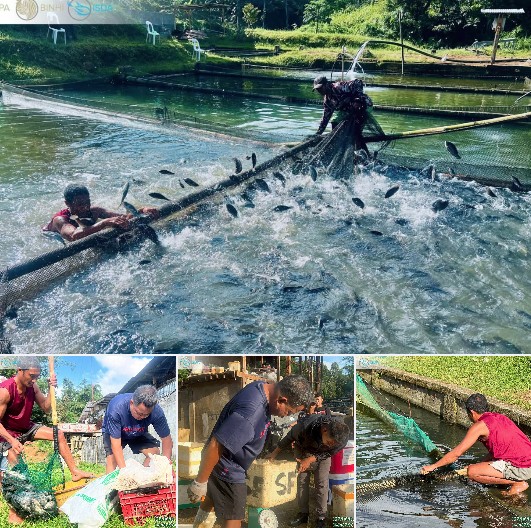
The association harvested a total of 1,005.7 kilograms of tilapia on August 5, 2026, translating to an estimated ₱120,115 in gross income—a result that demonstrates how sustained technical support, access to production inputs, and organized community participation can turn small-scale aquaculture into a viable source of livelihood.
The harvest was carried out with the assistance of the Ministry of Agriculture, Fisheries and Agrarian Reform (MAFAR) Saguiaran Office, led by Engr. Soraya Manalocon, and was witnessed by personnel from the MAFAR-Lanao del Sur Fisheries Division, headed by Senior Aquaculturist Allanodin Pagadilan.
More than a routine harvest, the activity represented a tangible measure of the association’s progress in developing aquaculture as an alternative and sustainable income-generating activity for its members.
From Assistance to Actual Income
For many fisherfolk and rural families, government assistance is most meaningful when it translates into something concrete: food on the table, income for household needs, and a livelihood that can be sustained beyond a single intervention.
The Kayrandaya association’s latest harvest provides precisely that kind of outcome.
According to Engr. Manalocon, MAFAR’s support went beyond the initial provision of production materials. The agency provided the association with technical assistance, fish feeds, storage boxes, and other necessary interventions intended to improve the group’s capacity to manage and sustain its aquaculture operation.
These interventions helped address some of the practical challenges commonly faced by small-scale fish growers, particularly the costs of feeds and production inputs, technical knowledge, and the proper handling and storage of harvested fish.
With those forms of assistance in place, the association was able to bring its production cycle to harvest and convert its aquaculture investment into measurable economic returns.
The estimated ₱120,115 in gross income is therefore more than a financial figure. It represents the economic value generated by the members’ work, the productivity of their aquaculture facility, and the potential of organized fish farming to become a dependable livelihood activity.
A Harvest That Goes Beyond the Pond
The significance of the harvest extends beyond the association itself.
Tilapia remains one of the most accessible and widely produced freshwater fish in the Philippines, making aquaculture an important component of efforts to increase local food production. In communities where livelihood opportunities may be limited, fish farming can provide families with an additional source of income while contributing to the availability of locally produced food.
For an association such as Kayrandaya, a successful production cycle can also create a foundation for expansion.
A productive harvest can generate capital that may be reinvested into the next production cycle, allowing members to purchase additional inputs, improve facilities, increase stocking capacity, or strengthen post-harvest handling.
This creates the possibility of a cycle in which technical assistance and initial interventions eventually lead to greater community self-reliance.
The goal, ultimately, is not simply to produce more fish, but to develop an aquaculture enterprise capable of supporting families over the long term.
Partnership at the Center of the Success
Association President Mohammad G. Amaikorot expressed his gratitude to MAFAR for its continued assistance, acknowledging the agency’s contribution to the group’s productive harvest.
His statement underscores an important element behind many community livelihood programs: success often depends on sustained cooperation between organized community groups and government institutions.
For Kayrandaya, the partnership provided access to resources and expertise that may otherwise have been difficult for the association to obtain on its own.
Technical guidance is particularly important in aquaculture, where production outcomes can be affected by factors such as feeding practices, water quality, fish health, stocking density, and proper harvesting and post-harvest handling.
By combining the association members’ labor and commitment with institutional support and technical knowledge, the project was able to move from production to a successful commercial harvest.
Aquaculture as a Path to Sustainable Livelihoods
The Kayrandaya harvest also illustrates the broader role of aquaculture in rural development.
As communities seek livelihood opportunities that can complement traditional agriculture and fishing, small-scale fish farming offers the potential to produce both food and income within a relatively manageable production system.
When properly managed, aquaculture can help diversify household livelihoods and reduce dependence on a single source of income. It can also contribute to local food security by making fish available closer to communities where it is produced.
For Lanao del Sur, where strengthening rural livelihoods remains closely connected to broader development objectives, these community-level gains can have wider significance.
A single harvest of 1,005.7 kilograms may appear modest when viewed against the scale of the province’s agricultural and fisheries sector. But for a community association, it represents a concrete demonstration that an organized aquaculture venture can produce measurable economic returns.
It is also an indication of what can happen when livelihood interventions are matched with community participation and sustained technical support.
Turning Support Into Sustainability
The challenge moving forward will be to ensure that the success represented by the August 5 harvest does not remain a one-time achievement.
The real measure of the program will be whether Kayrandaya can maintain production, improve yields, manage operating costs, reinvest its earnings, and eventually strengthen its capacity to operate with greater independence.
That is where continued technical assistance and responsible management become critical.
For MAFAR, the association’s performance provides an encouraging example of how government support can be translated into actual livelihood outcomes.
For the members of Kayrandaya, meanwhile, the harvest provides something even more valuable: proof that their aquaculture venture can work.
With more than one ton of tilapia harvested and an estimated ₱120,115 generated in gross income, the association has demonstrated that a well-supported community aquaculture project can become more than a livelihood intervention—it can become a foundation for economic resilience.
The fish harvested from the ponds on August 5 were the immediate product of the project. But the larger harvest may be the confidence, experience, and capacity gained by the people behind it.
And in Lanao del Sur, where strengthening food security and rural livelihoods remains a continuing priority, that may be the most important yield of all.