
ESPERANZA, Agusan del Sur — The Communist Party of the Philippines-North Central Mindanao Region (CPP-NCMR) has confirmed the deaths of four New People’s Army (NPA) members following a series of armed encounters with government troops in Barangay Bakingking, Esperanza, Agusan del Sur, on September 10 and 12, 2026.
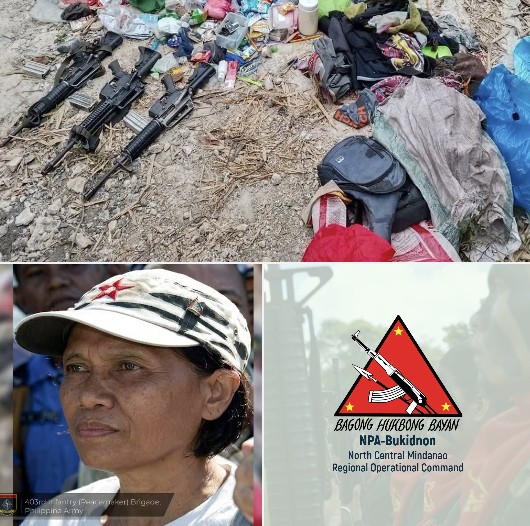
In a statement released after the clashes, the CPP-NCMR identified the four slain NPA members as Julia Cagadas-Lastimosa, alias “Ka Rida,” Rocha Mae Bihag, alias “Ka Maki,” Tiloy Basahon, alias “Ka Doydoy,” and Ringo Lindayo, alias “Ka Kikoy.”
The communist group described the four as revolutionary cadres and members of the NPA who had been involved in its underground movement in different parts of Northern and Central Mindanao.
The statement specifically described Cagadas-Lastimosa as one of the organization’s leading cadres in North Central Mindanao since the early 1980s. It said she came from Bugo, Cagayan de Oro City, and had worked as an organizer among youth, workers, urban poor communities and rural peasants before serving as a Party cadre and NPA officer.
The CPP said Cagadas was known by different aliases in various areas of Mindanao, including “Ka Rida” in Misamis Oriental, “Ka Toyang” in Agusan del Norte and “Ka Kayuka” in Bukidnon. She was also referred to as “Manang” by allies and friends and “Lola” by younger members of the movement.
The military had previously identified Cagadas, also spelled “Reda” or “Rheda” in earlier reports, and known as “Nanay,” as a senior NPA leader in Northern Mindanao and secretary of the North Central Mindanao Regional Committee. The military also reported that a ₱5.3-million reward had been offered for information leading to her capture, although details concerning the legal or administrative basis of the reported reward were not provided in the information available.
Series of clashes in Esperanza
The deaths followed a series of encounters between government forces and an armed NPA group in the mountainous portions of Barangay Bakingking.
According to the military’s account, the first reported clash occurred on September 10 near Palili Creek, where troops of the Army’s 26th Infantry Battalion encountered NPA members. The engagement reportedly lasted for more than an hour, with no confirmed casualties initially reported.
Fighting resumed on September 12, when troops from the 1st Special Forces Battalion engaged members of the same group.
The military reported that Lindayo, alias “Kikoy,” was killed during one of the encounters. Soldiers also recovered firearms from the area, while three NPA members reportedly surrendered along with their weapons.
Government troops subsequently deployed blocking forces, including elements of the 8th Infantry Battalion, as other members of the armed group attempted to withdraw through mountainous terrain.
The military described the subsequent engagements as a running battle. Three additional NPA members — Cagadas, Basason and Bihag — were reported killed.
The military said firearms, including high-powered weapons, were recovered following the encounters.
The four deaths reported by the military correspond to the four individuals later identified by the CPP-NCMR in its statement.
The military also said that pursuit operations continued after the encounters as government forces tracked other members of the group who reportedly escaped from the area.
CPP portrays slain members as long-time cadres
In its statement, the CPP-NCMR provided extensive accounts of the lives and revolutionary involvement of the four slain members.
It portrayed Cagadas as a veteran cadre who remained active in the movement despite periods of imprisonment.
The group recalled that she was among two women who, according to the CPP, escaped from the Cagayan de Oro City Jail in the late 1980s and swam across the approximately 150-meter-wide Cagayan de Oro River at night.
The CPP further claimed that following a subsequent arrest, Cagadas became involved in prison-based campaigns concerning prisoners’ conditions, alleged abuses by prison administrators and human rights issues before eventually returning to the countryside after her release.
The communist group also portrayed her as an advocate of women’s liberation and described her marriage to Benjamin Lastimosa, alias “Ka Karyas,” who the CPP said was also killed during the armed struggle, as intertwined with their commitment to the revolutionary movement.
The statement further said Cagadas participated in ideological debates and the organization’s rectification campaigns, portraying her as someone who remained committed to the positions she believed were correct despite internal disagreements and difficulties.
These descriptions are based on the CPP-NCMR’s own account and could not independently be verified.
Other slain NPA members identified
The CPP-NCMR also released accounts of the backgrounds of Bihag, Basahon and Lindayo.
Bihag, or “Ka Maki,” was described by the CPP as a former student of Mindanao State University-Iligan Institute of Technology and a lesbian who joined the armed movement after becoming convinced that discrimination against LGBTQ+ people was linked to the country’s broader social and economic system.
The CPP said Basahon, or “Ka Doydoy,” came from Gingoog City and became involved in a land dispute involving his family’s farm.
According to the group’s account, Basahon’s family allegedly faced attempts to take control of the land they cultivated and harassment involving armed men and members of the Citizens Armed Force Geographical Unit, or CAFGU. The CPP said he subsequently organized with other peasants to defend their land rights.
The group also said Basahon was arrested after authorities raided the office of a legal peasant organization and accused him of illegal possession of explosives. According to the CPP, he spent several years in prison before joining the NPA at the age of 40 after his release.
Lindayo, alias “Ka Kikoy,” was described as coming from a revolutionary family, with the CPP claiming that two of his siblings had also been killed in the armed struggle.
The group portrayed Lindayo as a quiet and dependable member who took care of fellow combatants and served as Cagadas’ close-in security. It said he remained with the movement following the death of his wife and endured separation from his only child.
The CPP-NCMR described the four as martyrs and called on its party organs, NPA units, mass organizations, allies and supporters in North Central Mindanao to conduct memorial activities.
Military rejects claim of insurgency resurgence in Caraga
The encounters occurred despite the military’s declaration that Caraga has achieved Stable Internal Peace and Security, or SIPS, status.
The 4th Infantry Division has stressed that SIPS does not mean that an area is completely free from security threats. Rather, it reflects a level of stability in which civilian authorities, communities and other stakeholders are expected to take the lead in sustaining peace and development, with security forces remaining prepared to respond to emerging threats.
The military said information from residents helped authorities identify the presence of the armed group and respond before it could establish a foothold in the community.
The 4th Infantry Division also rejected the characterization of the encounters as evidence of a resurgence of communist insurgency in Caraga. It described the armed group instead as displaced NPA elements from neighboring Region 10 who had attempted to enter areas previously declared cleared of insurgent activity.
The military said it would continue coordinating with local governments, law enforcement agencies and communities while maintaining security operations against armed groups.
CPP links deaths to broader political and economic grievances
In its statement, the CPP-NCMR placed the deaths within its broader political narrative, citing what it described as increasing United States military intervention, the establishment of three Enhanced Defense Cooperation Agreement sites, worsening land disputes, government corruption and the deepening crisis of global capitalism.
The group said the deaths of Cagadas, Bihag, Basahon and Lindayo demonstrated what it characterized as the continuing willingness of its members to sacrifice their lives for national liberation and democracy.
The CPP-NCMR urged its supporters not to be discouraged by the deaths and called for the continuation of its rectification campaign and armed revolutionary struggle.
It also issued calls honoring the four slain members and reaffirmed its allegiance to the CPP, the NPA and the National Democratic Front of the Philippines.
The statement represents the position of the CPP-NCMR. Its descriptions of the four individuals, its political assessments and its characterization of the armed conflict are claims made by the organization and are not independently verified.
The September 10–12 encounters nevertheless underscore that armed NPA elements remain capable of operating in remote portions of Mindanao despite government declarations of improved internal peace and security.
For communities in the affected areas, the clashes also highlight the continuing risks posed by armed confrontations in mountainous and geographically isolated communities, where military operations and insurgent activity can directly affect civilian safety and access to essential services.