
SULU — Two municipalities in Sulu are strengthening the province’s peace and security gains after formally declaring themselves Gun-Free, Rido-Free, and Peace-Centered Communities, alongside the declaration of a State of Stable Internal Peace and Security (SIPS).
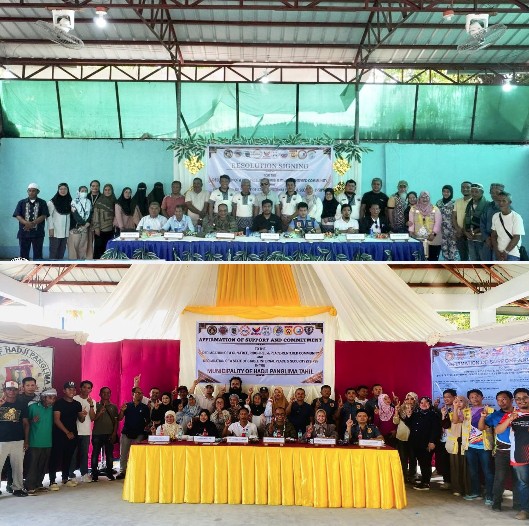
The declarations in Pangutaran and Hadji Panglima Tahil (HPT) highlight the growing role of local governments, communities, traditional and religious leaders, and security forces in sustaining peace and preventing the return of armed conflict and clan-related violence.
The milestones were achieved through the partnership of the 1103rd Infantry (Kalis) Brigade, 11th Infantry (Alakdan) Division, Philippine Army, particularly through the 100th Infantry (Kalasag) Battalion, and the respective municipal governments, with the participation of community stakeholders.
For the Philippine Army, the declarations represent more than ceremonial recognition. They reflect the communities’ collective commitment to maintaining peace, preventing the proliferation and irresponsible use of firearms, resolving family and clan disputes through peaceful and lawful means, and creating conditions where development can take root.
Pangutaran takes major step toward lasting peace
On August 25, 2026, Pangutaran formally declared itself a Gun-Free, Rido-Free, and Peace-Centered Community, together with the declaration of a State of Stable Internal Peace and Security.
The municipality’s declaration reflects a shared commitment among local officials, security forces, traditional leaders, religious leaders, families, youth, and residents to protect the peace gains achieved in the community.
The Gun-Free Community declaration underscores the municipality’s commitment to preventing the proliferation and irresponsible use of firearms and promoting a safer environment for its residents.
Its Rido-Free Community declaration, meanwhile, highlights the strengthened resolve of families, clans, traditional leaders, and local authorities to settle disputes through dialogue, mediation, and lawful mechanisms instead of violence.
The Peace-Centered Community declaration goes beyond simply declaring the absence of armed conflict. It represents an effort to make peace a continuing way of life anchored on cooperation, mutual respect, community resilience, dialogue, and inclusive development.
The accompanying SIPS declaration further signifies the municipality’s strengthened capacity, together with its stakeholders, to maintain a peaceful and secure environment where government services, economic activities, and community development can flourish.
The 1103rd Infantry Brigade emphasized that the achievement should not be viewed solely as a military accomplishment.
Rather, it is a shared victory involving the people themselves—the local government, security forces, traditional and religious leaders, youth, families, and other community stakeholders who have contributed to maintaining peace.
Hadji Panglima Tahil joins the peace milestone
Hadji Panglima Tahil has likewise formally been recognized as a Gun-Free, Rido-Free, and Peace-Centered Community, alongside the declaration of a State of Stable Internal Peace and Security.
The milestone reflects the municipality’s collective effort to sustain peace and prevent the resurgence of armed conflict and clan-related violence.
HPT’s declaration also marks an important development in the broader peace and security efforts in Sulu. The municipality was identified as the eighth municipality in the First District of Sulu to achieve the significant peace and security declarations, according to the information released by the 1103th Infantry Brigade and its partners.
The achievement underscores the municipality’s progress in fostering a culture of peace, strengthening community resilience, and promoting peaceful conflict resolution.
It also highlights the continuing partnership between the Philippine Army and the local government in ensuring that peace gains are translated into meaningful and sustainable development for residents.
Sustaining peace beyond military operations
The twin declarations underscore a broader approach to peacebuilding in Sulu—one that places communities at the center of efforts to maintain stability.
Through sustained Civil-Military Operations, community engagements, information and education campaigns, and coordination with local stakeholders, the 1103th Infantry (Kalis) Brigade, the 100th Infantry Battalion, and partner units continue to support communities in strengthening their capacity to address conflict peacefully.
Such efforts recognize that lasting peace cannot depend solely on military or law enforcement presence.
While security forces play an important role in protecting communities and maintaining public safety, sustainable peace also depends on the ability of local institutions and communities to prevent disputes from escalating, address grievances through dialogue, and strengthen social relationships.
This is particularly significant in addressing rido, or clan and family-related conflicts, which can have consequences beyond the parties directly involved. When left unresolved, such disputes can disrupt community relations, livelihoods, public services, and local development.
The Gun-Free and Rido-Free declarations therefore represent commitments that will require continued community participation to sustain.
Peace as a foundation for development
The declaration of stable internal peace and security also creates a stronger environment for development initiatives.
A community free from recurring armed violence and clan conflict is better positioned to improve access to government programs and services, strengthen economic activities, encourage investment, and pursue development projects.
For Pangutaran and Hadji Panglima Tahil, the declarations consequently serve not only as milestones in peace and security but also as commitments to protect an environment where residents can pursue their livelihoods and communities can plan for their future with greater stability.
The achievements also demonstrate the importance of cooperation between local governments and security institutions.
By working with traditional and religious leaders, community organizations, youth, families, and other stakeholders, authorities can develop peacebuilding mechanisms that are rooted in the realities and needs of individual communities.
A growing peace movement in Sulu
The declarations of Pangutaran and Hadji Panglima Tahil add to Sulu’s continuing efforts to consolidate peace and security at the community level.
For the Kalis Brigade and its partner stakeholders, the milestones demonstrate what can be achieved when government institutions, security forces, and communities share responsibility for protecting peace.
They also reinforce the principle that peace is not simply the absence of fighting. It requires sustained dialogue, respect for the rule of law, responsible citizenship, cooperation among communities, and the willingness to resolve disputes without resorting to violence.
The challenge now is to sustain these gains.
A Gun-Free and Rido-Free declaration carries with it an ongoing responsibility for residents and local institutions to prevent the return of violence, address emerging disputes early, discourage the irresponsible use of firearms, and preserve the culture of dialogue that made the declarations possible.
For Pangutaran and Hadji Panglima Tahil, the milestones represent another step in Sulu’s continuing journey toward a more peaceful, secure, and resilient future.
The declarations send a clear message: when communities, local governments, traditional and religious leaders, and security institutions work together, peace can become more than a declaration—it can become the foundation for lasting stability and development.