
For years, fear, tension, and unresolved anger silently divided families and communities in Tipo-Tipo, Basilan. But inside the halls of the People’s Capitol in Lamitan City on May 18, old wounds that had fueled years of hostility were finally confronted—not with bullets or retaliation, but with dialogue, reconciliation, and a collective desire for peace.
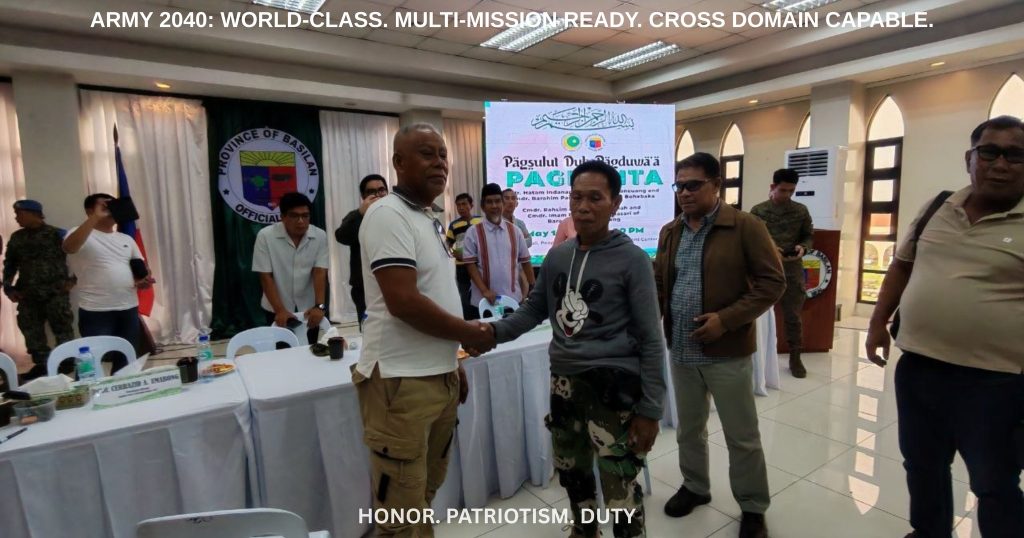
Two separate rido, or clan feuds, that had haunted communities for nearly a decade were formally settled through a peace reconciliation initiative led by the Provincial Government of Basilan, marking another crucial milestone in the province’s long and difficult journey toward lasting harmony.
Around 140 participants composed of local government officials, military leaders, barangay representatives, elders, and residents gathered at the Basilan Government Center in Sta. Clara, Lamitan City to witness what many described as a rare and emotional moment of unity.
One of the settled disputes involved Mr. Hatam Indanan of Barangay Bangcuang and Mr. Barahim Paising of Barangay Bohe Baca, whose conflict had dragged on for eight years. Another reconciliation effort ended the five-year dispute between Mr. Rahsim of Barangay Banah and Mr. Listari Masari of Barangay Bohe Lebbung. All parties involved are residents of Tipo-Tipo municipality, an area that has long struggled with recurring violence and armed conflict.
For years, the feuds reportedly created fear and instability within affected communities, with tensions threatening to erupt into renewed violence at any moment. In many parts of Mindanao, rido has historically become one of the root causes of bloodshed, displacement, and retaliation, often involving entire clans and generations.
But this time, leaders in Basilan sought a different outcome.
Under the leadership of Basilan Governor Hon. Mujiv S. Hataman, the provincial government intensified efforts to promote peaceful conflict resolution mechanisms aimed at healing divisions before they escalate into violence. The reconciliation gathering was not merely ceremonial—it represented months, and in some cases years, of mediation, negotiation, and confidence-building among the opposing parties.
Present during the settlement was Brigadier General Frederick M. Sales, Commander of the 1101st Infantry (Gagandilan) Brigade, alongside personnel of the 45th Infantry (Gallant) Battalion, who witnessed and supported the peace process.
Security officials emphasized that ending long-standing family feuds is critical not only to maintaining peace and order but also to preventing extremist groups and criminal elements from exploiting local tensions.
Military and community leaders alike underscored that genuine peace in Basilan cannot rely solely on armed security operations. Instead, they said, it requires trust, dialogue, and cooperation between communities, local leaders, and government institutions.
The reconciliation effort also highlighted the evolving role of the military in Basilan—not only as protectors against armed threats but also as partners in peacebuilding and community development.
The 45th Infantry Battalion reaffirmed its commitment to supporting initiatives that strengthen unity and mutual understanding among communities affected by conflict.
For many attendees, the event symbolized more than the end of personal disputes. It reflected hope that Basilan, once synonymous with violence and instability, continues to move toward a future defined by reconciliation rather than revenge.
In a province where conflict has often shaped generations, the peaceful settlement of these rido cases served as a powerful reminder that even the deepest divisions can still be healed when communities choose dialogue over bloodshed.