
There is a cruel irony unfolding in General Santos City—the so-called Tuna Capital of the Philippines. In a place where the sea has long been synonymous with livelihood, abundance, and national pride, fishing boats now sit idle along the coast, their silence louder than any storm warning. The reason is not a lack of fish, nor a failure of skill. It is fuel—scarce, expensive, and increasingly out of reach.
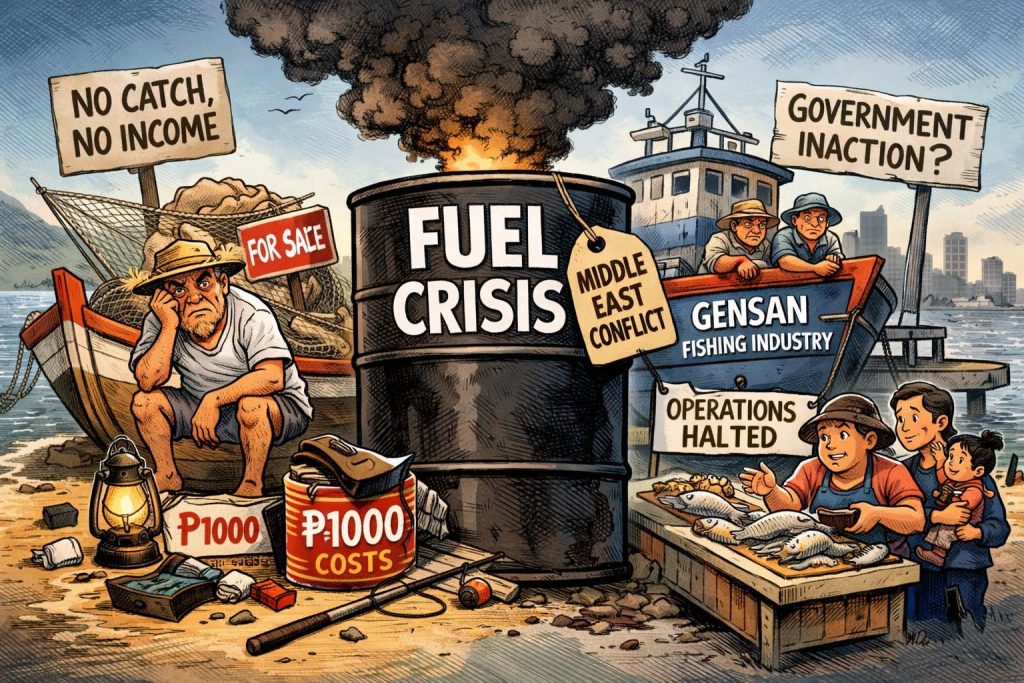
The ongoing conflict in the Middle East has once again exposed a brutal truth: when global oil supply trembles, it is not the powerful who suffer first—it is the poor. And in this case, it is the Filipino fisherman.
A small-scale fisherman today needs at least ₱1,000 just to attempt a single fishing trip. That amount covers roughly five liters of fuel—already costing around ₱600—along with bait, food, kerosene for traditional fishing lights, and basic maintenance. And even after all that, there is no guarantee of a catch. Imagine gambling your entire day’s capital on uncertainty, with the sea as both your partner and your risk.
For larger fishing vessels, the situation is even more dire. Operating costs have nearly doubled, forcing companies to cut back operations by as much as 30 percent. Some have scaled down. Others are on the brink of halting entirely.
This is not just an industry under strain. This is an industry bleeding.
Even fishing magnate Marfin Tan has raised the alarm, warning that a complete shutdown of fishing operations is possible if fuel supply issues are not addressed immediately. His call is not for charity, but for something far more critical: stability. A guaranteed fuel allocation, not temporary aid.
Because let’s be clear—subsidies, as currently designed, are band-aid solutions. The transport sector has received assistance, yes, but even that has proven insufficient. And the fishing industry? It remains largely overlooked, despite being just as fuel-dependent and arguably more fragile.
This neglect is staggering, especially considering what is at stake.
General Santos is not just another coastal city. It is the backbone of the country’s tuna industry. Its fish port complex serves as a national hub for high-value exports. Its canneries process hundreds of tons of tuna daily. Thousands of workers—from fishermen to factory laborers—depend on this ecosystem. When fishing slows, the ripple effects are immediate and devastating: fewer fish landed, reduced processing, lost jobs, and rising prices.
And those prices are already climbing.
Fish in local markets have surged by 20 to 30 percent, depending on quality and origin. For consumers, this means tighter budgets. For fishermen, it means fewer buyers and more uncertainty. For everyone, it signals a broken chain—from sea to table.
What is perhaps most alarming is the lack of a clear, decisive response from both local and national governments. There is no comprehensive plan. No long-term strategy. No urgent sense that an industry central to food security and export revenue is in crisis.
Instead, what we see are fragments—temporary aid here, statements of concern there. But no cohesive direction.
Meanwhile, along the shores of Barangay Labangal, boats remain docked. Some fishermen have stopped going out to sea altogether. Others have begun selling their vessels, unable to keep up with the rising costs. These are not just economic decisions—they are acts of desperation.
And desperation, left unaddressed, becomes collapse.
The government must act—and act decisively. This is not the time for piecemeal solutions. A targeted fuel allocation program for the fishing sector is not a luxury; it is a necessity. Stabilizing supply chains, regulating fuel pricing where possible, and providing accessible financing for small-scale fishermen are urgent steps that cannot wait.
More importantly, there must be recognition that the fishing industry is not peripheral—it is foundational. It feeds the nation. It fuels local economies. It sustains communities that have few alternatives.
To ignore its current suffering is to gamble with both livelihoods and food security.
The Middle East conflict may be thousands of kilometers away, but its consequences are crashing onto Philippine shores with undeniable force. And unless those in power respond with urgency and clarity, the cost will not just be measured in pesos—but in lost livelihoods, shuttered industries, and empty plates.
In General Santos City, the boats are ready. The fishermen are willing. The sea is waiting.
But without fuel—and without leadership—none of it matters.