
SULU / COTABATO CITY — The Muslimin G. Sema–led faction of the Moro National Liberation Front (MNLF–Sema faction) has issued a strongly worded position paper cautioning that Sulu’s controversial Resolution No. 83-2025 — which bars the presence and activities of the Moro Islamic Liberation Front (MILF), its armed wing the Bangsamoro Islamic Armed Forces (BIAF), and BARMM-linked entities — risks deepening fractures within the Moro community and eroding decades of peace-building efforts.
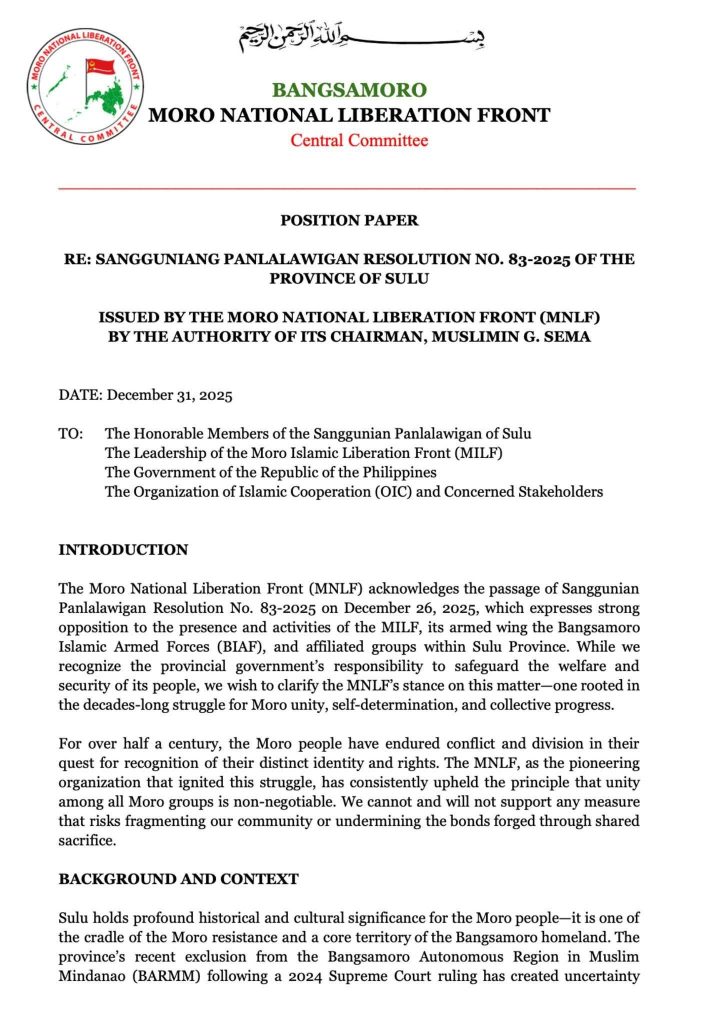
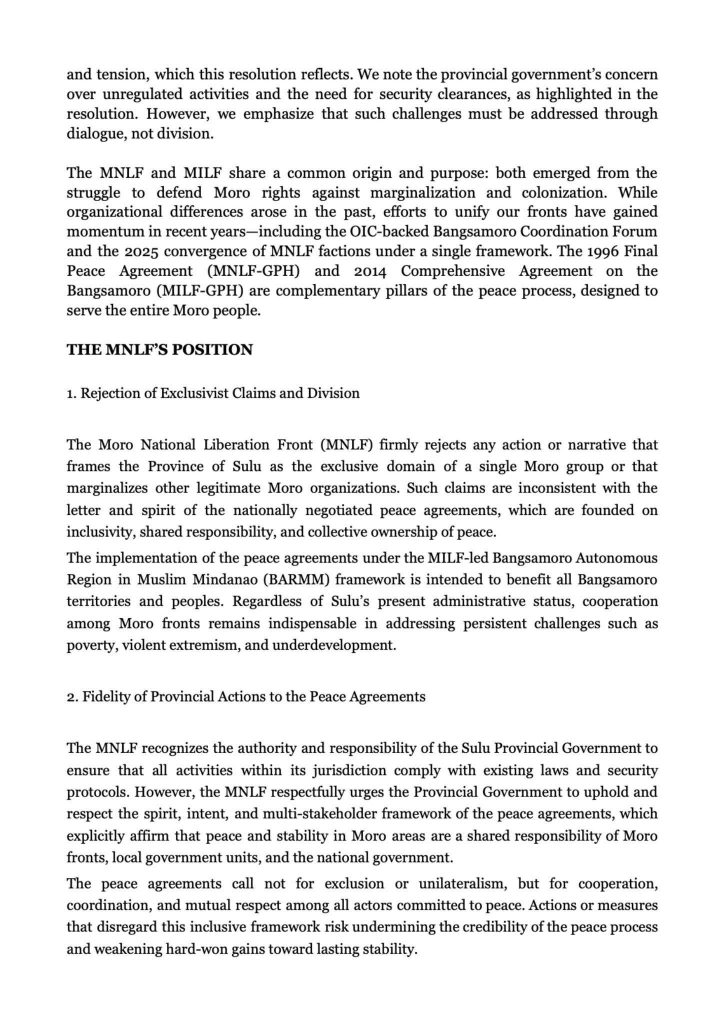
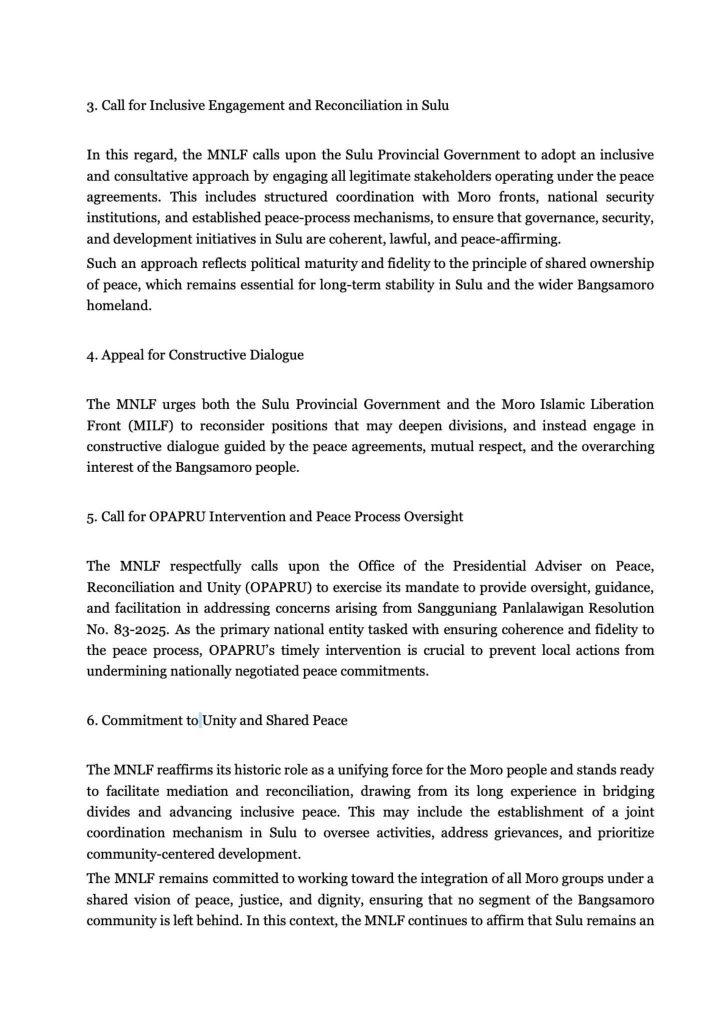
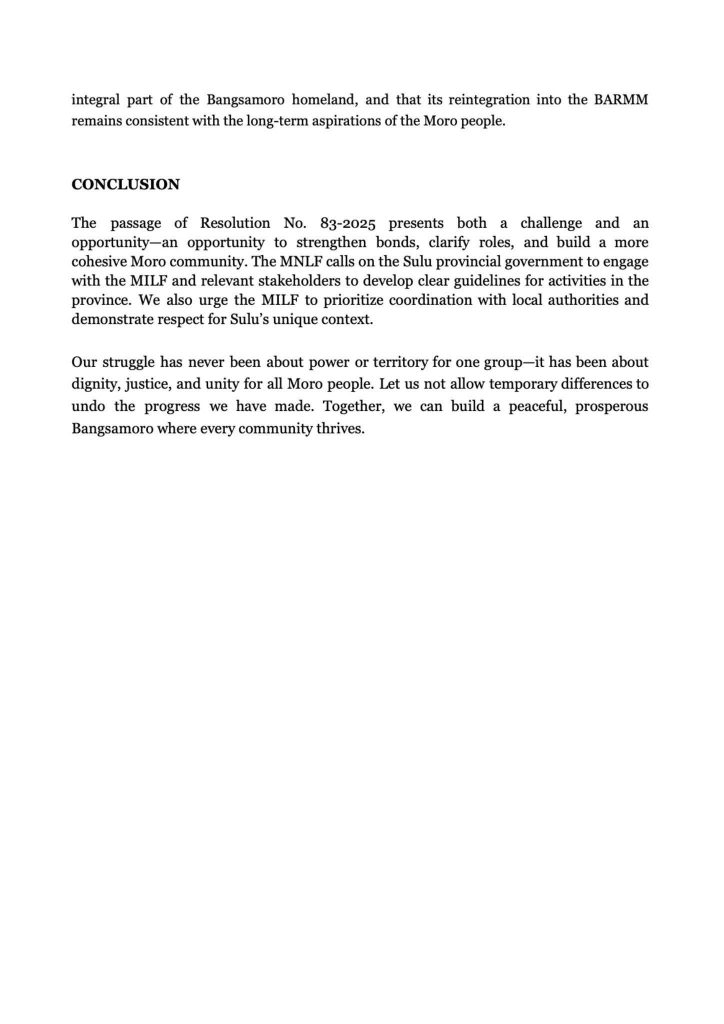
The position paper, dated December 31, 2025, was released by the MNLF Central Committee under the authority of Chairman Muslimin G. Sema, and formally addressed to the Sangguniang Panlalawigan of Sulu, the MILF leadership, the Government of the Republic of the Philippines, the Organization of Islamic Cooperation (OIC), and other concerned stakeholders.
While acknowledging the Sulu provincial government’s mandate to ensure peace and public order, the MNLF–Sema faction warned that exclusionary measures targeting another Moro revolutionary front could undermine the inclusive foundations of the Bangsamoro peace process.
“Our struggle has never been about power or territory for one group,” the Sema-led MNLF said. “It has always been about dignity, justice, and unity for all Moro people.”
Sulu at the Center of Renewed Moro Tensions
Resolution No. 83-2025, unanimously passed by the Sangguniang Panlalawigan and approved by Governor Abdusakur Tan II, asserts that Sulu — no longer part of the Bangsamoro Autonomous Region in Muslim Mindanao (BARMM) following a 2024 Supreme Court ruling — does not recognize any political, administrative, or security authority of the MILF within its jurisdiction.
The resolution was enforced on December 29, when military forces blocked a scheduled MILF Political Committee assembly in Patikul, deploying troops and armored vehicles after citing lack of security clearance and legal basis. The incident triggered sharp reactions from the MILF, which condemned the measure as “exclusionary” and a violation of the right to peaceful assembly.
Amid the mounting tension, the MNLF–Sema faction positioned itself as a stabilizing voice, rejecting both unilateral provincial restrictions and any assertion that Sulu belongs exclusively to a single Moro organization.
MNLF–Sema: Peace Agreements Are Complementary, Not Competing
In its statement, the Sema-led MNLF underscored that the 1996 Final Peace Agreement (MNLF–GPH) and the 2014 Comprehensive Agreement on the Bangsamoro (MILF–GPH) are complementary pillars of a single national peace process, not rival frameworks.
“Sulu is one of the cradles of Moro resistance and an integral part of the Bangsamoro homeland,” the group said, stressing that administrative boundaries should not sever shared history, identity, and collective responsibility for peace.
The MNLF–Sema faction acknowledged provincial concerns regarding unregulated activities and security protocols but emphasized that these should be addressed through dialogue, coordination, and established peace-process mechanisms — not blanket prohibitions that risk marginalizing legitimate Moro stakeholders.
Call for OPAPRU Oversight and Mediation
The Sema faction of the MNLF formally appealed to the Office of the Presidential Adviser on Peace, Reconciliation and Unity (OPAPRU) to exercise its oversight mandate and facilitate dialogue, warning that local actions inconsistent with nationally negotiated peace agreements could weaken public confidence in the process.
It also floated the establishment of a joint coordination mechanism in Sulu, involving Moro fronts, local government units, and national security institutions, to manage activities, address grievances, and ensure peace-affirming governance.
Independent Analysis: A Fragile Balance Between Law and Legacy
Independent analysts note that the intervention of the MNLF–Sema faction highlights a growing fault line in Moro governance: how revolutionary movements that are national peace partners should operate in provinces outside BARMM.
While Sulu’s legal authority following its exclusion from BARMM is undisputed, observers caution that rigid territorial interpretations risk sidelining Moro groups that remain signatories to national peace agreements and recognized by international bodies such as the OIC.
The MNLF–Sema faction’s warning reflects concern that the dispute could rekindle historical rivalries among Moro fronts — a scenario that violent extremist groups could exploit, particularly in vulnerable areas of the Sulu archipelago.
Analysts further warn that militarized enforcement of political restrictions, such as blocking assemblies, may revive old grievances and reinforce narratives of exclusion — conditions that peace agreements were specifically designed to dismantle.
A Crossroads for Sulu and the Moro Peace Process
As tensions persist, the MNLF–Sema faction framed Resolution No. 83-2025 as both a challenge and an opportunity — a chance for Sulu to demonstrate political maturity through inclusive governance and dialogue.
“Let us not allow temporary differences to undo the progress we have made,” the statement said, reiterating the faction’s readiness to mediate and promote reconciliation.
With security forces on heightened alert and political uncertainty mounting, the Sulu standoff is shaping up as a critical test of whether the Bangsamoro peace process can withstand jurisdictional disputes without sacrificing its core principle: unity in diversity among the Moro people.