
The controversy surrounding the reported restrictions on Muslim students wearing hijab at Iligan Medical Center College raises a fundamental question about religious freedom, equal access to education, and the responsibility of academic institutions to respect the rights and dignity of the communities they serve.
Religious Freedom Does Not End at the School Gate
A Muslim student should never have to choose between pursuing an education and observing a fundamental expression of her faith. Yet this is precisely the concern raised by the reported treatment of Muslim students at Iligan Medical Center College (IMCC), where the wearing of hijab has become the subject of a dispute involving students, school officials, Muslim community representatives, and advocates for religious freedom. What might appear to some as a matter of school uniform or institutional policy is, in reality, a much larger question about constitutional rights, religious accommodation, and whether educational institutions are prepared to recognize the diversity of the people they are supposed to serve.
According to Ustadh Abdul Jabbar Montaner, he and representatives of the National Commission on Muslim Filipinos (NCMF) met with the College of Nursing dean to discuss the legal and policy grounds supporting Muslim students’ right to wear hijab. During that meeting, Montaner alleged that the dean made the following remarks: “Kung hindi susunod ang mga Muslim na estudyante sa policy namin, huwag silang mag-enroll sa amin!” and “We prefer that!” These statements, if accurately reported, are deeply troubling. They suggest an institutional position that places compliance with a school policy above the need to consider reasonable religious accommodation. A college cannot simply dismiss the concerns of Muslim students by telling them not to enroll if they cannot set aside an expression of their faith. Education is not a privilege that institutions may condition on a student’s willingness to abandon religious practices.
The reported remarks must be taken seriously, while also recognizing that they remain attributed statements and that IMCC’s side has not been included in the information made available for this discussion. The school deserves an opportunity to explain its position and clarify the policy in question. But the absence of an institutional response does not diminish the importance of the concerns raised, particularly when the matter involves students who may feel pressured to choose between their religious convictions and their academic future.
The Law and the Responsibility of Educational Institutions
The legal principles cited by Muslim advocates are not merely symbolic appeals. Article III, Section 5 of the 1987 Philippine Constitution protects the free exercise and enjoyment of religious profession and worship without discrimination or preference. This protection is central to the discussion because religious freedom must have practical meaning in everyday life, including in educational settings. It cannot be reduced to a right that exists only when it does not inconvenience an institution.
CHED Memorandum Order No. 47, series of 2016, and Republic Act No. 9710, or the Magna Carta of Women, particularly Section 32(e), have also been raised by advocates as relevant policy and legal bases for protecting Muslim women’s right to wear appropriate religious attire. These provisions must be considered carefully in assessing the school’s policy and its obligations. The central issue is not whether a private educational institution may establish reasonable standards for students. Institutions plainly have responsibilities to maintain discipline, safety, and professional standards. The issue is whether those standards are being applied in a manner that unnecessarily restricts religious expression or disadvantages students because of their faith.

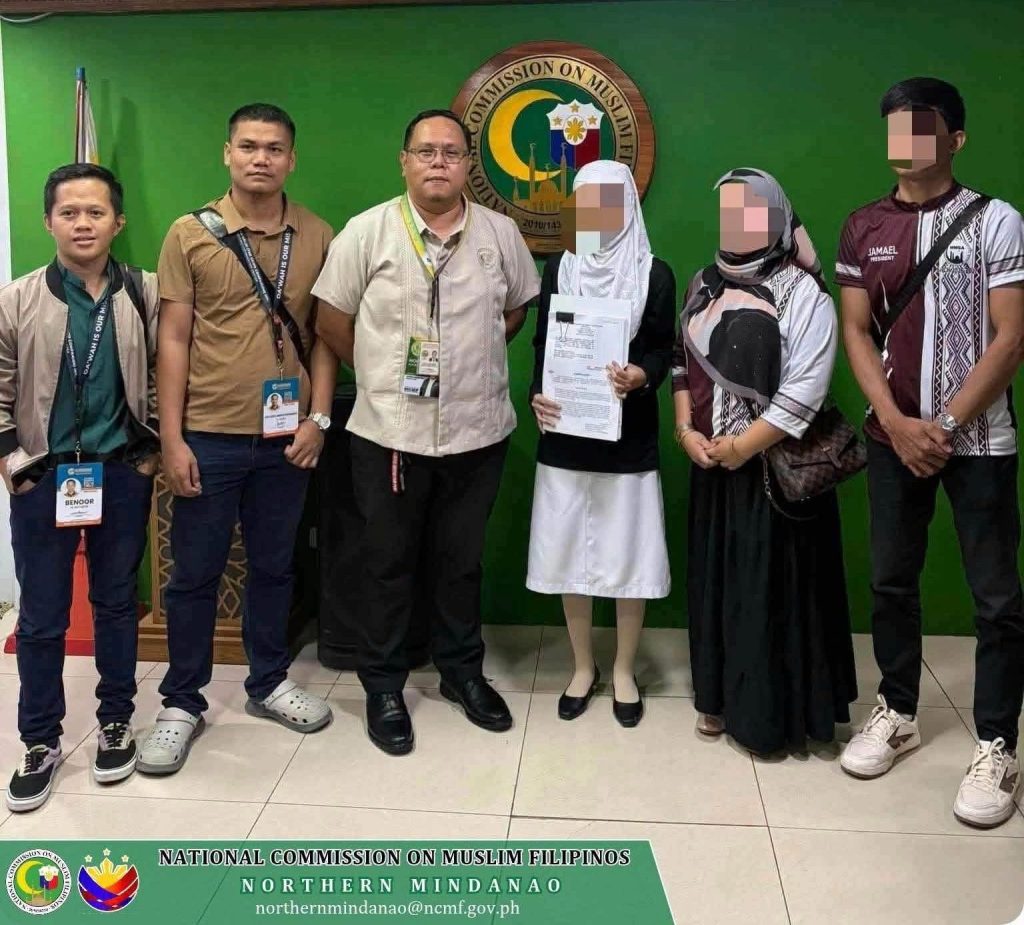
The NCMF-X’s reported filing of a formal complaint with CHED Regional Office X on November 4, 2026, is therefore an important development. It brings the dispute beyond social-media exchanges and public statements and places it before the government agency responsible for overseeing higher education institutions. CHED should examine the school’s policy, the circumstances surrounding its implementation, and the concerns raised by affected students and their representatives. This should not be treated as a routine disagreement over dress codes. It deserves a substantive assessment grounded in constitutional protections, applicable laws, and the responsibility of educational institutions to provide an inclusive learning environment.
Patient Safety Must Not Become a Reason to Exclude
The College of Nursing setting deserves particular attention because nursing education involves clinical training, patient care, infection prevention, hygiene, and professional identification. These are legitimate considerations, and no responsible advocate for religious accommodation should suggest that patient safety or clinical standards be disregarded. Nursing students must comply with appropriate requirements designed to protect patients, healthcare workers, and themselves. However, recognizing these responsibilities does not automatically justify a blanket restriction on hijab.
There is a meaningful difference between enforcing reasonable clinical standards and prohibiting religious attire without seriously examining possible accommodations. Appropriate clinical hijabs, for example, may be considered as part of a policy that addresses hygiene, safety, and identification while respecting religious practice. The relevant question should be how to reconcile legitimate institutional requirements with the rights of Muslim students, not how to force students to abandon one in order to satisfy the other. If a particular garment or manner of wearing it presents a demonstrable safety concern in a specific clinical situation, the institution should identify that concern and work toward a reasonable solution. A blanket rejection without meaningful consultation risks turning professional standards into an unnecessary barrier to education.
A nursing college should be capable of teaching students how to balance professional responsibilities with respect for individual rights and cultural differences. Indeed, future healthcare professionals will serve patients from different religious, cultural, and social backgrounds. An educational environment that models understanding and reasonable accommodation strengthens, rather than weakens, the values expected of the nursing profession. Respect for a patient’s dignity and beliefs begins with an institution’s willingness to respect the dignity and beliefs of its own students.
This Is Bigger Than One School’s Dress Code
The concerns raised by Muslim advocates have drawn support from several organizations, including the Medical Muslim Students’ Association, Al-Jalis As-Salih, Inc., the MSU-IIT Muslim Students’ Association, and the Kabataan Partylist Iligan chapter. Their involvement reflects a broader concern that the treatment of Muslim students in educational institutions should not be dismissed as an isolated administrative matter. For Muslim women, hijab may be an important expression of faith, identity, and personal conviction. Being asked to remove it as a condition of enrollment or participation can carry consequences far beyond compliance with a uniform policy. It can communicate that their religious identity is unwelcome in an institution where they are supposed to learn, develop professionally, and prepare to serve society.
Calls for CHED to investigate, for IMCC to review its policy, and for meaningful dialogue between the institution and Muslim stakeholders are therefore reasonable and necessary. Equally important is the protection of affected students from retaliation, discrimination, academic disadvantage, or any form of pressure arising from their decision to assert their rights. Students should not have to fear that raising a legitimate concern could jeopardize their grades, clinical placements, enrollment, or future opportunities. Any investigation must consider not only the written policy but also how it is communicated, interpreted, and enforced in practice.
Some advocates have also called on Muslim students to consider boycotting or transferring to other institutions. Such decisions may be understandable options for students who feel that their dignity and beliefs are not respected, but they should not become the principal solution to an institutional problem. Transferring schools can mean additional expenses, disrupted studies, lost time, and uncertainty about the recognition of academic credits. It is unfair to place the burden of resolving a potentially discriminatory policy entirely on the students who are affected by it. The responsibility to review and correct an unreasonable policy rests with the institution, subject to the oversight of the appropriate authorities.
IMCC Must Choose Dialogue Over Division
IMCC now has an opportunity to address the controversy in a manner that demonstrates institutional responsibility. It should clearly explain its policy, respond to the allegations raised by Montaner and Muslim representatives, and engage directly with the affected students and relevant organizations. If the institution has legitimate concerns about clinical safety, hygiene, or professional standards, it should identify those concerns specifically and explore workable accommodations. A willingness to listen does not mean abandoning academic standards. It means recognizing that standards must be reasonable, lawful, and applied with respect for the rights of everyone within the institution.
CHED, for its part, should ensure that the complaint receives a fair and timely examination. The inquiry should establish the facts, assess the relevant policies and legal protections, and determine whether the school’s practices are consistent with its obligations as a higher education institution. The process should also give affected students a safe avenue to raise concerns without fear of retaliation. The goal should not be to prejudge the institution, but neither should it be to minimize the concerns of students whose religious freedom may have been placed in conflict with an administrative rule.
At its heart, this controversy is about the kind of educational environment Philippine institutions are willing to build. Schools are expected to prepare students for a society defined by diversity, mutual respect, and equal opportunity. They cannot credibly teach inclusion while refusing to consider reasonable accommodation for students whose religious practices differ from the majority. Nor should a student’s ability to pursue a profession depend on whether she is willing to compromise a deeply held religious conviction when a reasonable solution may be possible.
A hijab should never be treated as a barrier to education. Muslim students should not have to surrender their religious identity to gain access to a classroom, a laboratory, or a clinical training environment. IMCC must answer the concerns raised, CHED must examine the complaint, and the rights and dignity of the students must remain at the center of the discussion. The measure of an educational institution is not simply how strictly it enforces its rules, but whether it can uphold those rules without denying the rights of the people it serves. No student should have to choose between her faith and her future.