
DAVAO CITY — Strengthening the role of religious leadership in peacebuilding and community security, Task Force Davao, in partnership with the Davao City Government, convened the 4th Ulama and Muslim Leaders Summit 2026 on November 3 at The Pinnacle Hotel and Suites along Sta. Ana Avenue in Davao City.
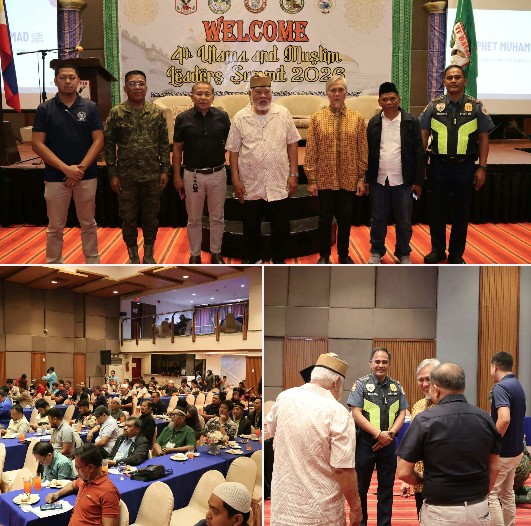
Anchored on the theme, “Rooted in Islam, United in Purpose: Laying the Foundations for Lasting Peace and Harmony,” the annual gathering brought together Ulama, Muslim community leaders, government representatives, and security officials to discuss concrete ways of sustaining peace, addressing community conflicts, and promoting social cohesion across the city and neighboring communities.
The summit highlighted the importance of engaging religious leaders not only as spiritual guides but also as key partners in preventing conflict, strengthening community relationships, and promoting peaceful coexistence among people of different religious and cultural backgrounds.
Among the prominent officials who attended were Task Force Davao Commander Colonel Rodrigo A. Mariñas Jr., Davao City Police Office (DCPO) Director Colonel Peter Bauzon Madria, Chairman of the Davao City Muslim Affairs Office Pamikiren Latip A. Atumpac Jr., and Region XI Grand Mufti Sheikh Mohammad Y. Pasigan.
Davao City Mayor Sebastian Z. Duterte was represented by Public Safety and Security Office (PSSO) Head and retired Police Lieutenant Colonel Angel B. Sumagaysay. Several deputy mayors and other Muslim community leaders also participated in the gathering.
In his message, Madria emphasized the importance of sustained cooperation between law enforcement agencies, religious institutions, and community stakeholders in maintaining public safety while fostering mutual understanding and respect among different faith groups.

He underscored that lasting peace cannot be achieved through security operations alone but requires the active participation of communities and their leaders in building trust, addressing underlying tensions, and promoting a shared commitment to peace.
The discussions also focused on the role of dialogue and community engagement in preventing radicalization and extremism. Organizers emphasized the importance of advancing Islamic values such as peace, justice, compassion, and mutual respect as foundations for stronger and more harmonious communities.
Rather than treating peace and security solely as responsibilities of government and law enforcement, the summit sought to reinforce a broader approach in which religious leaders, local officials, and ordinary community members share responsibility for preventing conflict and sustaining stability.
The annual gathering also serves as a platform for strengthening relationships among different religious groups, encouraging community-based peace initiatives, and improving coordination between religious leaders and government institutions.
For Davao City, where diverse religious and cultural communities share the same urban and social spaces, the summit underscored the continuing importance of interfaith understanding and cooperation in addressing challenges that could threaten community harmony.
Ultimately, the gathering sought to translate shared religious and civic values into sustained community action, recognizing that lasting peace depends not only on preventing violence but also on nurturing trust, inclusion, justice, and solidarity among communities.