
LAMITAN CITY, Basilan — A Philippine Army corporal died while undergoing treatment after an ambush in Lamitan City, Basilan, on October 8, as a series of attacks against government forces in the province prompted the military to intensify pursuit operations and the provincial government and human rights authorities to strengthen efforts to protect civilians.
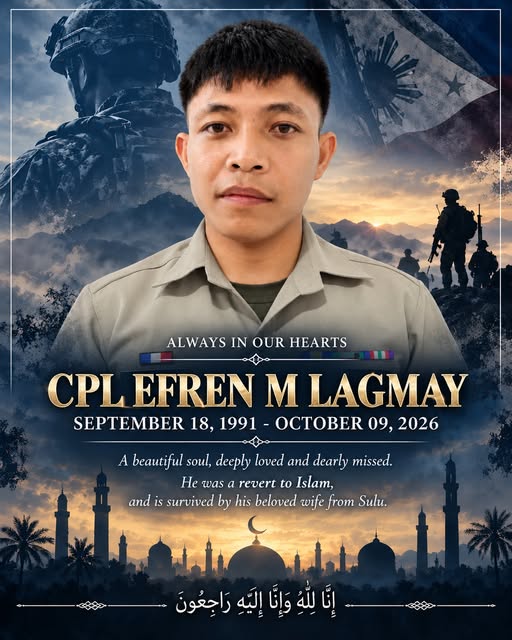
Cpl. Elmer Lagmay, a member of the Army’s 45th Infantry Battalion (45IB), succumbed to his injuries at a military hospital at the Western Mindanao Command (WestMinCom) headquarters in Zamboanga City, Brig. Gen. Frederick Sales, commander of the 1101st Infantry Brigade, confirmed.
Six other soldiers were reported wounded in the Lamitan attack. Five were identified as Sgt. Edgardo Gayao, Staff Sgt. Noel Backas, Pfc. Ismael Degamo, Pfc. Felipe Tañamor Jr., and Staff Sgt. Dwight Eissen Villamil. Authorities were still determining the identity of the sixth wounded soldier in the initial account.
Two civilians—a father, Daniel Hajim Onton, and his 10-year-old son, Erpan, a Grade 4 pupil—were also wounded after being caught in the crossfire while traveling in a multicab behind the military truck.
According to reports, the soldiers had departed from the Lamitan City port and were heading to the 45IB headquarters when armed men positioned along the highway in Barangay Sabong suddenly opened fire on their military truck.
Three soldiers, including Lagmay, were airlifted by an Air Force helicopter to the military hospital in Zamboanga City after sustaining serious injuries. Lagmay later died despite medical treatment, while the other wounded soldiers and the father and son were brought to Lamitan District Hospital by emergency responders.
Police Capt. Steffie Salanguit, spokesperson for the Police Regional Office–Bangsamoro Autonomous Region (PRO-BAR), said investigators from the Lamitan City Police Station, the Basilan Provincial Police Office, and local officials were coordinating to identify and locate those responsible for the attack.
Second Ambush in Three Days
The Lamitan attack came three days after an ambush in Sitio Bauno Dagao, Barangay Badja, Tipo-Tipo, on October 5, which wounded government personnel, including soldiers and members of the Citizen Armed Force Geographical Unit (CAFGU).
The Bangsamoro Human Rights Commission (BHRC), through its Basilan Provincial Office, said in an October 9 statement that the Tipo-Tipo incident wounded 10 government personnel. Its statement also described the October 8 Lamitan ambush as having wounded seven soldiers and two civilians, including the 10-year-old boy.
The consecutive attacks have heightened concern over the security situation in Basilan, particularly the safety of troops traveling along roads and civilians who may be caught in armed encounters.
Sales attributed both ambushes to the group allegedly led by Saddam Siddick, described in reports as a wanted criminal gang leader with past links to the now-defunct Abu Sayyaf Group.
Siddick is reportedly the husband of Nermalyn Musa, who was killed during a law enforcement operation in Barangay Baimbing, Lamitan City, on September 29. Reports said Musa had standing warrants of arrest for three counts of murder.
Authorities have suggested that the recent attacks may have been motivated by retaliation following the operation that killed Musa. However, the circumstances and motive behind the ambushes remain subject to investigation.
WestMinCom Gives Commanders Two Weeks to Deliver Results
In response to the attacks, Maj. Gen. Jose Vladimir Cagara, acting commander of WestMinCom, ordered military units in Basilan to intensify security operations and pursue those responsible, giving commanders two weeks to produce results.
Cagara issued the directive following a meeting on October 9 with leaders of the 11th Infantry Division, brigade commanders, and battalion commanders to assess the attacks and the overall security situation in their areas of responsibility.
He ordered troops to conduct pursuit operations, secure main supply routes, strengthen coordination with local government units, and activate intelligence networks. He also emphasized operational security to reduce the vulnerability of military personnel while moving between locations.
“Protecting civilians remains our top priority, particularly after two civilians were wounded during an incident the previous night,” Cagara said in an interview on Friday night.
He cautioned against interpreting the attacks as proof that Siddick’s group had become a major security threat or that the 45IB was necessarily being deliberately targeted.
According to Cagara, the group’s recent advantage appeared to stem largely from its mobility, familiarity with the terrain, and ability to exploit opportunities when soldiers were on the move.
Despite the attacks, he maintained that Basilan remained generally peaceful and free of the Abu Sayyaf Group, characterizing the incidents as the actions of a criminal group whose recent operations had attracted heightened attention.
Basilan Government Strengthens Security Coordination
On October 10, the Provincial Government of Basilan, led by Governor Mujiv Hataman, convened a security coordination meeting with the 1101st Infantry Brigade and other security stakeholders to reinforce inter-agency cooperation and prevent further violence.
The meeting, held at the brigade headquarters, focused on the province’s prevailing security situation and the need for closer coordination among the provincial government, military, police, and other concerned agencies.
The provincial government emphasized sustained dialogue, timely information-sharing, and coordinated security measures to address threats and strengthen the protection of communities throughout Basilan.
It reaffirmed its commitment to safeguarding civilians, maintaining public order, and pursuing lasting peace and stability in the province.
Human Rights Commission Opens Investigation
The BHRC Basilan Provincial Office strongly condemned both ambushes, emphasizing that the right to life and personal security applies to everyone, including soldiers and civilians who may be caught in armed violence.
The commission expressed particular concern over the wounding of the 10-year-old boy, stressing that civilians must be protected from the effects of armed encounters.
Following the incidents, the commission opened a motu proprio investigation into both attacks under human rights and international humanitarian law standards. It said it had requested and received official spot reports from the Basilan Provincial Police Office and Lamitan City Police Station and had visited victims to assess their condition and their families’ needs.
The commission called on all armed actors to keep civilians out of the line of fire and urged anyone with relevant information to report it to the proper authorities.
It also said it would complete its investigation and submit its findings to the commission, while processing assistance available under Bangsamoro Autonomy Act No. 4 for eligible civilian victims. Potential assistance includes medical, psychosocial, and financial support, with particular attention to the child.
The BHRC further committed to monitoring pursuit operations and checkpoints to ensure compliance with the law, including body-worn camera requirements and proper verification of identities. It stressed that efforts to apprehend the perpetrators must not result in additional civilian casualties or other human rights violations.
Calls for Accountability and Civilian Protection
The two ambushes have underscored the risks faced by security personnel traveling through vulnerable areas and the danger posed to ordinary residents when armed attacks occur near public roads.
While the military pursues those responsible, the provincial government and human rights authorities have called for stronger coordination, accountability, and strict protection of civilians.
The investigation into the attacks is ongoing, and the identities of all those responsible, along with the precise circumstances and motives behind the incidents, must be established through evidence and due process.
For Lagmay’s family and the wounded soldiers and civilians, the attacks have brought renewed uncertainty and grief. The immediate challenge for authorities is to bring those responsible to justice while preventing further violence and ensuring that civilians are not caught in the crossfire again.