
PATIKUL, Sulu — September 24, 2026 — After decades marked by armed conflict, terrorism, kidnappings and persistent security challenges, the province of Sulu has formally entered a new chapter after being declared under a State of Stable Internal Peace and Security (SIPS) on Thursday.
The historic declaration was made by Sulu Governor Abdusakur “Toto” A. Tan II during a ceremony at the Sulu Provincial Multi-Purpose Gymnasium in Barangay Bangkal, Patikul, attended by national and local government officials, security forces and municipal leaders.
Among those present were Department of National Defense Secretary Gilberto “Gibo” Teodoro Jr., former Interior Secretary Rafael Alunan III, Vice Governor Abdusakur M. Tan, members of the Sulu Provincial Board, municipal mayors and other local officials.
The declaration was formally established through the reading of Provincial Peace and Order Council Resolution No. 3, Series of 2026, by DILG Sulu Provincial Director Emini Kadiri.
The resolution affirmed the assessment that insurgent formations in the province have been dismantled and degraded to a non-threat level, marking a significant change in the province’s security landscape.
The assessment was based on joint validation involving the Armed Forces of the Philippines (AFP), Philippine National Police (PNP), and Philippine Coast Guard (PCG). Authorities said remaining isolated incidents of lawlessness can now primarily be handled through regular law-enforcement mechanisms rather than requiring major military intervention.
The SIPS declaration does not mean that all security concerns have disappeared. Instead, it represents a transition in how the government addresses threats—from a setting requiring extensive military operations toward one where regular law enforcement, local governance and community-based mechanisms are expected to take a greater role.
From a History of Conflict to a Hope for Peace
For Vice Governor Abdusakur M. Tan, the declaration represented the realization of a dream that once seemed unlikely.
In an emotional address, Tan recalled the difficult years when kidnappings, terrorism and armed violence were major threats to communities across Sulu.
“All the while, I thought I would never see peace again. My dream was to see peace again at least during my lifetime,” Tan said, recalling a period when local government units had to organize police auxiliaries to help defend their municipalities.
“Alhamdulillah, I am experiencing it, I am seeing it, and I am glad that our people are enjoying the peace we have today. Let us not go back to the past,” he added.
Tan attributed much of the progress to the military’s strengthened Civil-Military Operations, particularly efforts to build closer relationships between security forces and communities.
He cited the principle that cooperation with the people is essential to achieving lasting peace, emphasizing that security gains cannot be sustained without community participation.
504 Firearms Presented During Ceremony
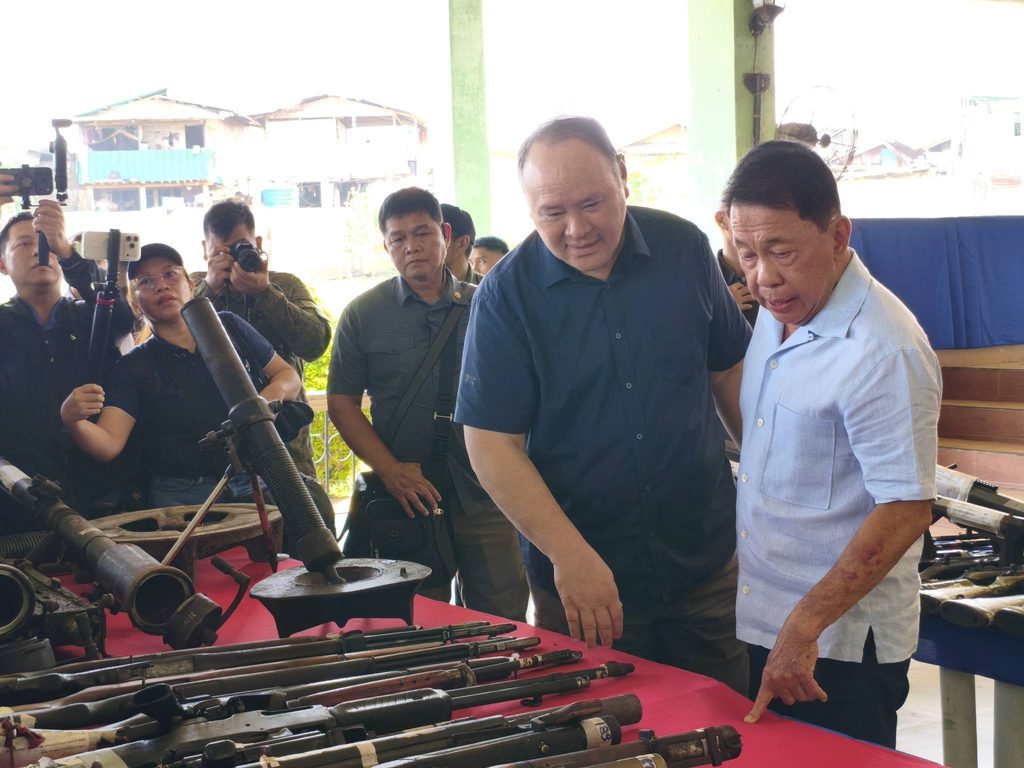
One of the most visible symbols of Sulu’s transition was the presentation of 504 firearms during the SIPS declaration ceremony.
The firearms were presented as part of the security forces’ inventory and peace-and-security efforts in the province. Units represented included Army formations such as the 1103rd Brigade, 1102nd Brigade and 104th Brigade, as well as the Sulu Police Provincial Office.
The display provided a stark visual reminder of the province’s long history of armed conflict while simultaneously serving as a symbol of the government’s continuing efforts to reduce the presence of firearms connected to violence and instability.
The presentation was followed by the signing of a Pledge of Commitment by national and local officials, military and police representatives and local chief executives.
Peace Must Now Be Sustained
Government officials emphasized that the SIPS declaration is not the conclusion of Sulu’s peace-building journey.
The provincial resolution calls for continued vigilance and sustained efforts to address remaining security concerns, including the responsible management of loose firearms, the peaceful settlement of rido or clan conflicts, and the delivery of basic government services.
These priorities are particularly significant because lasting peace depends not only on the absence of organized armed threats but also on the ability of communities to resolve disputes peacefully, access government services and create opportunities for future generations.
Defense Secretary Teodoro stressed that sustaining peace requires a whole-of-community approach, with education, family values, community leadership and religious guidance playing important roles.
He highlighted the responsibility of community leaders and religious teachers in transmitting proper values and interpretations of the Holy Quran, describing it as a source associated with peace, development and equality.
“This is the gift we give to the children of Sulu and their families,” Teodoro said, underscoring the need to develop future community leaders who can protect and strengthen the gains achieved by the present generation.
A New Test for Sulu
The SIPS declaration effectively changes the nature of the challenge confronting Sulu.
For years, security efforts were largely centered on confronting armed threats. With insurgent formations assessed to have been reduced to a non-threat level, the next challenge is ensuring that peace becomes durable enough to support development, education, livelihoods, public services and stronger local institutions.
Recent Philippine experience with SIPS declarations elsewhere has similarly emphasized that achieving stable peace is only one stage of the process, with authorities stressing the need to sustain security gains through cooperation among government agencies, communities and local stakeholders.
For Sulu, the responsibility now extends beyond the military and police.
It will involve local governments, traditional and religious leaders, families, educators, civil society organizations and communities themselves.
The message delivered during Thursday’s ceremony was therefore not simply that Sulu has moved away from decades of conflict, but that its people now have a collective responsibility to ensure that the province does not return to the conditions of its past.
Symbol of a New Beginning
The ceremony concluded with a symbolic release of doves and balloons led by Secretary Teodoro, Governor Tan II, Vice Governor Tan, provincial officials, AFP and PNP personnel and local chief executives.
As the doves and balloons rose over Sulu, the ceremony carried a message of healing, reconciliation and renewed hope.
For a province long associated with armed conflict and insecurity, the declaration of Stable Internal Peace and Security represents a significant institutional milestone.
But its ultimate significance will be measured not only by the absence of major armed threats, but by whether peace translates into safer communities, stronger institutions, improved services and greater opportunities for the people of Sulu.
The declaration marks the end of one chapter.
For Sulu, the harder task now is to make peace permanent.