
INDANAN, Sulu — After more than five decades marked by armed conflict, violence, clan disputes and instability, the Municipality of Indanan has reached what local officials and security authorities describe as a historic turning point, formally declaring itself a Gun-Responsible, Rido-Free, and Peace-Centered Community while affirming a State of Stable Internal Peace and Security (SSIPS).
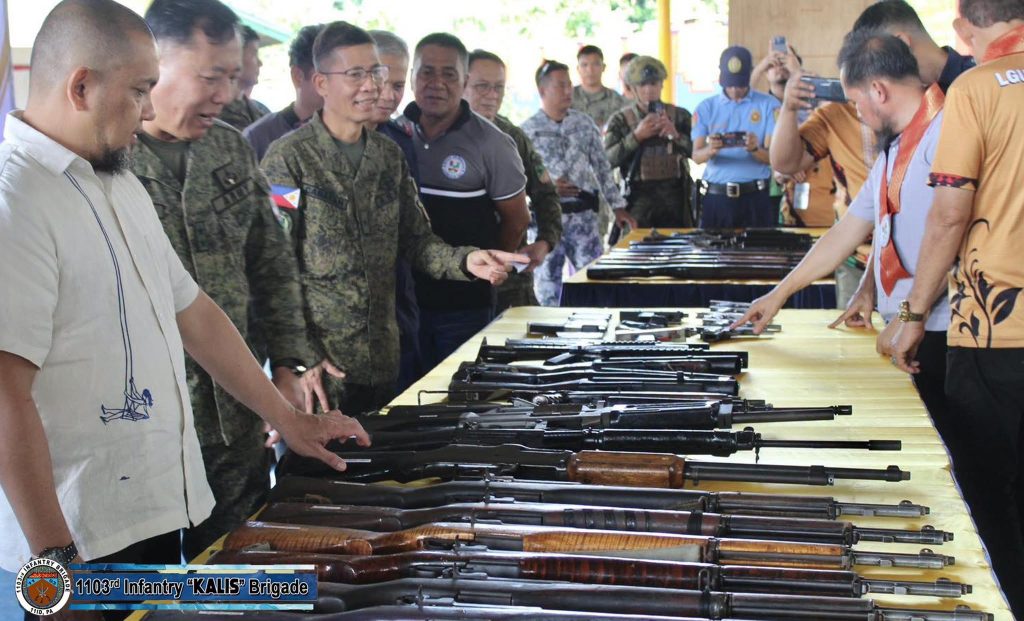
The declaration on August 6, 2026, marked a defining moment for a municipality that has endured generations of insecurity and conflict.
But the milestone was accompanied by an equally significant demonstration of community commitment: 49 high-powered firearms were voluntarily surrendered by residents, reinforcing the municipality’s declaration and signaling a collective decision to reject violence and embrace a future anchored in peace, unity, responsibility and development.
For Indanan, the significance extends far beyond the ceremonial declaration or the number of weapons turned over.
It represents a community attempting to close one of the darkest chapters of its history—and to prove that even deeply rooted cycles of violence can be broken when government institutions, security forces, traditional and religious leaders, and ordinary citizens work together toward a common goal.
From decades of conflict to a declaration of peace
For generations, communities across Sulu, including Indanan, have experienced the devastating consequences of armed conflict and long-standing disputes.
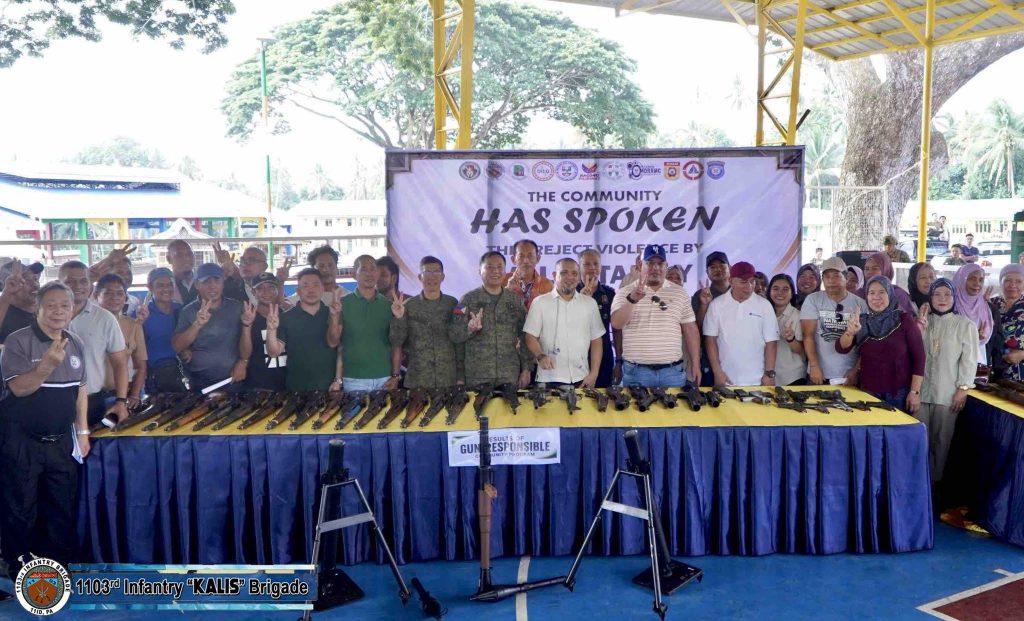
Violence has affected families, disrupted livelihoods, constrained development, displaced communities and created an environment in which insecurity could become part of everyday life.
In such an environment, achieving peace is not simply a matter of ending active fighting.
It requires rebuilding trust, resolving longstanding disputes, reducing the availability of firearms, strengthening local institutions, and convincing communities that peace can provide greater security and opportunity than violence.
The declaration by Indanan represents an attempt to institutionalize that transformation.
The municipality is no longer defining itself solely through the conflicts it has endured.
Instead, it is asserting a new identity—Gun-Responsible, Rido-Free and Peace-Centered.
That shift is perhaps the most consequential aspect of the August 6 milestone.
Forty-nine high-powered firearms voluntarily surrendered
The declaration was reinforced by the voluntary surrender of 49 high-powered firearms by residents of Indanan, removing a significant number of potentially dangerous weapons from communities.
The surrender was made possible through sustained peace-building efforts of the 1103th Infantry “Kalis” Brigade, 11th Infantry Division, Philippine Army, through the 100th Infantry “Kalasag” Battalion, in close partnership with the Local Government Unit of Indanan.
The operation was built not simply around enforcement but around engagement.
Dialogue, trust and collaboration with local leaders and stakeholders were central to encouraging residents to voluntarily give up their firearms.
That distinction matters.
Weapons recovered during combat or law-enforcement operations represent an immediate security gain. But firearms surrendered voluntarily can indicate something deeper: a shift in community attitudes toward armed violence and a growing confidence that security and protection can be achieved without keeping high-powered weapons.
The surrender therefore became a tangible expression of the larger peace declaration.
Each firearm removed from circulation potentially eliminates one tool that could be used in a future confrontation, retaliation or rido.
A historic partnership behind the transformation
The milestone was achieved through the sustained partnership of the Local Government Unit of Indanan under Mayor Albakil Jikiri, the 1103th Infantry “Kalis” Brigade, 11th Infantry Division, and the 100th Infantry “Kalasag” Battalion, led by Lt. Col. Samuel Bayongasan PA.
Law enforcement agencies, religious and traditional leaders, community stakeholders and, most importantly, the people of Indanan also played central roles in the process.
The broad coalition reflects a fundamental reality of peace-building in conflict-affected communities: no single institution can create lasting peace on its own.
The military can provide security. Law enforcement can enforce the law. Local governments can deliver services and governance. Traditional and religious leaders can help mediate disputes and influence communities.
But lasting peace ultimately depends on whether residents themselves accept and protect it.
In Indanan, authorities say that collective responsibility is increasingly becoming a reality.
The larger campaign for peace and development
The Indanan initiative forms part of the broader peace and development campaign of the 11th Infantry “Alakdan” Division, led by Maj. Gen. Leonardo I. Peña PA, in partnership with the Provincial Government of Sulu under Governor Abdusakur “Toto” A. Tan II.
The objective goes beyond achieving a temporary reduction in violence.
The larger challenge is to transform hard-earned peace gains into opportunities for sustainable development.
Peace and development are closely linked.
A community cannot fully benefit from economic opportunities, education, infrastructure, investment and improved public services if insecurity continues to threaten daily life.
Conversely, sustainable development can help reinforce peace by providing communities with legitimate opportunities and strengthening their stake in stability.
For Indanan, the declaration therefore represents not an end point but a foundation upon which a new development trajectory can be built.
Peña: Communities must choose to protect peace
Maj. Gen. Peña described Indanan’s achievement as evidence that lasting peace is strongest when communities themselves choose to protect and sustain it.
“This historic milestone shows what can be achieved when people choose dialogue over violence, unity over division, and progress over conflict. The peace we see today is the product of years of sacrifice, cooperation, and the collective determination of the people of Indanan.”
The statement underscores an important principle in conflict transformation: peace becomes more durable when communities have ownership of it.
External forces can help establish security, but peace cannot be permanently imposed from outside.
It must eventually become part of the community’s own social and political fabric.
The voluntary surrender of firearms and the formal declaration by Indanan provide two concrete manifestations of that ownership.
Breaking the cycle of rido
One of the most significant dimensions of the declaration is the commitment to becoming Rido-Free.
Rido—often involving clan or family-based disputes and cycles of retaliation—can persist long after the original grievance has been forgotten.
A single violent incident can trigger retaliatory attacks, drawing relatives and allied families into an escalating cycle.
The presence of high-powered firearms can make those disputes considerably more deadly.
By voluntarily surrendering firearms, communities are taking a direct step toward reducing the capacity for armed escalation.
But becoming genuinely rido-free will require more than disarming communities.
It will require sustained reconciliation, mediation, early intervention in disputes, credible local leadership and mechanisms that allow grievances to be addressed before they turn violent.
The declaration therefore carries a challenge as much as it carries an achievement: Indanan must now protect the peace it has declared.
From a ceremonial declaration to a social transformation
For the 1103th Infantry “Kalis” Brigade, the declaration is more than a ceremonial milestone.
It represents the transformation of a community that has endured decades of conflict into one that can now stand as an example of reconciliation, stability and hope.
That transformation cannot be measured solely through the number of firearms surrendered.
It can also be measured through the willingness of communities to engage in dialogue, the ability of leaders to resolve disputes peacefully, and the growing confidence of residents in institutions tasked with protecting them.
The 49 firearms are therefore physical symbols of a much broader process.
They represent weapons being removed from circulation at the same time that dialogue, cooperation and community ownership are being strengthened.
A turning point for Indanan—and potentially Sulu
The significance of Indanan’s declaration extends beyond its municipal boundaries.
Sulu has spent decades confronting the consequences of armed conflict and insecurity. A successful transition toward stable peace in one municipality could provide a model for other communities facing similar challenges.
Indanan’s experience demonstrates that peace-building is possible even in places where conflict has become deeply entrenched.
But the declaration should also be viewed realistically.
A State of Stable Internal Peace and Security is not something that can be taken for granted permanently. It must be continuously maintained through effective governance, responsive security institutions, conflict prevention, community participation and development.
The greatest test of the declaration will come not during the ceremony, but in the months and years that follow.
Will disputes continue to be settled without violence?
Will firearms remain out of the hands of those who could use them for retaliation?
Will traditional, religious and political leaders continue working together?
Will young people inherit a community where peace, rather than armed conflict, is regarded as the normal condition?
The answers to those questions will ultimately determine whether August 6 becomes simply a historic date—or the beginning of a lasting transformation.
Every surrendered firearm represents more than a weapon
Governor Abdusakur “Toto” A. Tan II commended the people of Indanan for their voluntary surrender of firearms, describing the milestone as a powerful testament to the community’s trust in government peace initiatives.
Tan emphasized that every firearm surrendered represents more than a weapon removed from circulation.
It represents a potential life protected, a possible conflict prevented and another step toward a peaceful and progressive Sulu.
The provincial government also reaffirmed its commitment to initiatives that strengthen peace and order, promote responsible firearm ownership and sustain the gains achieved through years of peace-building efforts.
The message is clear: peace must be protected collectively.
The responsibility cannot rest solely on soldiers or police officers.
It must also belong to local officials, community leaders, religious figures, traditional authorities, families and residents themselves.
A new identity forged from the ashes of conflict
After more than 50 years of armed conflict, Indanan is now attempting to redefine its future.
The municipality’s declaration sends a powerful message across Sulu: the cycle of violence can end, peace can prevail, and a better future can begin.
The 49 high-powered firearms surrendered on August 6 are tangible reminders of that decision.
They represent a community’s willingness to exchange the logic of armed confrontation for dialogue, retaliation for reconciliation, division for unity, and instability for peace.
But the deeper achievement lies in the collective decision behind the surrender.
For generations, conflict shaped the lives of many communities in Sulu. Now, Indanan is seeking to ensure that peace shapes the generations that come after them.
The municipality’s transformation will not be complete simply because firearms have been surrendered or a declaration has been signed.
The real measure of success will be whether peace becomes deeply rooted in the community’s institutions, relationships and everyday life.
For now, however, Indanan has reached a historic turning point.
After more than five decades of conflict, it is choosing to define itself not by the violence it survived, but by the peace it intends to protect.