
DAVAO CITY, Philippines — In a landmark reaffirmation of one of the country’s most significant peace initiatives, the Government of the Philippines (GPH) and the Moro Islamic Liberation Front (MILF) have renewed their commitment to fully implement the Comprehensive Agreement on the Bangsamoro (CAB), pledging to sustain the gains of the peace process and ensure that the promise of lasting peace endures beyond political transitions.
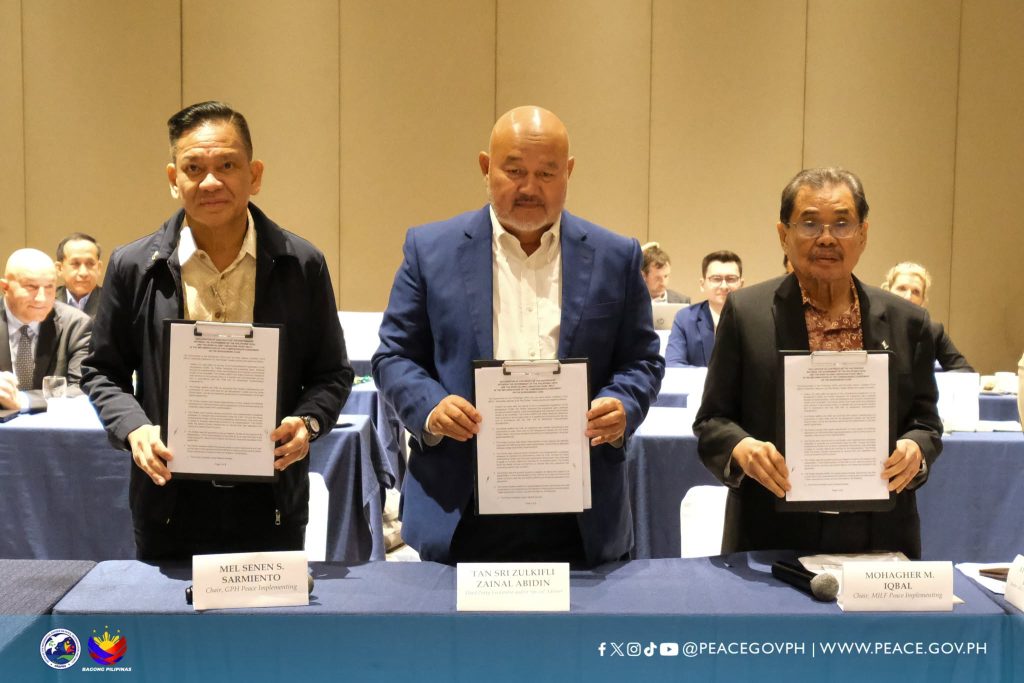
The commitment was formalized through the Declaration of Continuity of Partnership between the Government of the Philippines and the Moro Islamic Liberation Front in the Implementation of the Comprehensive Agreement on the Bangsamoro, signed on August 4, 2026, in Davao City during the 38th Meeting of the GPH and MILF Peace Implementing Panels.
The declaration was signed by GPH Peace Implementing Panel Chair Mel Senen S. Sarmiento and MILF Peace Implementing Panel Chair Mohagher M. Iqbal, in the presence of Malaysian Third Party Facilitator and Special Adviser Tan Sri Dato’ Seri Panglima TS Haji Zulkifli Bin Zainal Abidin, reaffirming both parties’ unwavering commitment to complete all remaining obligations under the historic peace agreement.
Twelve Years of Peace Gains, With More Work Ahead
Twelve years after the signing of the Comprehensive Agreement on the Bangsamoro, both parties acknowledged the significant progress achieved in ending decades of armed conflict in Mindanao while recognizing that critical commitments remain unfinished.
The declaration stressed that the remaining obligations under the CAB will continue to be implemented jointly “in a parallel and commensurate manner,” emphasizing that the agreement remains the fundamental framework governing all signed peace agreements between the government and the MILF.
Both parties likewise reaffirmed their shared responsibility to honor and faithfully implement the CAB while strengthening cooperation through their Peace Implementing Panels and established peace mechanisms.
The declaration also directs the peace process mechanisms to resume and sustain joint operations to ensure that the remaining commitments—including normalization, decommissioning, socioeconomic interventions, and institutional reforms—are successfully completed.
“How Do We Make This Agreement Truly Last?”
In his first official address as Chairperson of the GPH Peace Implementing Panel, Mel Senen S. Sarmiento delivered a deeply reflective message centered on one defining question that has guided him since assuming office in April:
“What will make an agreement like this truly last? Not only on paper, but in the hearts of our people and in the lives of the generations that will follow?”
Sarmiento said the durability of the Bangsamoro peace agreement should never be measured merely by the passing of years, but by whether institutions remain effective, peace mechanisms continue resolving problems, trust between the parties grows stronger, and communities experience the tangible benefits of peace.
“Our task is no longer simply to keep the process moving,” Sarmiento said.
“Our task is to ensure that what we have built together will continue to stand, long after today’s challenges have passed.”
He emphasized that every component of the peace process—including parliamentary elections, intergovernmental relations, ceasefire implementation, decommissioning of former combatants, camp transformation, socioeconomic development, transitional justice, and amnesty—must reinforce one another.
“They are all part of the same question,” he said.
“How do we make each one reinforce the other so that this Agreement becomes stronger with every passing year?”
Peace Must Be Felt by Communities
Sarmiento underscored that peace should not merely exist in official documents but must become part of the daily lives of Bangsamoro communities.
Recalling his recent visit to Camp Badre in Guindulungan, Maguindanao del Sur, he described seeing paved access roads replacing isolated paths, government security forces working alongside former Bangsamoro Islamic Armed Forces (BIAF) members, and community members earning livelihoods through a bakery established under the Joint Task Forces on Camps Transformation (JTFCT).
According to him, these are the true indicators of successful implementation.
“A road that allows safer travel. A livelihood that creates opportunity. A functioning ceasefire that gives communities the confidence to invest in their future. Access to government services,” he said.
“These are not isolated interventions. Together, they become the lived experience of peace.”
He also commended the MILF for remaining steadfast in preserving the ceasefire and strengthening the jointly established peace mechanisms despite political transitions and implementation challenges.
Accountability, Transparency, and Public Trust
Sarmiento also highlighted the need for stronger monitoring systems to ensure that every commitment under the CAB reaches its intended beneficiaries.
He acknowledged that while numerous government programs are already benefiting Bangsamoro communities, authorities still need a clearer system to determine who has received assistance, who remains underserved, and what commitments are still pending.
“We cannot improve what we cannot clearly see. Accountability begins with visibility,” he said.
He likewise stressed the importance of communicating the peace process more openly with the public.
“The Filipino people deserve to know not only that we continue to meet, but what we have agreed upon, who is responsible, and how we intend to move forward together.”
He added that the parties should never allow others to define the narrative of peace for them.
Partnership Beyond the First Bangsamoro Parliamentary Elections
One of the declaration’s most significant provisions is the assurance that the implementation of the CAB will continue even as the Bangsamoro Autonomous Region prepares for its first regular Bangsamoro Parliamentary Elections and the anticipated establishment of the regular Bangsamoro Government.
Both the GPH and MILF emphasized that the transition to regular governance does not mark the end of the peace process but rather the beginning of a new phase where institutions, peace mechanisms, and reforms must continue functioning effectively.
The declaration reaffirmed the continued role of key peace mechanisms, including the International Contact Group (ICG), Third Party Monitoring Team (TPMT), Coordinating Committee on the Cessation of Hostilities (CCCH), Ad Hoc Joint Action Group (AHJAG), Joint Normalization Committee (JNC), Independent Decommissioning Body (IDB), Joint Peace and Security Teams (JPSTs), Joint Task Forces on Camps Transformation (JTFCT), Bangsamoro Normalization Trust Fund (BNTF), Technical Working Group on Transitional Justice and Reconciliation (TWG-TJR), Joint Communications Committee (JCC), and the International Monitoring Team (IMT), among others.
These mechanisms continue to serve as the backbone of the Bangsamoro peace process by maintaining the ceasefire, supporting normalization, promoting reconciliation, facilitating development, and ensuring that former combatants and conflict-affected communities benefit from the peace dividends.
Making Peace Irreversible
Concluding his address, Sarmiento assured the MILF that the Philippine Government remains fully committed to fulfilling every promise embodied in the Comprehensive Agreement on the Bangsamoro.
“We are not here to revisit what we have already settled,” he said.
“We are here to fulfill what we have promised, strengthen what we have built together, and ensure that this Agreement continues to bring hope, opportunity, and a better future for every Bangsamoro community.”
He expressed hope that future generations would remember not the meetings held or documents signed, but the peace that both parties succeeded in making permanent.
“Together, let us make this Agreement endure. Together, let us make peace irreversible.”
The renewed declaration and the strong message delivered during the 38th Meeting of the Peace Implementing Panels underscore a shared determination by the Government of the Philippines and the Moro Islamic Liberation Front to protect more than a decade of peace gains and ensure that the Comprehensive Agreement on the Bangsamoro continues to serve as the cornerstone of lasting peace, inclusive development, reconciliation, and shared prosperity for the Bangsamoro people and the entire Filipino nation.