
TARAKA, Lanao del Sur — More than a hundred loose firearms, including high-powered assault rifles, sniper rifles, grenade launchers, and machine guns, were voluntarily surrendered during a major ceremonial turnover under the Small Arms and Light Weapons (SALW) Management Program in Taraka, Lanao del Sur on May 19, signaling what government officials described as a crucial step toward lasting peace and the prevention of violent clan conflicts in the province.
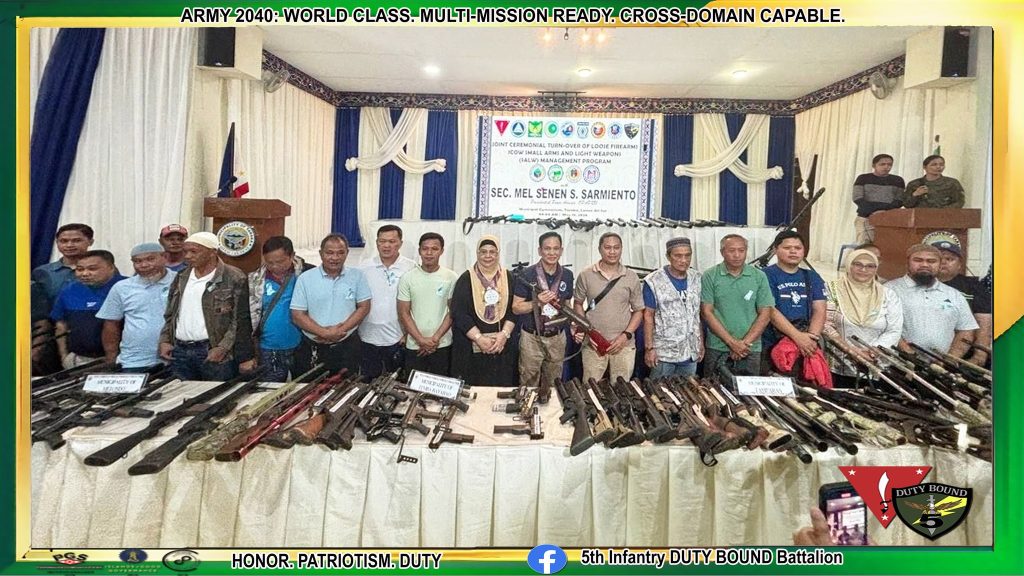
The Joint Ceremonial Turnover, held at the Taraka Municipal Gymnasium, brought together local government units, security forces, peace stakeholders, and community leaders from the municipalities of Mulondo, Taraka, Lumba-Bayabao, and Tamparan in a coordinated effort to curb the proliferation of unregistered firearms across communities vulnerable to rido and armed violence.
A total of 108 loose firearms of various calibers and classifications were turned over during the activity. The cache included sniper rifles, assault rifles, rocket-propelled grenade launchers, grenade launchers, heavy and sub-machine guns, carbines, shotguns, and pistols ranging from .50 caliber to 9mm.
The program was spearheaded through the combined efforts of participating LGUs, local communities, the 5th Infantry “Duty Bound” Battalion, the 103rd Infantry “Haribon” Brigade, the Philippine National Police, the Bangsamoro Autonomous Region in Muslim Mindanao (BARMM), and the Provincial Government of Lanao del Sur.
Among the top officials present was Presidential Peace Adviser Secretary Mel Senen Sarmiento of the Office of the Presidential Adviser on Peace, Reconciliation and Unity (OPAPRU), who served as guest of honor and speaker during the event.
Sarmiento emphasized the importance of unity and collective action in ending internal armed conflicts and sustaining the gains of the Bangsamoro peace process, noting that the SALW Management Program forms part of the normalization track under the Comprehensive Agreement on the Bangsamoro (CAB).
Officials said the surrender of firearms is intended to reduce the likelihood of violent confrontations, especially in communities historically affected by family feuds and politically motivated armed disputes.
Lieutenant Colonel Mark Francis N. Garcia, commander of the 5th Infantry Battalion, said the activity demonstrated the willingness of communities to support lawful and peaceful initiatives aimed at securing a safer future for the next generation.
“Peace can only flourish when communities, religious and traditional leaders, local chief executives, and security forces work together with sincerity and trust,” Garcia said.
He stressed that the turnover was more than a symbolic ceremony, describing it as “a strong manifestation of the communities’ commitment” to peace, stability, and lawful governance in Lanao del Sur.
Garcia added that the 5th Infantry Battalion would continue supporting programs designed to strengthen public safety, improve coordination with communities, and sustain peace and development efforts across its area of responsibility.
Brigadier General Billy O. Dela Rosa, commander of the 103rd Infantry Brigade, underscored the direct connection between loose firearms and the escalation of rido, or clan feuds, which have long plagued parts of Lanao del Sur and neighboring provinces.
“Rido and other forms of community conflict can escalate when firearms are readily available and are used not for protection but for personal interests,” Dela Rosa said.
He noted that reducing the number of unregistered firearms gives local leaders, elders, and peace mediators more room to settle disputes peacefully before violence erupts.
Dela Rosa also vowed that units under the 103rd Infantry Brigade would continue implementing interventions aimed at addressing community-based conflicts while supporting peaceful mechanisms for conflict resolution.
Also present during the activity was Police Brigadier General Christopher M. Abecia, who reaffirmed the Philippine National Police’s commitment to strengthening the government’s campaign against loose firearms and supporting peace and security initiatives throughout the Bangsamoro region.
Authorities described the SALW Program as one of the government’s critical security mechanisms under the Annex on Normalization of the Comprehensive Agreement on the Bangsamoro, which seeks to transition conflict-affected communities toward stability, development, and civilian-led governance.
Officials said the voluntary surrender and proper management of small arms and light weapons are expected to help reduce violence, prevent armed confrontations, and create safer communities across Lanao del Sur and the wider Bangsamoro region.
Military officials from the 1st Infantry “Tabak” Division likewise reiterated their commitment to continue supporting the provincial government and local stakeholders in peacebuilding and development efforts aimed at ensuring long-term security, justice, and progress for the people of Lanao del Sur.