
Cotabato City — The Bangsamoro Darul-Ifta’, the highest Islamic advisory body in the Bangsamoro Autonomous Region in Muslim Mindanao (BARMM), has issued a far-reaching fatwa prohibiting Muslims from consuming civet coffee and all similar products produced from beans extracted from animal feces. The ruling—released as Fatwa No. 18, Series of 2025—has sent ripples across Mindanao’s Muslim communities and the region’s growing specialty coffee market.
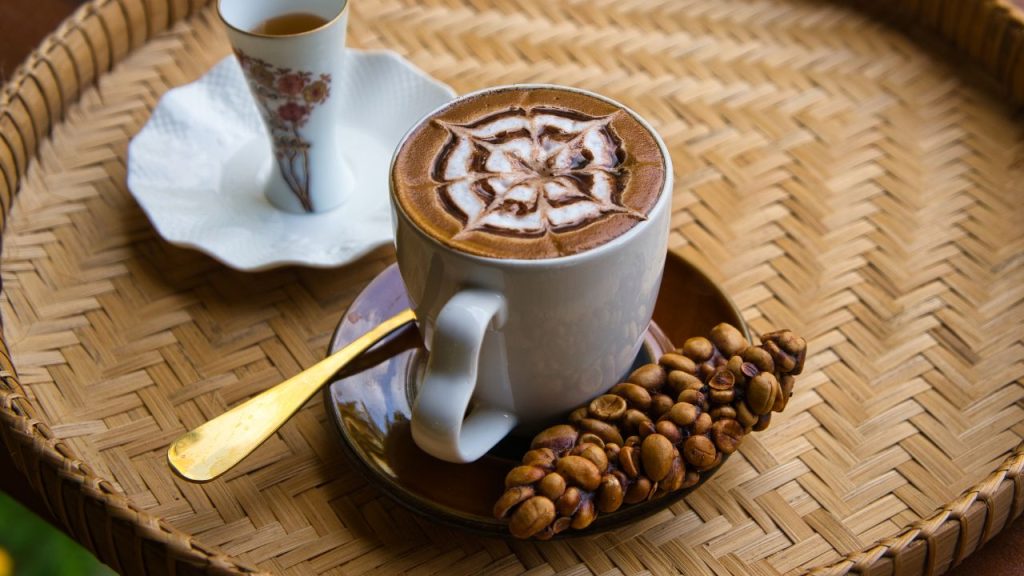
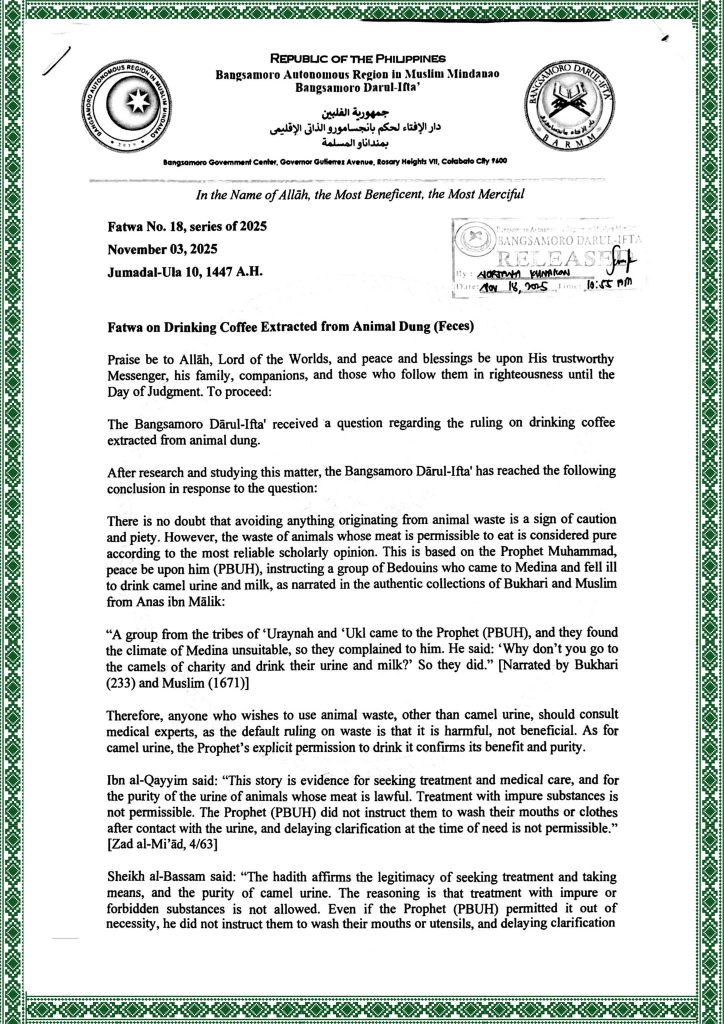
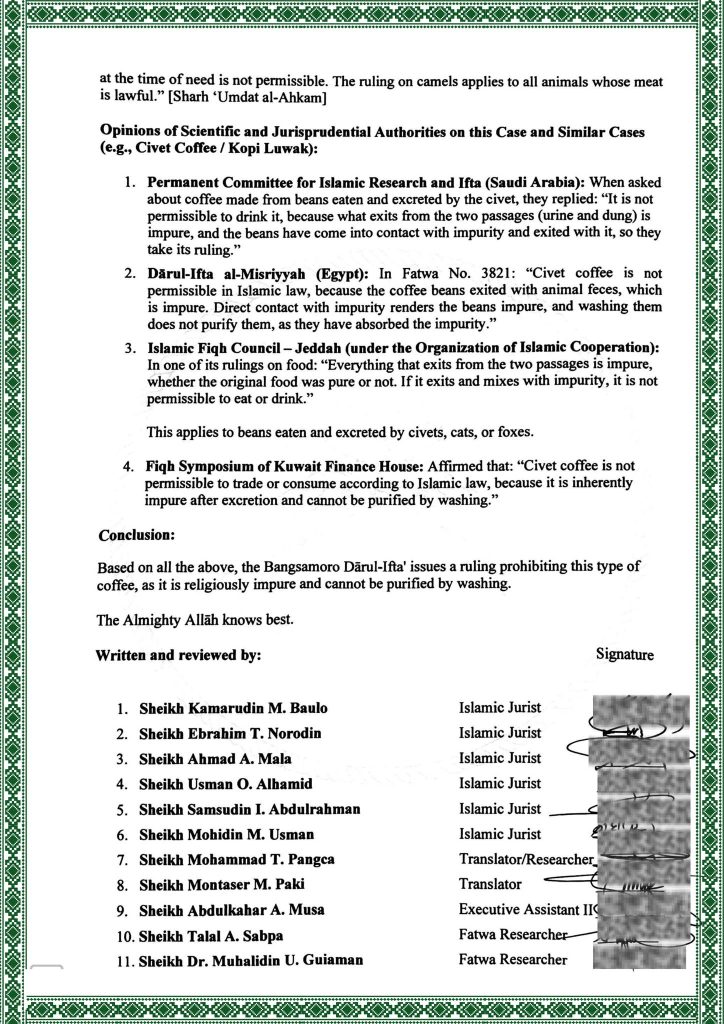
The fatwa addresses a long-standing question: Is coffee made from beans eaten and excreted by animals, such as civets or wild cats, permissible under Islamic law? After months of scholarly review, Darul-Ifta’ concluded that such beverages are haram, citing their inherent impurity and direct contact with feces.
A Strong Religious Ruling Backed by Global Jurisprudence
In its detailed explanation, Darul-Ifta’ emphasized a fundamental principle in Islamic jurisprudence: anything that exits from the “two passages”—urine and feces—is considered impure. Although the waste of animals normally permissible to eat is generally regarded as clean by many scholars, the fatwa stresses that coffee beans excreted with feces acquire impurity that cannot be removed even with washing or industrial processing.
The ruling aligns with the positions of several highly respected Islamic bodies, including:
- Saudi Arabia’s Permanent Committee for Islamic Research and Ifta
- Darul-Ifta al-Misriyyah (Egypt)
- The OIC Islamic Fiqh Council in Jeddah
- Regional Fiqh symposiums, including the Kuwait Finance House
These bodies unanimously ruled that civet coffee (popularly known as kopi luwak) and similar products are not permissible because the beans come into direct contact with impurity inside the animal and through excretion.
BARMM Muslims Asked to Avoid Civet Coffee, Seek Safer Alternatives
The Darul-Ifta’ ruling aims to guide Muslims “toward safer and religiously sound consumption practices.” It reminds the public that while some animal by-products—such as camel urine, explicitly mentioned in prophetic tradition—were permitted for medical purposes, this exception does not extend to other animals or commercially processed products.
The fatwa states that anything sourced from animal feces is “harmful and impure,” making its consumption religiously impermissible.
Impact on Muslim Coffee Drinkers and the Specialty Coffee Industry
The decision is expected to have a significant cultural and economic impact, especially in regions where premium animal-processed coffee has become a symbol of luxury and tourism.
Civet coffee—often priced from ₱1,500 to ₱8,000 per 100 grams—has long been marketed as one of the world’s most expensive coffees. In Mindanao, small-scale producers in Bukidnon, Sultan Kudarat, and parts of Lanao del Sur have tapped into this niche market, selling civet coffee to tourists and high-end consumers, including some Muslims.
With the new fatwa, Muslim consumers in BARMM and beyond are now expected to avoid civet coffee entirely, a move likely to shift local market dynamics.
Muslim business owners involved in production or trade may also need to reassess their operations to ensure religious compliance. Some local traders anticipated the ruling and have begun shifting to alternative specialty brews such as:
- High-grade Arabica from Mount Apo, Piapayungan, or Bukidnon
- Robusta and Excelsa varieties processed using halal-certified methods
- Naturally-fermented coffee not involving animal digestion
A Cultural Turning Point
The fatwa also challenges the perception of civet coffee as a luxury product. For years, the beverage has been marketed internationally as “naturally refined” through animal digestion—a process now recognized by BARMM scholars as intrinsically impure from an Islamic standpoint.
For Muslim communities that value both culinary heritage and religious observance, the ruling marks a significant cultural moment. It clarifies long-standing questions, empowers consumers to make faith-aligned choices, and encourages producers to innovate within halal guidelines.
Guidance Moving Forward
The Darul-Ifta’ encourages Muslims to consult the full fatwa for deeper understanding and urges local authorities, food entrepreneurs, and community leaders to help disseminate the ruling.
As BARMM continues to strengthen its halal governance, this fatwa reinforces the region’s commitment to ensuring that Muslim consumers have clear, authoritative guidance—especially when it comes to products as beloved and widely consumed as coffee.