
MAKILALA, Cotabato — The 39th Infantry “Smash ’Em” Battalion of the Philippine Army has launched a 15-day deradicalization program for former conflict-affected individuals in Cotabato Province, bringing together government agencies, local officials, security forces and community stakeholders in an effort to support their transition away from armed conflict and toward peaceful community reintegration.
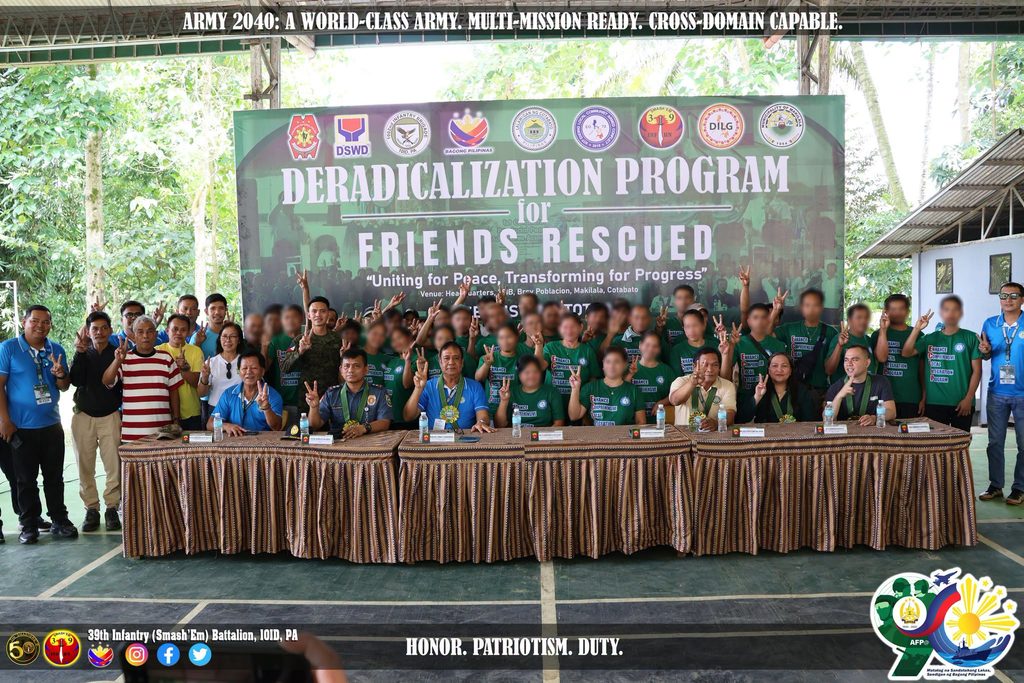
The program officially opened on September 14, 2026, at the 39th Infantry Battalion headquarters in Barangay Poblacion, Makilala, Cotabato, under the leadership of Battalion Commander Lt. Col. Hector A. Estolas.
Carrying the theme “Uniting for Peace, Transforming for Progress,” the initiative is designed to provide participants, identified by the military as “Friends Rescued” (FRs), with structured opportunities for values formation, personal transformation, skills development and community reintegration.
The Philippine Army said the program forms part of a broader government effort to address factors associated with violent extremism and armed conflict by helping former rebels develop the knowledge, skills and values needed to rebuild their lives and participate constructively in their communities.
For 15 days, participants will undergo lectures, discussions and values-oriented workshops facilitated by the 39IB Deradicalization Team in coordination with various national government agencies.
The team is led by Belly S. Berana Jr., identified by the Army as a former secretary of the dismantled Guerrilla Front ALIP of the New People’s Army (NPA). His involvement is intended to provide participants with a perspective drawn from his own experience of leaving the armed movement and pursuing a different path.
The sessions will focus on responsible citizenship, peaceful conflict resolution, values formation and active participation in community affairs. The program also seeks to provide practical avenues through which participants can regain confidence, strengthen their relationships with their families and communities, and pursue more sustainable livelihoods.
The opening ceremony brought together representatives from the Provincial Social Welfare and Development Office, police, local government, Public Attorney’s Office and the provincial government.
Messages of support were delivered by Luis Caytor, RSW, E-CLIP focal person of the Provincial Social Welfare and Development Office of Cotabato; Police Lieutenant Colonel Romeo M. Calamba, police community relations officer; Makilala Municipal Councilor Romnick Cabaron; Atty. Noreen M. Napoles, Public Attorney II of the Public Attorney’s Office in Kidapawan City; and representatives of Cotabato Governor Emmylou “Lala” Taliño-Mendoza.
Florentino R. Villasor, the province’s Provincial ELCAC focal person, represented Governor Taliño-Mendoza and delivered the keynote message during the ceremony.
Villasor commended the Armed Forces of the Philippines and the Philippine National Police for their continuing efforts to maintain peace and security in Cotabato Province. He also emphasized the importance of institutional reintegration programs in helping former rebels move beyond conflict and rebuild their lives in a peaceful environment.
For the government, reintegration is a critical component of sustaining peace because the end of an individual’s involvement in armed conflict does not automatically resolve the social, economic and personal challenges that may have contributed to their participation in the first place.
Programs such as the deradicalization initiative therefore seek to complement security operations with interventions aimed at addressing individual and community needs.
Estolas expressed his appreciation to the Provincial Government of Cotabato, led by Governor Taliño-Mendoza, as well as participating national government agencies and other stakeholders for their continued support for the peace initiative.
He also thanked the participating FRs for voluntarily taking part in the program and urged them to actively participate in all of its activities.
Estolas stressed that their willingness to cooperate and embrace positive change would be essential not only to the success of the program but also to their efforts to rebuild their lives, strengthen their families and contribute to the development of their communities.
The initiative reflects the continuing effort of government institutions in Cotabato to combine security, social services and community-based interventions in addressing armed conflict and violent extremism.
The 39th Infantry Battalion said it will continue working with local governments, national government agencies, law enforcement agencies and civil society organizations in advancing peacebuilding initiatives.
Through the program, the battalion said it seeks to help former rebels make the transition from armed conflict to peaceful civilian life and eventually become productive members of their families and communities.
The initiative also underscores a broader challenge in sustaining peace: ensuring that individuals who leave armed groups are given meaningful opportunities to rebuild their lives and participate in legitimate community development.
For the participating FRs, the 15-day program is intended to serve not simply as a series of lectures and workshops, but as part of a longer process of transformation, reintegration and renewed participation in peaceful community life.