
MUNAI, Lanao del Norte — A potentially sensitive dispute between government security forces and a Moro Islamic Liberation Front (MILF) leadership structure appeared to take a conciliatory turn Thursday after Philippine Army and MILF leaders met in Munai and exchanged a handshake for peace, following a series of tensions over checkpoints, armed movements and coordination procedures in Lanao del Norte.
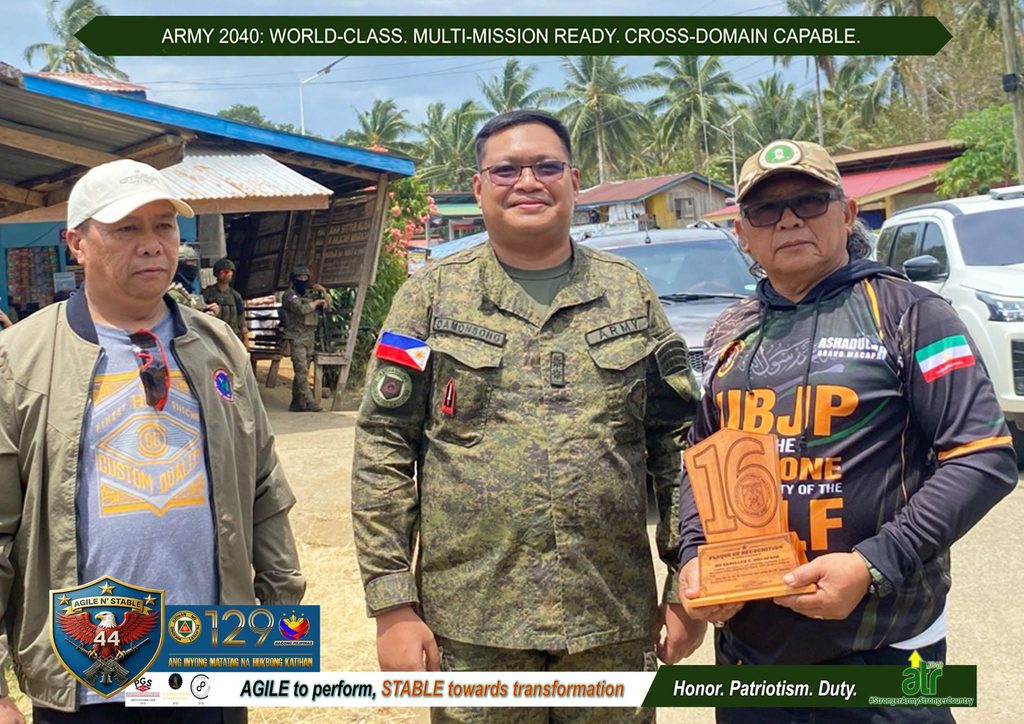
Lt. Col. Jeremy D. Damonsong, commanding officer of the 44th Infantry (Agile N’ Stable) Battalion of the Philippine Army’s 1st Infantry Division, and Hon. Abdullah G. Macapaar, popularly known as “Commander Bravo,” held a cordial meeting on September 10, 2026, in the Municipality of Munai.
The meeting came days after a September 2 checkpoint incident involving a large convoy identified as belonging to the MILF 131st Brigade, followed by Macapaar’s September 7 announcement that Philippine Army and Philippine National Police personnel should not enter his group’s declared area of responsibility without prior coordination.
The latest engagement is significant because the earlier incident had exposed competing concerns over public safety, firearms, organized movements and the coordination mechanisms surrounding the Bangsamoro peace process.
From checkpoint dispute to dialogue
The September 2 incident began when government security personnel stopped and verified a large convoy in Barangay Libertad, Kolambugan, Lanao del Norte.
The convoy reportedly consisted of 23 vehicles and five motorcycles and was identified as carrying MILF members traveling toward Camp Kura-Kura in Barangay Tamparan, Munai, reportedly for an MILF assembly. Government forces said the group could not present proof of prior coordination for its movement through the province.
The government side maintained that the checkpoint was conducted as part of public-safety and peace-and-order measures. Authorities also said some members of the convoy were reportedly in uniform and carrying firearms, prompting security forces to enforce restrictions concerning the movement of armed MILF personnel.
The encounter, however, did not escalate into violence. Negotiations were conducted at the checkpoint, after which the convoy returned toward Picong, Lanao del Sur, rather than proceeding to the planned assembly. Government forces described the incident as having been resolved peacefully and professionally.
The Lanao del Norte police subsequently emphasized that the action was directed at the absence of documented prior coordination and was not intended to undermine existing peace mechanisms. Police Provincial Director PCOL Leo De Leon Sua stressed the need for government authorities, armed groups and other stakeholders to coordinate before organized movements, particularly those involving large groups.
Commander Bravo raises coordination concerns
The incident nevertheless generated frustration on the MILF side.
On September 7, Macapaar said Philippine Army and PNP personnel would no longer be allowed to enter the 131st Brigade’s declared area of responsibility without prior coordination with MILF authorities.
Macapaar questioned the manner in which the convoy had been stopped and subjected to checkpoint procedures. He said the MILF did not want trouble but would not accept what he regarded as being singled out or bullied by government forces.
His declaration introduced a potentially delicate question for the peace process: how government security responsibilities and MILF structures are to interact in areas where both operate and where established coordination mechanisms are intended to prevent misunderstandings.
The AFP and PNP, for their part, maintained that government forces have continuing responsibilities for public safety, law enforcement and the enforcement of applicable security and firearms regulations. They also reiterated their respect for the peace process and called for prior coordination involving organized movements.
Elections heighten sensitivity
The dispute also unfolded as the 2026 Bangsamoro elections approach, adding another layer of sensitivity to the movement of armed personnel and large organized groups.
Government security authorities said they would intensify random checkpoints and coordination with the PNP, local governments, other national government agencies and the Commission on Elections as part of election-security preparations.
Authorities also urged the public to avoid panic and the circulation of unverified information that could aggravate tensions.
Against this backdrop, the September 10 meeting between Damonsong and Macapaar offers an important indication that disagreements can still be brought back to dialogue before they develop into a broader security confrontation.
A handshake after heightened tensions
The 44th Infantry Battalion said the meeting underscored the importance of open communication, direct coordination and mutual respect among peace stakeholders.
The battalion continues to operate within its area of responsibility in Munai, including the vicinity of Camp Bilal, while maintaining professional and respectful engagement with local leaders and members of the Northern Western Mindanao Front community under Commander Bravo through established communication and peace-engagement channels.
The significance of the meeting lies not simply in the handshake between two leaders, but in what it represents after a period of heightened sensitivity.
The September 2 checkpoint encounter ended without gunfire, arrests or physical confrontation. Yet the subsequent disagreement over government entry into the MILF’s claimed area of responsibility demonstrated that unresolved concerns remained.
The September 10 dialogue provides an avenue for those concerns to be addressed directly rather than through public warnings, assumptions or potentially escalating encounters.
For communities in Lanao del Norte, the stakes extend beyond the positions of individual leaders.
Any misunderstanding involving government security forces and armed groups can generate fear among residents, disrupt normal movement and potentially undermine confidence in the peace process. Conversely, clear communication and established coordination can help prevent security operations or organized movements from becoming sources of unnecessary confrontation.
The immediate message emerging from the Munai meeting is therefore one of restraint and engagement.
Peace in communities affected by decades of conflict depends not only on formal agreements but also on how local and security leaders handle moments of disagreement.
As the 2026 Bangsamoro elections draw closer, that responsibility becomes even more critical.
For now, the trajectory appears to have shifted from confrontation over procedures toward direct communication.
The September 10 meeting does not erase the questions raised by the earlier incidents, nor does it resolve every issue concerning jurisdiction, security operations or coordination. But it demonstrates that the parties can still sit down, communicate and engage respectfully.
In a region where small misunderstandings can carry significant security consequences, that choice matters.
Dialogue builds understanding. Coordination strengthens trust. Mutual respect helps sustain peace.
And when leaders choose to talk, communities gain greater confidence that tensions can be managed without returning to confrontation.