
CAGAYAN DE ORO CITY – A 17-year-old minor who allegedly made threats against several schools in Cagayan de Oro through a viral social media video has been voluntarily surrendered to the police by his guardians, prompting authorities to intensify security measures across the city and launch a full investigation into the incident.
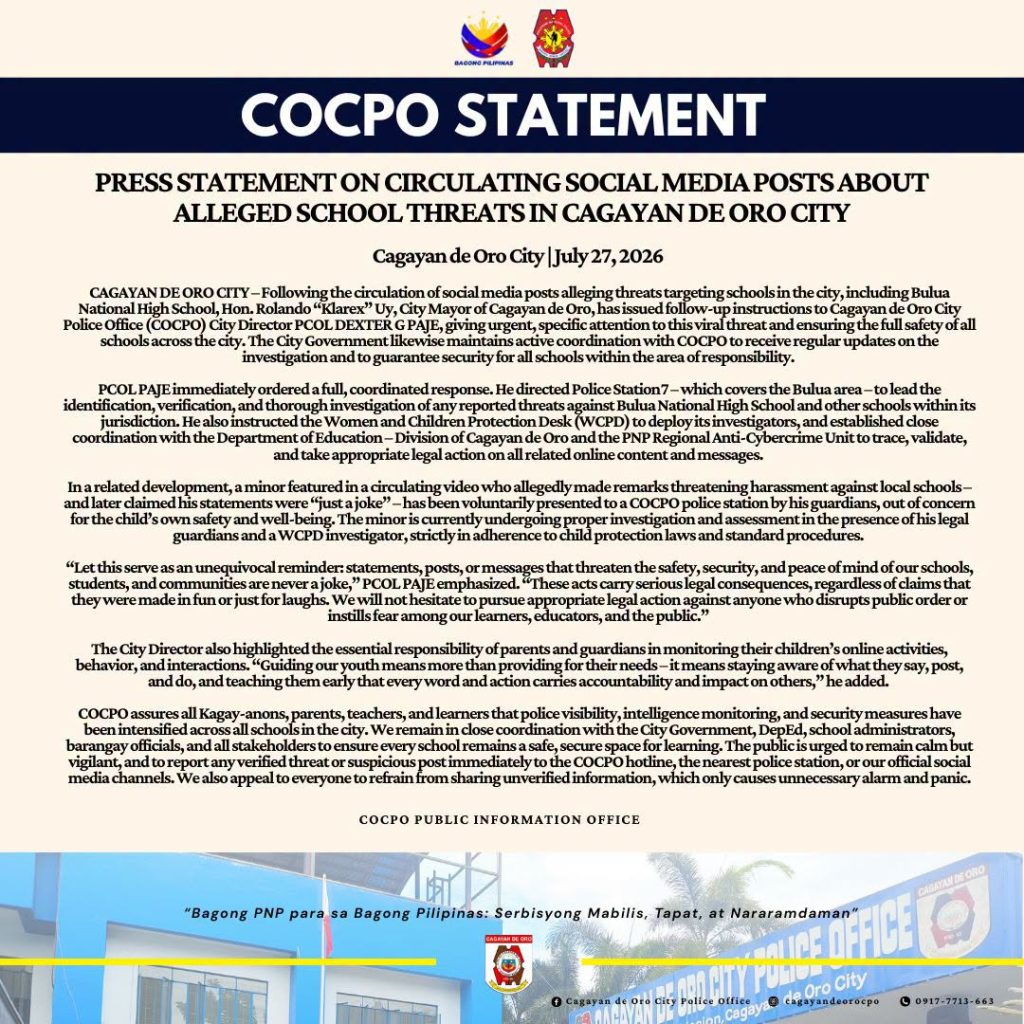

The surrender was confirmed by Police Captain Emelita Simon, spokesperson of the Cagayan de Oro City Police Office (COCPO), who said the teenager is now under the custody of the Women and Children Protection Desk (WCPD) while investigators determine the circumstances surrounding the viral video and the alleged threats.
The minor was brought to the police station by his guardians and is currently undergoing investigation and assessment in the presence of a WCPD investigator, in accordance with child protection laws and established procedures involving children in conflict with the law.
Threats Spark Fear Among Students and Parents
The viral social media posts allegedly contained threats directed at Bulua National High School and Bugo National High School, triggering widespread concern among students, parents, teachers, and residents.
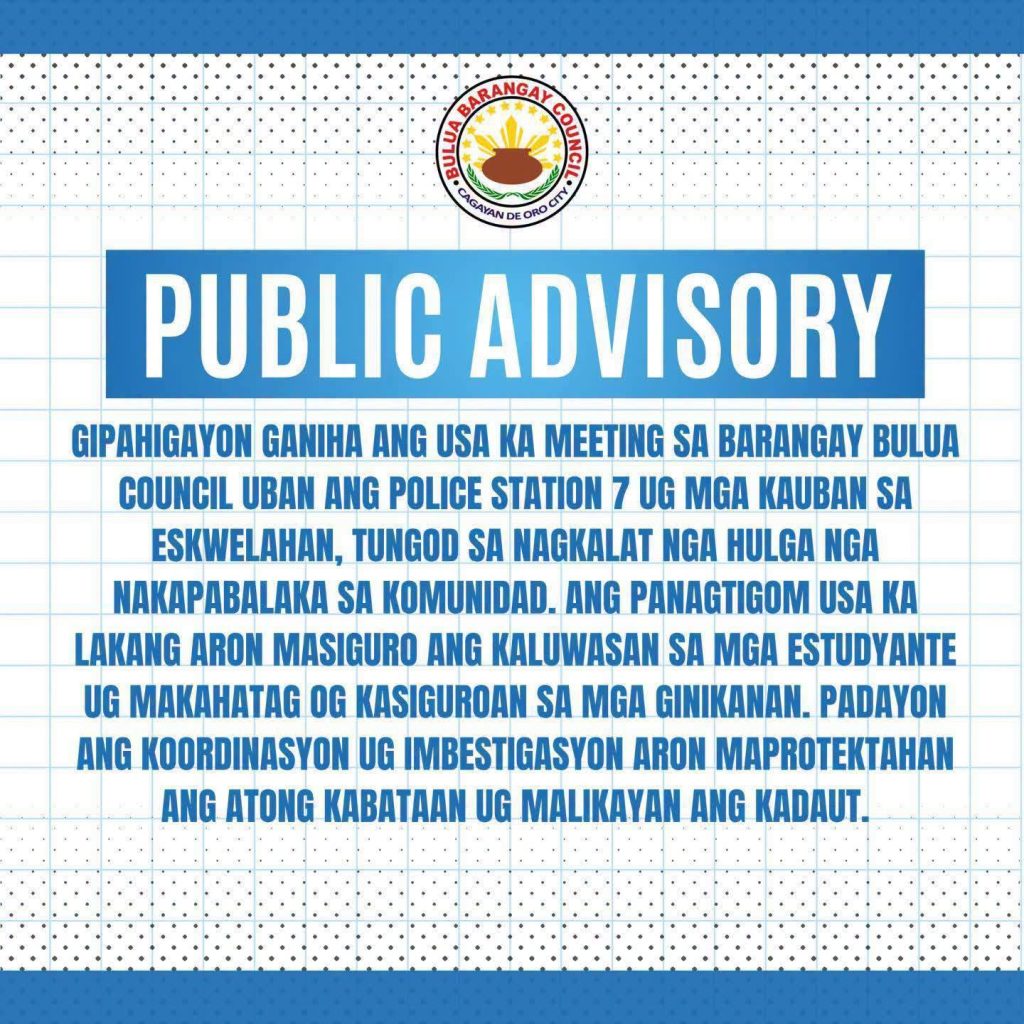
Following the circulation of the posts, Barangay Bulua, Police Station 7, and school officials immediately convened an emergency meeting to discuss security measures aimed at protecting learners and maintaining peace within school campuses.
Police visibility has since been increased around Bulua National High School and other educational institutions, while regular patrols have been intensified in surrounding areas.
Barangay officials earlier issued a public advisory assuring residents that an investigation was underway to determine the source of the threats and prevent any potential danger.
Meanwhile, authorities confirmed that the minor is also being investigated at the Women and Children Protection Desk after reports surfaced that he later claimed the threatening remarks were merely “a joke.”
Mayor Orders Full Investigation
In response to the incident, Cagayan de Oro City Mayor Rolando “Klarex” Uy instructed COCPO City Director Police Colonel Dexter G. Paje to prioritize the investigation and ensure the safety of every school in the city.
PCOL Paje immediately directed Police Station 7 to lead the verification and investigation of the reported threats while coordinating with the Department of Education (DepEd) – Division of Cagayan de Oro, the Women and Children Protection Desk, and the PNP Regional Anti-Cybercrime Unit to identify the origin of the online posts and determine possible violations of the law.
The City Government continues to coordinate closely with COCPO and receive regular updates regarding the progress of the investigation.
“Threats Are Never a Joke”
PCOL Paje emphasized that statements threatening schools should never be dismissed as harmless.
“Let this serve as an unequivocal reminder: statements, posts, or messages that threaten the safety, security, and peace of mind of our schools, students, and communities are never a joke.”
He warned that individuals who create fear or disrupt public order through social media may face legal consequences, regardless of claims that the posts were intended only for fun.
The police chief likewise urged parents and guardians to closely monitor their children’s online activities and teach them accountability in the use of social media.
Authorities also appealed to the public to remain calm, avoid spreading unverified information, and immediately report any credible threats to the nearest police station or through official COCPO communication channels.
Police visibility, intelligence monitoring, and security operations have been heightened across schools throughout Cagayan de Oro as a precautionary measure.
Analysis: A Troubling Question After Tacloban
While authorities have not established any connection between the Cagayan de Oro incident and the recent school-related tragedy in Tacloban City, the case inevitably raises a difficult but important question: Could this be another example of a copycat incident fueled by the rapid spread of viral content on social media?
At this stage, there is no evidence that the teenager’s actions were inspired by what happened in Tacloban, and drawing such a conclusion would be premature. However, the timing naturally invites scrutiny.
Criminologists and behavioral experts have long recognized the phenomenon known as the copycat effect, where highly publicized crimes or violent incidents receive extensive media and online attention, potentially influencing vulnerable or impressionable individuals to imitate similar behavior—not always with the intent to carry it out, but sometimes to gain attention, provoke fear, or achieve online notoriety.
Whether the Cagayan de Oro incident falls into that category remains for investigators to determine. Nevertheless, it highlights a growing challenge facing schools, parents, and law enforcement: the ease with which frightening messages can spread across social media and disrupt entire communities within minutes.
Regardless of motive, the incident serves as a stark reminder that threats against schools—even when later dismissed as “just a joke”—are never harmless. They create genuine fear among students and parents, disrupt education, strain law enforcement resources, and can result in serious legal consequences.
As investigations continue, one thing is clear: safeguarding schools today requires not only physical security but also vigilance against the misuse of digital platforms, where a single viral post can have real-world consequences far beyond the screen.