
SAN FERNANDO, Bukidnon — Deep within the ancient rainforests of Mindanao, where the critically endangered Philippine Eagle still rules the canopy, scientists and Indigenous forest stewards have uncovered a botanical marvel long hidden beneath the forest floor: a new sub-population of Rafflesia schadenbergiana, one of the largest and rarest flowers on Earth.
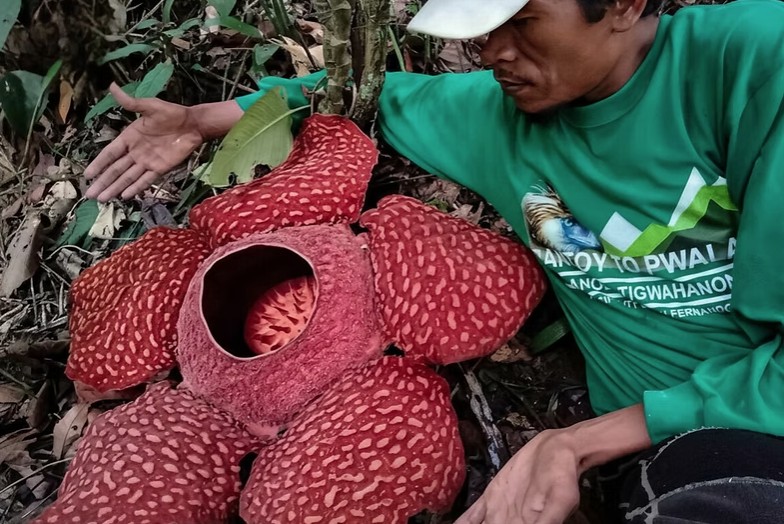
The discovery, announced by the Philippine Eagle Foundation (PEF), was made in the Mt. Sinayawan Range, within the ancestral domain of the Manobo Tigwahanon community in Barangay Kibongcog. It expands the known range of the critically endangered species and reinforces Bukidnon’s status as a global biodiversity stronghold.
Among the Tigwahanon people, the flower is known as “Kuron to Busaw”—the Flower of the Mischievous Spirits—an apt name for a plant that appears suddenly and mysteriously from the forest floor.
A Giant That Lives in Secrecy
For most of its life, Rafflesia schadenbergiana remains invisible. It exists as a parasite inside a host vine called Tetrastigma, with no leaves, roots, or stems of its own. Only when conditions are right does it emerge—bursting into a massive bloom that can reach nearly one meter in diameter, roughly the size of a car tire or small table.
Its thick, reddish petals, speckled with pale spots, spread across the forest floor like a giant starfish. But the spectacle is fleeting. Within just a few days, the bloom collapses and decays, returning to the forest that sustains it.
This newly documented cluster in Mt. Sinayawan represents a distinct sub-population, separate from previously recorded occurrences in Bukidnon, including those cited in a 2024 scientific study in the Philippine Journal of Science.
Science Meets Indigenous Knowledge
The discovery was made possible through close collaboration between scientists and the Manobo Tigwahanon, who serve not only as ancestral domain holders but also as co-researchers and forest guardians.
Botanist Pieter Pelser stressed the urgency of protecting the species, noting that Rafflesia schadenbergiana is among the country’s rarest plants and is critically endangered due to rapid rainforest loss.
Fellow botanist Julie Barcelona described the find as a reminder of how much biodiversity remains hidden in the Philippines’ forests—surviving only where ecosystems remain intact.
According to Andrei Von Tirona, senior author of the 2024 Bukidnon study, the discovery underscores the importance of partnerships between science and Indigenous communities in uncovering and protecting rare species.
For the Tigwahanon, however, the significance goes beyond science.
Community leader Lovermin Villasis explained that the Kuron to Busaw is a sacred gift of the forest—revealed only when the land is cared for.
A Biodiversity Stronghold Under Indigenous Care
The Tigwahanon ancestral domain is not only home to this rare flower but also to a remarkable array of wildlife. Scientists have documented at least 65 forest animal species in the area, 44 of which are endemic to the Philippines.
The same forests have also recently yielded sightings of two newly recorded pairs of the Philippine Eagle, further elevating the ecological importance of the Mt. Sinayawan Range.
Recognizing this, the Barangay Local Government Unit of Kibongcog has declared the site a local conservation area. The community is also working toward managing the land as an Indigenous and Community Conserved Area (ICCA), strengthening Indigenous leadership in conservation.
San Fernando Mayor Rogelio Yeke welcomed the discovery, calling it a testament to the municipality’s extraordinary natural heritage and the stewardship of the Tigwahanon people.
A Shared Responsibility
For the Philippine Eagle Foundation, the discovery carries a deeper message.
Executive Director Dennis Salvador described it as an honor to bring the Kuron to Busaw into scientific knowledge alongside Indigenous partners.
He emphasized that these forests can be understood in many ways: as sacred landscapes alive with spirit, and as living laboratories where evolution continues to shape rare and extraordinary life.
The emergence of Rafflesia schadenbergiana in Mt. Sinayawan ultimately points to a powerful truth—some of the world’s rarest species endure not in protected parks alone, but in ancestral lands where Indigenous communities continue to defend and nurture the forest.
As scientists and Indigenous stewards walk together, the hidden wonders of the Philippines’ forests are not only revealed—they are given a fighting chance to survive.