
Public criticism has mounted online after comments made by columnist and broadcaster Ramon Tulfo linked suspects in the killing of an airport official to Muslims from Lanao del Sur, prompting concerns about harmful generalizations and renewed calls for responsible reporting.
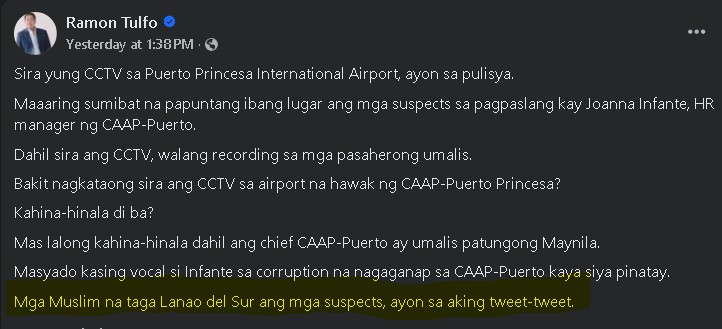
The controversy began after Tulfo posted on social media about the killing of Joanna Infante, human resources manager of the Civil Aviation Authority of the Philippines (CAAP) in Puerto Princesa. In his post, Tulfo cited police information that closed-circuit television (CCTV) cameras at Puerto Princesa International Airport were reportedly not functioning at the time of the incident, leaving no available recordings of departing passengers.
He questioned the circumstances surrounding the malfunctioning cameras and suggested the suspects may have already fled to another location. Tulfo also speculated about possible motives tied to alleged corruption issues raised by Infante prior to her death. However, the post drew the strongest reaction after he claimed on social media that the suspects were “Muslims from Lanao del Sur,” a statement critics say was made without confirmation from authorities.
Netizens raise concerns over sweeping generalizations
Following the post, many netizens expressed support for a thorough investigation into the killing but strongly objected to linking the alleged suspects to a religious community without verified information.
One commenter said public personalities should avoid generalizations that could stigmatize millions of peace-loving Filipino Muslims. The netizen stressed that law enforcement agencies are the only institutions authorized to release official findings after due process and investigation, adding that speculation tied to religion or ethnicity could harm social cohesion and distract from the pursuit of justice.
The same commenter also noted that the remarks came during the Islamic holy month of Ramadan, emphasizing that Muslims regard it as a time of reflection and discipline in speech. While choosing to respond with restraint, the commenter said an apology to the Muslim community could help demonstrate integrity and respect if harm had been caused.
Another netizen issued a similar appeal, stating that crime is committed by individuals—not by a religion, ethnicity, or community. The commenter emphasized that Islam teaches justice, compassion, and respect for life, and called on Tulfo to exercise greater care in language that may inadvertently reinforce prejudice.
Lawyer highlights impact on Muslim communities
Lawyer Asgar Mandal also weighed in on the issue, explaining that statements singling out “Muslims from Lanao del Sur” can cause harm far beyond the alleged suspects.
According to Mandal, such remarks can affect ordinary families, students, and professionals from Muslim communities who may face suspicion or stereotyping because of their identity. He stressed that religion and ethnicity are not evidence and should not be treated as indicators of guilt.
“Responsible journalism is not only about facts—it is also about humanity,” Mandal said, emphasizing that precision in language is an ethical responsibility in public discourse.
Calls for evidence-based reporting
The incident has reignited discussion on ethical reporting and the responsibilities of influential public figures when discussing sensitive criminal cases. Media advocates and online commentators reiterated that investigations should focus on verified facts, credible evidence, and the accountability of individuals directly involved.
Many also warned that associating crime with religious or regional identity can deepen divisions and revive long-standing stereotypes faced by Muslim communities in Mindanao, particularly those from Lanao del Sur and nearby areas.
As of this writing, authorities have yet to release official confirmation regarding the identities or backgrounds of the suspects in the killing of Infante. Netizens continue to call for a transparent investigation and careful communication from both officials and media personalities while the case is being pursued.