
MAGPET, COTABATO — The forests of Magpet have delivered both a message of hope and a warning. A young Philippine Eagle, one of the country’s most iconic and critically endangered species, is alive after surviving what appears to have been a shooting, but the circumstances surrounding her rescue once again expose the continuing danger faced by the country’s national bird.
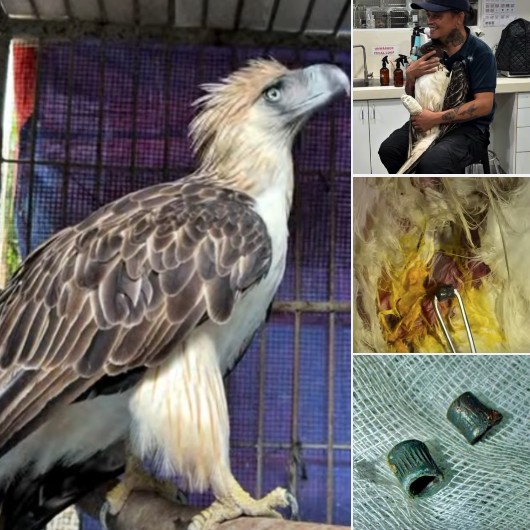
The approximately five-year-old presumed female eagle was rescued in Barangay Manobo, Magpet, on September 27, 2026, after she was found weak. She was subsequently turned over to the Department of Environment and Natural Resources–Community Environment and Natural Resources Office and later endorsed to the Philippine Eagle Foundation (PEF) for veterinary assessment, treatment and rehabilitation.
At first, there appeared to be no obvious major injury. But a veterinary examination and X-ray revealed a far more troubling story. Three airgun pellets were lodged inside the eagle’s body—one near her right wing, another near her right leg and a third near the base of her tail. Two of the pellets were close enough to the surface to be removed under local anesthesia. The third was left in place after veterinarians determined that removing it could pose additional risk to the bird. No fresh entry wound was found during the initial examination, suggesting that the eagle may have been carrying the pellets for some time.
The eagle was later named “Magpet,” after the municipality where she was rescued. Despite what she had endured, she remained bright, alert and responsive during her initial examination. Her survival is encouraging, but the discovery of three pellets inside her body is a painful reminder that survival is not the same as safety.
Magpet cannot tell her rescuers who shot her, when it happened or why. What is known is that she survived being hunted and shot. For a Philippine Eagle, however, even a single gunshot can result in broken bones, infection, loss of flight or death. In Magpet’s case, the evidence suggests that she had been carrying not one but three projectiles inside her body.
The case is particularly disturbing because it is not the first time a Philippine Eagle from the Magpet landscape has fallen victim to gunfire. In 2013, a juvenile Philippine Eagle rescued in nearby Barangay Amabel, Magpet, later died from a .22-caliber gunshot wound. More than a decade later, another young eagle from the same wider landscape has been found with projectiles lodged inside her body. The cases are separated by years, but they carry the same warning: Philippine Eagles are still being shot.
Philippine Eagle Foundation Executive Director Dennis I. Salvador said the problem has happened too many times, noting that Philippine Eagles continue to be shot with air guns and improvised firearms. He warned that the species could face a population collapse if human-caused deaths continue and stressed that protecting the country’s national bird requires a whole-of-nation effort involving government, communities, Indigenous Peoples, law enforcement, the private sector and every Filipino.
The danger becomes even more complicated because Philippine Eagles do not recognize property boundaries. They move across forests, farms, communities and open areas in search of food, mates and safe places to live. Their movements can sometimes bring them into conflict with people, particularly when they prey on domestic animals such as pigs. But such encounters should never end with a gunshot. One pull of a trigger can kill a bird that took years to grow and survive in the wild.
The place where Magpet was rescued also gives the incident a much deeper conservation significance. The area is part of an old Philippine Eagle nesting territory, with records dating back as early as 1983. The last confirmed nesting record in the area was in 1990, when an eaglet was verified at the nest. For many years afterward, there were no confirmed nesting records, although local residents continued to report occasional sightings of lone eagles flying over the area and encounters involving eagles taking domestic pigs.
The rescue of Magpet now confirms that Philippine Eagles are still using this landscape. The rescue area lies within the greater Mt. Apo Key Biodiversity Area, which covers around 100,000 hectares of forest and includes 10 ancient Philippine Eagle nest sites, according to the PEF. These landscapes carry a long history of Philippine Eagle presence, and even when an old nest is no longer active, the surrounding forest can remain important for hunting, movement and future breeding.
That is why the Magpet rescue tells two stories at the same time. The first is hopeful: Philippine Eagles are still present in a landscape where they have lived for generations. The second is harder to accept: they are still being shot. The incident demonstrates that saving the Philippine Eagle means more than protecting trees. A forest can remain standing, but an eagle can still be lost in seconds if someone decides to pull a trigger.
This is why communities living near eagle territories are among the most important partners in conservation. If a Philippine Eagle is seen near farms, livestock or homes, the appropriate response is to report the sighting to local authorities, the Department of Environment and Natural Resources or the Philippine Eagle Foundation. The answer should be intervention, reporting and protection—not a gun.
The incident has also raised questions about how wildlife rescues are handled. Doc Bayani, who performed the procedure on Magpet, raised concerns about the practice of giving rewards to supposed rescuers, saying such incentives can create an opportunity for people to capture and turn over more eagles. He also called for greater awareness, protection and accountability, emphasizing that conserving this critically endangered species is everyone’s responsibility.
That observation is important because conservation cannot simply begin after an animal has already been injured. Saving wildlife must also involve understanding what happened in the field, ensuring that rescue circumstances are properly documented, strengthening accountability and preventing similar incidents from happening again.
For now, Magpet remains under close veterinary care. The areas where the pellets were removed are being monitored for swelling, infection and other complications. Once she is cleared, she is expected to be transferred to the Philippine Eagle Center to continue her rehabilitation.
The Philippine Eagle is found only in the Philippines, inhabiting forests in Luzon, Samar, Leyte and Mindanao. It is classified as critically endangered, with the Philippine Eagle Foundation estimating that around 400 pairs remain in the wild. A 2023 study cited in the supplied material estimated a potential breeding population of 392 territorial pairs, or about 784 mature individuals, based on modeled suitable habitat and the species’ average home-range requirements.
In a country where the remaining population is already so limited, every adult eagle matters. Every breeding pair matters. Every territory matters. And every death caused by human action carries consequences that extend far beyond a single bird.
Magpet’s story is therefore more than a rescue story. It is a story about a species that continues to survive despite enormous pressure, and about a landscape that continues to provide refuge for one of the world’s rarest eagles. But it is also a warning that the presence of forests alone cannot guarantee the survival of wildlife if those forests remain unsafe.
After more than four decades of records from this landscape, the forests of Magpet are telling us something important: the eagles are still here. But so is the danger.
Three airgun pellets inside the body of one young Philippine Eagle should concern not only conservationists but every community living near the country’s remaining forests. The question is no longer simply whether Philippine Eagles can survive in the wild. The more urgent question is whether people will allow them to survive.
Magpet has been given a chance to recover. Her story will continue as veterinarians and keepers monitor her condition and work toward her rehabilitation. But the larger responsibility belongs to all of us. The greatest victory would not be rescuing another eagle after it has been shot. It would be creating communities where the next Philippine Eagle can fly through the forest without becoming a target.
The eagles are still here.
The danger is still here, too.
And Magpet’s three pellets are a warning that the next eagle may not be as fortunate.