
KUALA LUMPUR, Malaysia — The Government of the Philippines (GPH) and the Moro Islamic Liberation Front (MILF) have agreed on a new roadmap aimed at completing the remaining commitments under the 2014 Comprehensive Agreement on the Bangsamoro (CAB), reinforcing the peace process following the conclusion of the first Bangsamoro Parliamentary Elections.
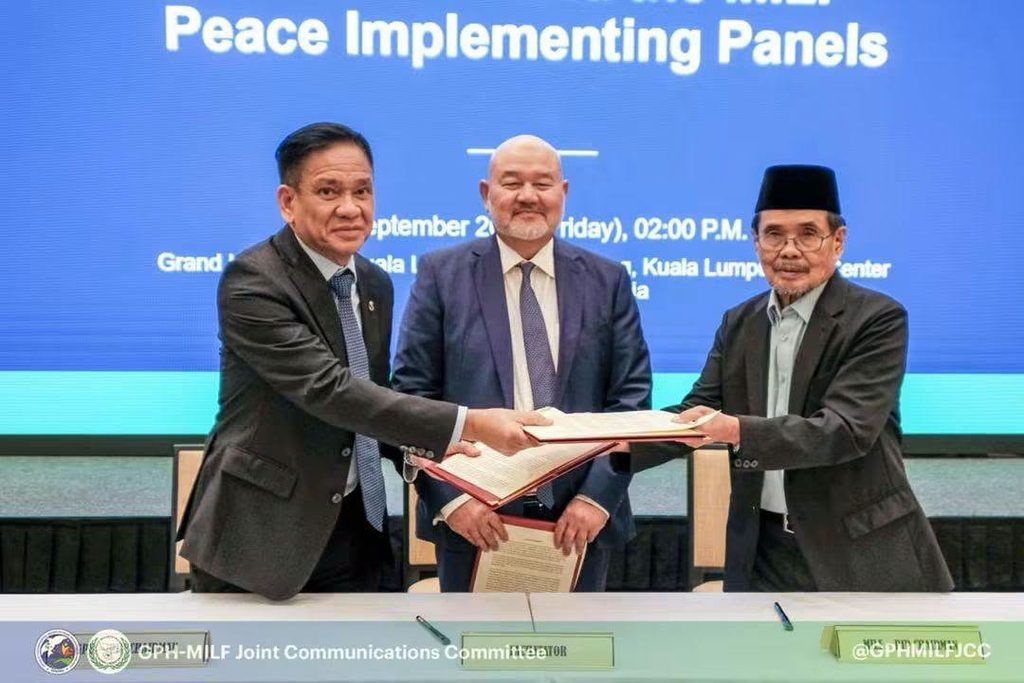
The agreement was reached during a special meeting of the GPH and MILF Peace Implementing Panels held in Kuala Lumpur on September 25, 2026.
The meeting focused on concrete measures to advance the remaining political, security, normalization, transitional justice and socioeconomic commitments under the peace agreement.
The GPH Peace Implementing Panel was led by Secretary Mel Senen S. Sarmiento, while the MILF Peace Implementing Panel was headed by 1st Vice Chairman Mohagher M. Iqbal.
Roadmap for Remaining CAB Commitments
A major outcome of the meeting was the approval of the Terms of Reference (TOR) of the Technical Working Group (TWG) that will develop a roadmap for the implementation of the remaining commitments under the CAB.
The roadmap is intended to provide a structured mechanism for identifying, sequencing and advancing the commitments that remain to be fulfilled under the 2014 peace agreement.
The agreement comes at an important point in the Bangsamoro transition, following the completion of the first Bangsamoro Parliamentary Elections. With the political track reaching another major milestone, the GPH and MILF are now placing renewed attention on the commitments connected to normalization, security, socioeconomic transformation and reconciliation.
The parties said the Kuala Lumpur meeting builds on their renewed commitment to the implementation of the CAB and to completing its remaining deliverables.
Security and Weapons Management
Security and normalization were among the central issues discussed by the panels.
The GPH and MILF agreed in principle to the proposed GPH-MILF Framework for the Small Arms and Light Weapons Management (SALW-M) Program.
The Technical Working Group on the Reduction and Management of SALW was directed to finalize the framework, taking into consideration issues involving the disbandment of private armed groups (PAGs) and the decommissioning of MILF combatants, among other concerns.
Once finalized, the framework will be submitted to the Joint Normalization Committee (JNC) for endorsement before being forwarded to the Peace Implementing Panels for approval.
The two sides also agreed that discussions on the proposed revitalization of the International Monitoring Team (IMT) and recommendations concerning Putting Weapons Beyond Use (PWBU) will continue.
The measures form part of the broader normalization process, which seeks to reduce the presence and threat of armed groups and weapons while supporting former combatants in their transition to civilian life.
AHJAG and Civilian Protection Mandates Extended
The Peace Implementing Panels also extended the mandates of two important mechanisms under the peace process.
The mandate of the Ad Hoc Joint Action Group (AHJAG) was extended until September 25, 2027.
Meanwhile, the mandate of the Civilian Protection Component (CPC) was extended until September 25, 2028.
The continued operation of these mechanisms is intended to support security and civilian protection as the parties work through the remaining commitments of the peace agreement.
The extensions also ensure that established peace-process mechanisms remain operational during the next phase of the Bangsamoro transition.
Transitional Justice Moves Forward
Transitional justice and reconciliation also figured prominently in the Kuala Lumpur discussions.
The Peace Implementing Panels adopted and approved Resolution No. 3, Series of 2026, of the Technical Working Group on Transitional Justice and Reconciliation (TWG-TJR).
The resolution covers proposed enhancements to bills filed in the 20th Congress seeking the creation of a National Transitional Justice and Reconciliation Commission for the Bangsamoro (NTJRCB).
The panels directed the TWG-TJR to immediately conduct a writeshop to further refine the proposed legislation.
The technical working group was also instructed to invite representatives of the Philippine Congress–Bangsamoro Parliament Forum (PCBPF) and other relevant stakeholders to participate in the process.
The proposed commission is envisioned as a mechanism for addressing the legacy of conflict, supporting reconciliation and advancing transitional justice in the Bangsamoro.
Socioeconomic Program for Decommissioned Combatants
Another significant agreement involved socioeconomic assistance for decommissioned combatants and communities associated with six previously acknowledged MILF camps.
The GPH and MILF panels signed an Addendum to the Decision Points on the Socioeconomic Development Program for the Decommissioned Combatants and the Six Previously Acknowledged Camps of the MILF.
Under the agreement, the parties adopted an integrated, beneficiary-centered mode of delivery aimed at accelerating the implementation of agreed socioeconomic interventions.
The program is intended to benefit decommissioned combatants as well as other qualified beneficiaries.
Socioeconomic assistance is a major component of normalization because the transition from armed struggle to civilian life requires sustainable livelihood opportunities and access to development programs.
For the peace process, the success of decommissioning is closely linked to whether former combatants and their communities can establish stable and productive civilian lives.
Malaysia Continues to Facilitate the Peace Process
The Kuala Lumpur meeting also reaffirmed Malaysia’s continuing role in facilitating the GPH-MILF peace process.
The two parties expressed their appreciation to the Malaysian government led by Prime Minister Dato’ Seri Anwar Ibrahim and to General Tan Sri Dato’ Seri Panglima Ts. Hj. Zulkifli bin Hj. Zainal Abidin (Ret.), who attended as Third Party Facilitator and/or Special Adviser.
The parties also recognized the contributions of the International Contact Group, composed of the governments of Japan, Saudi Arabia, Türkiye and the United Kingdom, as well as international nongovernment organizations that have supported the peace process.
The Third Party Monitoring Team was likewise recognized for its role in monitoring and assessing implementation of agreements reached by the parties.
Peace Process Enters Another Critical Phase
The September 25 meeting comes after the completion of the first Bangsamoro Parliamentary Elections, giving the latest GPH-MILF agreement added significance.
The parliamentary elections represented a major development in the political transition envisioned under the CAB. However, the Kuala Lumpur discussions underscored that the peace process extends beyond the establishment of political institutions.
Major commitments involving decommissioning, weapons management, private armed groups, civilian protection, socioeconomic development and transitional justice remain part of the broader implementation agenda.
The new roadmap is therefore expected to serve as a framework for moving these commitments forward in a more coordinated manner.
The parties said they remain committed to completing the deliverables of the CAB and ensuring that its implementation produces meaningful and inclusive benefits for the people of the Bangsamoro.
In their joint statement, the GPH and MILF expressed appreciation to national government agencies, the Bangsamoro Transition Authority, international partners, peace-process mechanisms and Mindanao peace advocates for their continued participation.
Both sides also reaffirmed their shared responsibility to pursue a just and lasting peace and to work toward the meaningful and inclusive fulfillment of the peace agreement for the benefit of communities across the Bangsamoro.