
TUBAJON, Dinagat Islands — For residents of Tubajon, the controversy surrounding a proposed large-scale nickel mining operation has become more than a debate over investment, employment and economic development. It has become a fight over water, farms, fishing grounds and the future of the communities that depend on them.
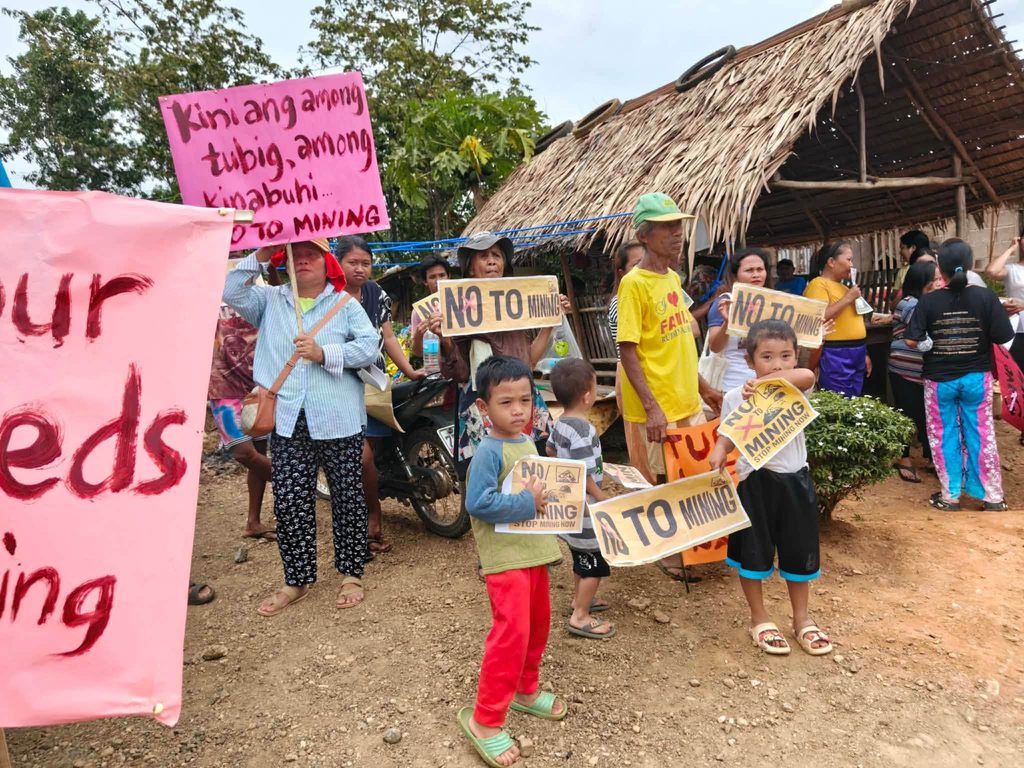
“Ang kinaiyahan mao ang atong kinabuhi ug kaugmaon”—nature is our life and our future—is the message being carried by residents opposing the proposed Tubajon Nickel Mining Project of Core Mining Corporation (CMC), a project that covers five barangays: Diaz, Imelda, Mabini, Navarro and Sta. Cruz.
The proposed mining operation, according to a Department of Environment and Natural Resources-Environmental Management Bureau (DENR-EMB) Notice of Public Hearing, covers approximately 2,187.5378 hectares and is designed for the extraction of metallic minerals with a proposed capacity of 6 million metric tons per year. The project consists of three major mining areas covering 788 hectares, 637 hectares and 762 hectares, respectively, alongside a 20-hectare stockyard, 16 hectares of stockpile areas and a 0.58-hectare causeway area.
CMC’s stated rationale, as reflected in the DENR notice, is that the mining industry can contribute to employment, infrastructure development, industrialization, rural development and economic activity at the local and national levels. The company says communities are expected to benefit from mining-related programs and activities throughout the life of the mine.
But for residents of Tubajon, the promises of economic benefits have not erased their concerns about what they say could happen to the natural resources upon which their communities already depend.
The immediate controversy intensified in Navarro when residents gathered outside the barangay hall over a planned meeting involving barangay officials and representatives of Core Mining Corporation. Residents said five barangay captains had been called to attend the meeting, with provincial officials, including Governor Demery and several members of the Sangguniang Panlalawigan, also expected to participate.
According to the residents, the meeting was intended to discuss the company’s Impact Management Plan (IMP) for the proposed mining operation involving the watershed areas of Navarro and Imelda. They said a barangay resolution was being sought to endorse the IMP, which they understood to be part of the requirements connected with the company’s application for an Environmental Compliance Certificate (ECC).
The residents’ concern was not simply that a meeting was being held. Their concern was that they had not been given sufficient opportunity to examine the contents of the plan before any endorsement could be considered.
For the people of Navarro, the question was straightforward: How can a community properly evaluate or support an environmental management plan if it has not been given access to the document and the technical information behind it?
The meeting did not push through that day, according to the residents, but the gathering outside the barangay hall sent a clear message that the community intends to closely monitor the mining process and demand answers from both the company and government officials.
Among the residents’ biggest concerns is the protection of the Navarro and Imelda watersheds.
They say Navarro has already experienced serious water problems, particularly during periods associated with El Niño. Residents claimed that the barangay had gone for approximately three months without adequate water, while heavy rains have historically brought flooding.
For a community facing both water scarcity during dry periods and flooding during intense rainfall, the prospect of altering portions of the watershed raises fears about what could happen to an already vulnerable water system.
“If the mining proceeds, what will happen to the remaining watershed?” residents ask. “Where will the barangay get its water?”
The concern becomes even more significant in light of the project’s own environmental documentation. The DENR notice states that CMC proposes to establish its own water system by tapping one of the tributaries of the Buajahan River or available springs.
For residents, the proposed use of local water sources makes transparency over the project’s water requirements particularly important. They want to know which tributaries or springs would be tapped, how much water would be withdrawn, what safeguards would be established and how the system would function during prolonged dry periods.
The residents also fear that the consequences of mining could extend beyond the mountains and into the sea.
Their concern centers on sedimentation and runoff. They fear that the disturbance of land associated with mining could result in increased sediment entering waterways and eventually affecting coastal areas where fishing communities earn their livelihoods.
The residents argue that the environmental implications of the project cannot be assessed solely by looking at the boundaries of the mining areas. The watershed, rivers, farms and coastal waters form an interconnected system, they say, and any major disturbance in the uplands must be assessed for its potential downstream consequences.
For fishing families in and around the affected communities, the issue is particularly serious. The sea is not simply an environmental resource; it is a source of food and income. Residents fear that damage to marine ecosystems could eventually translate into reduced catches and greater economic hardship for households already dependent on fishing.
Farmers face similar uncertainty.
Residents say agricultural lands are located near areas identified for mining and worry that changes in drainage, soil stability and water availability could affect farms. For agricultural households, water is fundamental to production, and any long-term disruption to local water systems could have consequences far beyond the mine’s immediate footprint.
The controversy has also revived questions about the exact boundaries of the proposed mining areas and their relationship with the watershed.
One resident, recounting an earlier public hearing believed to have been held in Mabini in 2023, claimed that the community had previously questioned the company’s project map because of the extensive area apparently covered by the proposal. The resident said the community had raised concerns about whether the watershed would be included in the mining footprint.
The account further claimed that the company had assured residents that the watershed would not be included, even as residents questioned the extent of the area shown on the map.
Those claims require verification against the official technical maps and project documents. But the controversy illustrates why residents are demanding access to the project’s complete environmental documentation, particularly maps showing precisely where mining activities, infrastructure and protected or excluded areas would be located.
The DENR-EMB has already subjected the project to the formal environmental impact assessment process.
In a Notice of Public Hearing, the EMB announced a public hearing for the Environmental Impact Statement (EIS) of the proposed Tubajon Nickel Mining Project on February 11, 2025, at the Mabini Gymnasium in Barangay Mabini, Tubajon.
The notice said the hearing was being conducted as part of the EMB’s review of the project’s EIS and invited interested parties to submit their opinions and position papers regarding the proposed project.
The notice also identified the project’s major components and environmental-management measures. These include settling ponds, perimeter canals, stockpile areas for topsoil and subsoil, a nursery, materials recovery facility, hazardous-waste storage facility, oil-water separators, septic tanks and buffer zones.
According to the DENR document, copies of the project’s EIS and Executive Summary for the Public were made available through the EMB Region XIII office, the Tubajon Municipal Hall and the barangay halls of Diaz, Imelda, Mabini, Navarro and Sta. Cruz.
The existence of those environmental safeguards, however, has not eliminated the community’s concerns.
For residents, the central issue is whether the proposed safeguards will be sufficient to protect the area’s watersheds, agricultural lands, rivers and coastal ecosystems and whether those safeguards can be effectively monitored and enforced throughout the life of the project.
The controversy reflects a familiar tension surrounding large-scale mining in the Philippines: the promise of economic development on one side and the fear of environmental and livelihood losses on the other.
CMC maintains that the project is expected to generate economic benefits and support communities through employment, infrastructure and mining-related programs. Residents, meanwhile, are asking whether those benefits can justify the risks they believe the project could pose to water sources, farms and fishing grounds.
For communities that depend directly on natural resources, the issue is not simply whether mining can produce economic activity. It is whether development can proceed without undermining the ecological foundations of the local economy.
A job created by mining, residents argue, cannot simply replace a watershed if that watershed is permanently degraded. Economic assistance cannot automatically compensate a farming family for the loss of productive agricultural land. And promises of rehabilitation cannot eliminate the importance of preventing environmental damage in the first place.
That is why residents are calling for a more thorough and transparent examination of the Impact Management Plan and all supporting documents.
They want public consultations involving all affected barangays. They want copies of the IMP and related technical documents made available to local governments and communities. And they want the remaining watershed areas of Navarro and Imelda protected.
Their demands are rooted in the belief that affected communities should have access to the information necessary to understand a project that could potentially alter the landscape around them.
The residents’ opposition has been expressed in blunt terms: “Dili kami motugot.”
“We will not allow it.”
They say they are prepared to continue monitoring the process, attending consultations and questioning government and company officials about the project’s potential effects.
Their concern is also deeply intergenerational.
“What will remain for our children and grandchildren?” residents ask.
The question cuts through the technical language of mining permits, environmental impact statements, management plans and certificates.
For people whose daily lives depend on water, farms and the sea, environmental protection is not an abstract policy issue. It is directly connected to whether families can grow food, secure drinking water and earn a living.
Tubajon’s mining debate therefore presents government regulators and local officials with a difficult responsibility: to determine whether the proposed project can meet environmental standards while genuinely protecting the communities and ecosystems within and around its footprint.
That determination cannot be based on assurances alone. It requires transparent technical information, meaningful public participation, careful assessment of cumulative environmental impacts and clear, enforceable safeguards.
For the residents gathered outside the Navarro Barangay Hall, the message was unmistakable.
They are not asking only what Core Mining Corporation intends to extract from Tubajon’s mountains.
They are asking what the community could lose in return.
They are asking where their water will come from if the watershed is compromised, what will happen to their farms if water systems change, what will happen to fishermen if sedimentation affects coastal resources, and what kind of environment will be inherited by their children and grandchildren.
Their warning is simple: “Ang kinaiyahan mao ang atong kinabuhi ug kaugmaon.”
Nature is their life.
And, they insist, it must remain their future.