
MALAYBALAY CITY, Bukidnon — Deep within the ancient forests surrounding the Mount Kitanglad Range Natural Park, a haunting chorus of distressed calls echoed through the trees. What initially appeared to be an ordinary commotion among wildlife would soon unfold into a dramatic rescue mission that has become both a symbol of hope and a stark reminder of the fragile future facing the Philippine Eagle—the country’s national bird and one of the world’s rarest birds of prey.
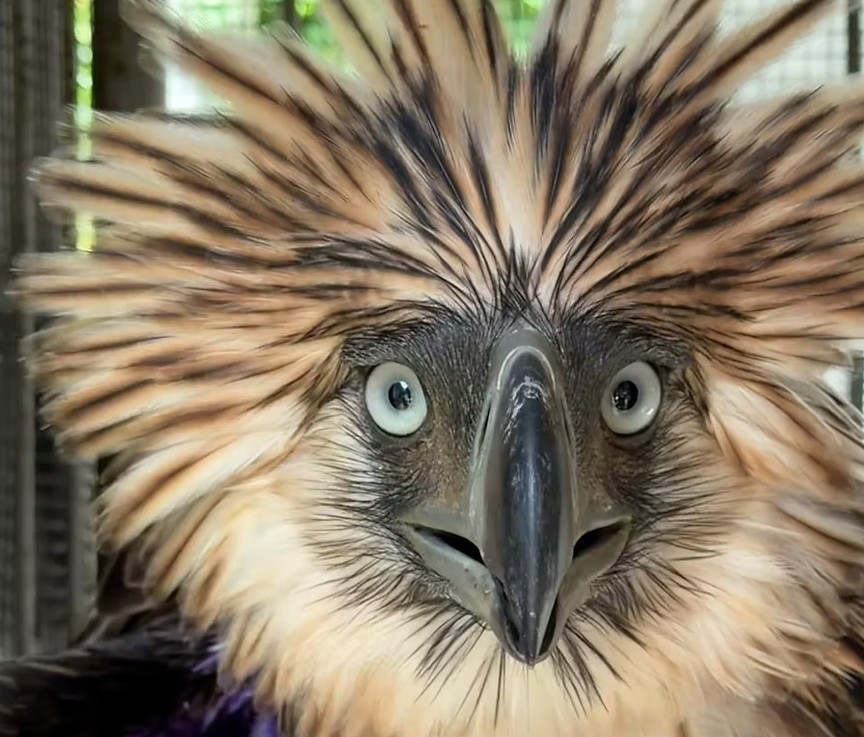
On July 3, 2026, an adult female Philippine Eagle, now named Sawaga-Dalwangan, was rescued after being discovered gravely injured near the Sawaga River in Barangay Dalwangan, Malaybalay City. Weak, dehydrated, unable to fly, and already being consumed by maggots, the majestic raptor was only hours—perhaps days—away from death.
Yet because ordinary people chose to act, one of fewer than 400 remaining breeding pairs in the wild was given another chance at life.
A Rescue That Began with an Unusual Sound
Lumad resident Marven Linoy was harvesting passion fruit when he heard unusual noises coming from the nearby forest.
Curious, he investigated and found more than 30 aggressive monkeys surrounding what he initially believed was a wild chicken. To drive the troop away, Linoy barked loudly like a dog, startling the monkeys and forcing them to scatter.
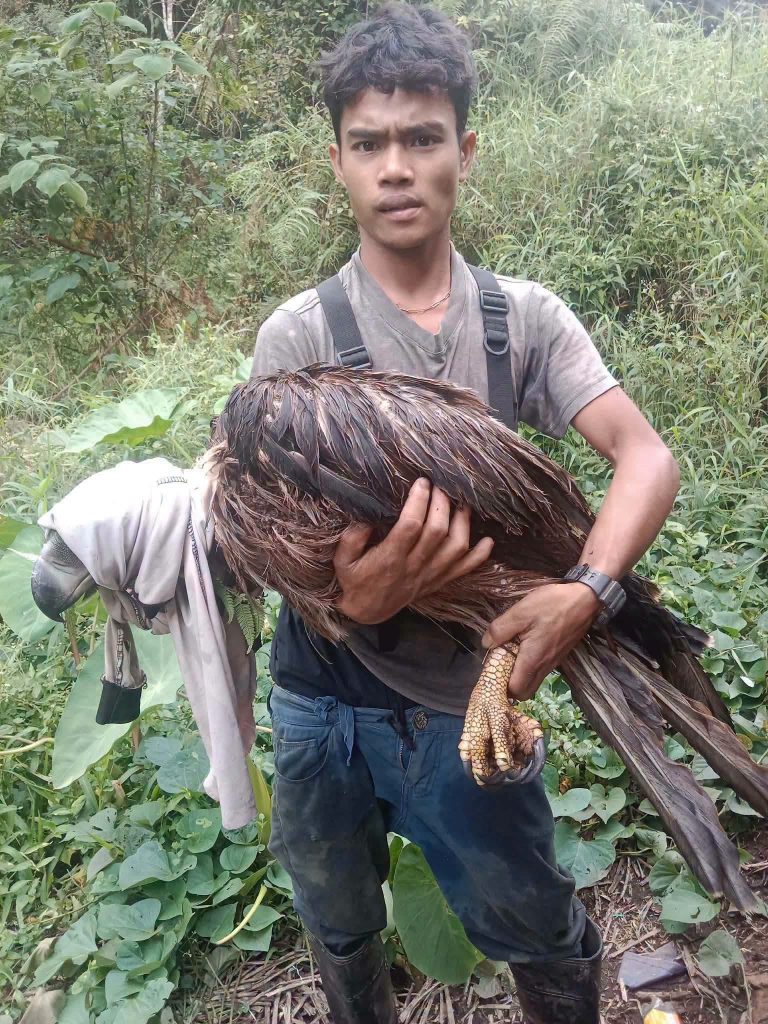
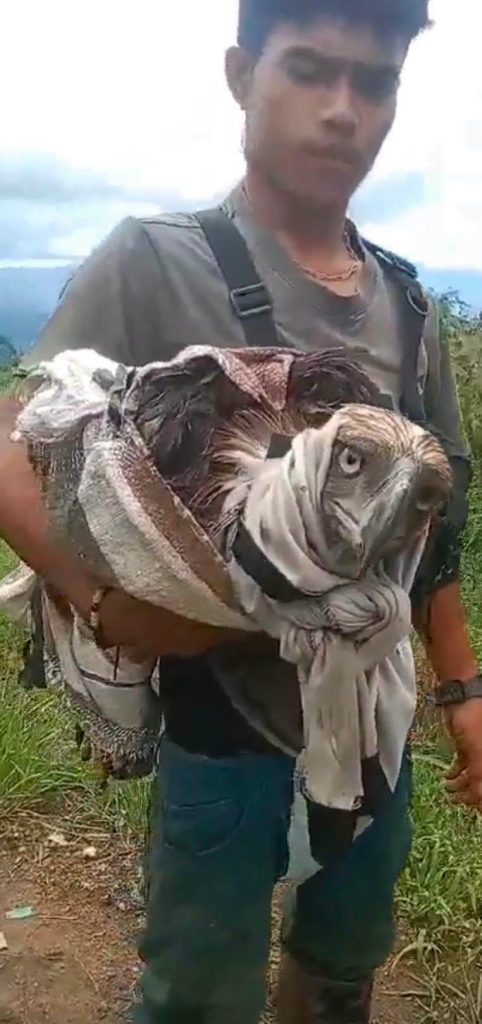
What emerged from beneath the mud shocked him.
Lying helpless on the forest floor was an exhausted Philippine Eagle—its once majestic plumage covered in mud, its body trembling, and its powerful wings too damaged to carry it back into the skies.
Recognizing the urgency of the situation, Linoy gently covered the eagle with his jacket while placing fern leaves over its eyes to calm the stressed bird as help was summoned.
Members of the Inhandig Tribal Multi-Purpose Cooperative (ITMPC), led by Junissa Valdueza Docenos, immediately coordinated with government authorities, ensuring the eagle was safely turned over to the Department of Environment and Natural Resources (DENR).
Their swift response would ultimately save one of the country’s most precious wildlife treasures.
A Race Against Time
Veterinarians who first examined Sawaga-Dalwangan immediately realized the severity of her condition.
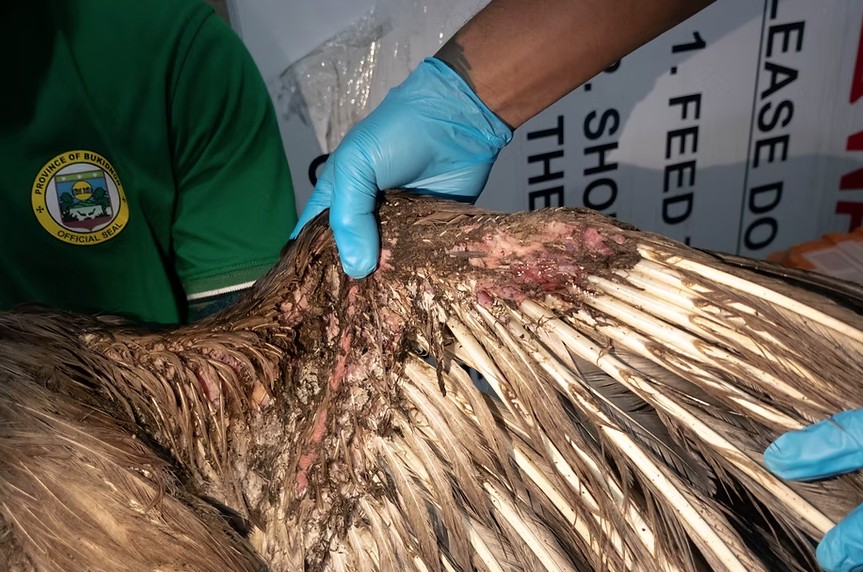
The eagle’s chest and belly feathers were heavily stained with mud, while her wings were badly damaged, indicating she had likely been stranded on the forest floor for several days.
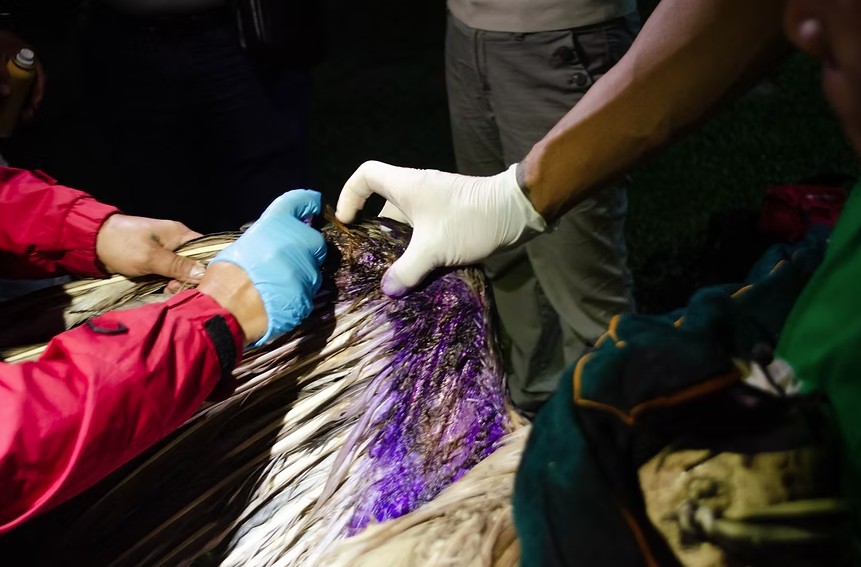
As the veterinary team carefully cleaned her wounds, they made a horrifying discovery.
Large numbers of maggots had already infested her injuries.
Larvae were found deep inside wounds on both wings, around the base of her tail feathers, surrounding the vent, and even inside the cloaca—clear signs that the injuries had remained untreated for an extended period.
The bird was suffering from severe dehydration, exhaustion, extensive tissue damage, and advanced infection.
According to Dr. Bayani Vandenbroeck, veterinarian of the Philippine Eagle Foundation (PEF), another 24 to 48 hours of delay would likely have been fatal.
Emergency treatment immediately began.
Veterinarians painstakingly removed maggots one by one, disinfected the wounds, administered pain medication, treated dehydration with fluids, and stabilized the eagle before transporting her to Davao City for specialized care.
A Disturbing Discovery
Further examinations at the Philippine Eagle Foundation and Doc Bayani’s Animal Wellness Hospital revealed an even more alarming finding.
Radiographic examinations uncovered two airgun pellets lodged inside Sawaga-Dalwangan’s body—one embedded in her right wing and another deep inside her left thigh.
Veterinarians successfully removed the pellet from her wing, but the second remains lodged deep within muscle tissue, where surgical removal currently poses greater risks than leaving it in place.
The discovery strongly suggests the eagle had been intentionally shot before ending up helpless on the forest floor.
While investigators continue to determine the exact circumstances surrounding her injuries, conservationists say the findings underscore an ongoing threat faced by Philippine Eagles across the country.
Every Eagle Matters
For the Philippine Eagle Foundation, the rescue represents much more than saving a single bird.
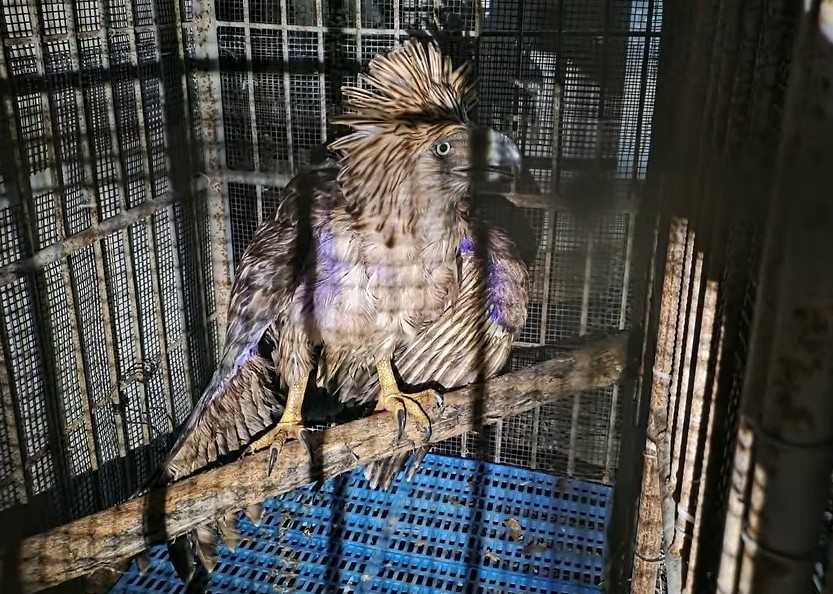
Today, experts estimate that fewer than 400 breeding pairs of Philippine Eagles remain in the wild.
Found only in the Philippines, the species is listed as Critically Endangered, making every surviving adult crucial to the survival of the entire population.
The forests of Barangay Dalwangan within the Mount Kitanglad Range Natural Park hold particular significance.
The area has been recognized as one of the Philippine Eagle’s oldest documented breeding territories, with nesting records dating back to 1986, making it among the longest continuously monitored nesting sites for the species anywhere in the country.
Losing even one breeding adult from this important habitat could have lasting consequences for future generations of Philippine Eagles.
Conservation Is a Community Effort
Sawaga-Dalwangan’s rescue demonstrates what can happen when communities, Indigenous Peoples, conservation organizations, and government agencies work together.
The successful operation involved the Department of Environment and Natural Resources (DENR), Philippine Eagle Foundation (PEF), City Environment and Natural Resources Office (City ENRO) of Malaybalay, Provincial Zoo, Kitanglad Guard Volunteers-Kibenton (KGV-Kibenton), Barangay Dalwangan officials, Lumad community members, veterinarians, wildlife biologists, volunteers, and local residents.
Without their coordinated response, Sawaga-Dalwangan would almost certainly have died unnoticed in the forest.
Her story highlights the indispensable role Indigenous communities continue to play in protecting the country’s remaining biodiversity.
A Crime Against Nature
The Philippine Eagle enjoys full protection under Republic Act No. 9147, or the Wildlife Resources Conservation and Protection Act.
Hunting, capturing, injuring, or killing a Philippine Eagle is punishable by six to 12 years imprisonment and fines ranging from ₱100,000 to ₱1 million, depending on the circumstances of the offense.
Following the discovery of the embedded airgun pellets, conservationists have called for intensified enforcement against the illegal use of pellet and airguns on wildlife, while urging authorities to identify those responsible for harming Sawaga-Dalwangan.
The DENR, together with law enforcement agencies, continues to investigate the case.
More Than a Rescue—A Wake-Up Call
The story of Sawaga-Dalwangan is both heartbreaking and inspiring.
It is heartbreaking because one of the world’s rarest birds nearly died—not simply from natural causes, but from injuries that may have been inflicted by humans.
It is inspiring because ordinary citizens refused to look away.
From a Lumad farmer who followed an unusual sound in the forest, to veterinarians who spent nights removing maggots one by one, to conservation workers who raced against time to save a critically endangered bird, every person involved became part of a remarkable story of compassion.
Yet Sawaga-Dalwangan’s struggle also raises an urgent question for every Filipino:
If our national bird is not safe in its own forest, what does that say about the future of our remaining wildlife?
Protecting the Philippine Eagle is about far more than saving a single species. It means safeguarding the country’s remaining old-growth forests, preserving vital ecosystems, and ensuring that future generations inherit a Philippines where this magnificent raptor still soars above the canopy.
For now, Sawaga-Dalwangan continues her long road to recovery under intensive veterinary care.
Whether she will one day return to the wild remains uncertain.
But her survival has already delivered a powerful message—that every Philippine Eagle matters, every rescue counts, and every Filipino has a role in ensuring that the “King of Philippine Birds” does not disappear forever.