
A Dangerous Pause in a Fragile Peace
The recent statement of the Moro Islamic Liberation Front (MILF) announcing a temporary halt in several engagements under the peace implementation mechanisms of the Comprehensive Agreement on the Bangsamoro (CAB) should not be dismissed as a mere procedural issue. It is a warning shot—one that signals a dangerous unraveling of the fragile architecture that has held together the Bangsamoro peace process for more than a decade.
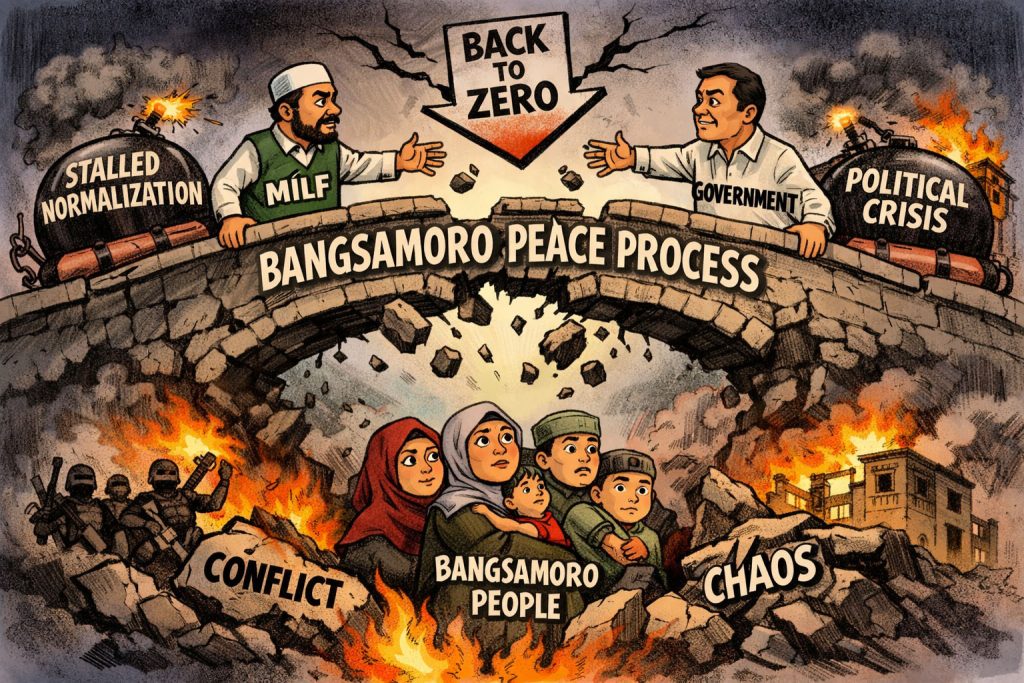
On the surface, the MILF’s concern appears technical: the absence of a chairperson for the Government of the Philippines (GPH) Peace Implementing Panel following the resignation of its leader. But beneath this procedural vacuum lies something far more troubling. The peace mechanisms that sustain the CAB were designed to operate through mutual representation and joint decision-making. Without a counterpart from the government empowered to negotiate and commit, the entire structure becomes paralyzed.
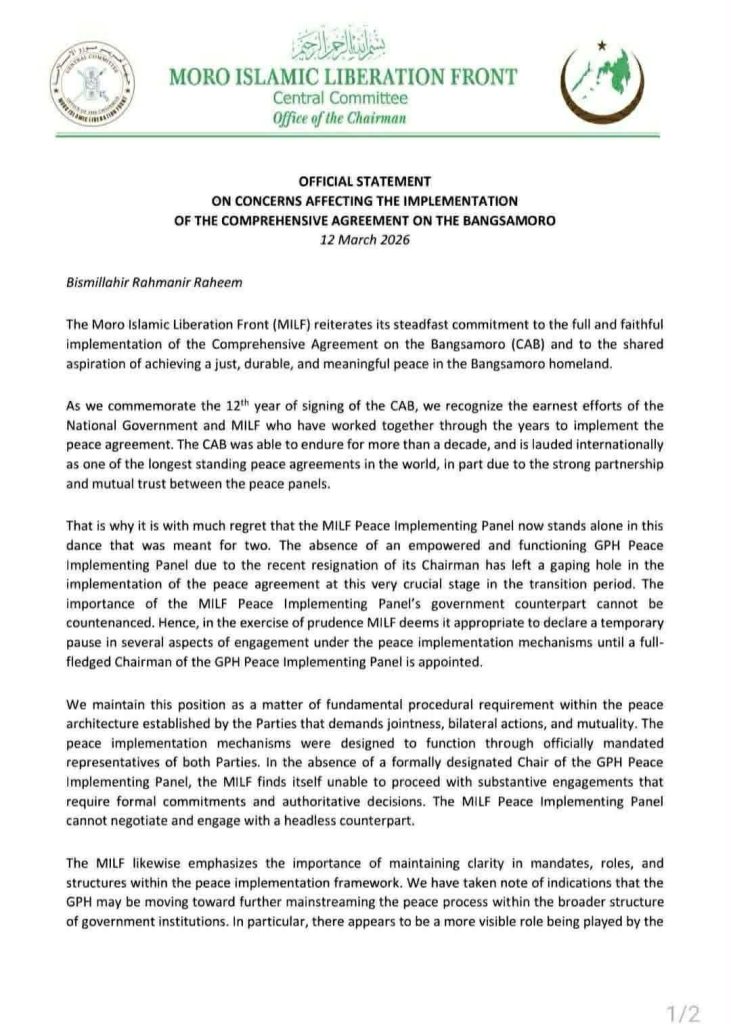
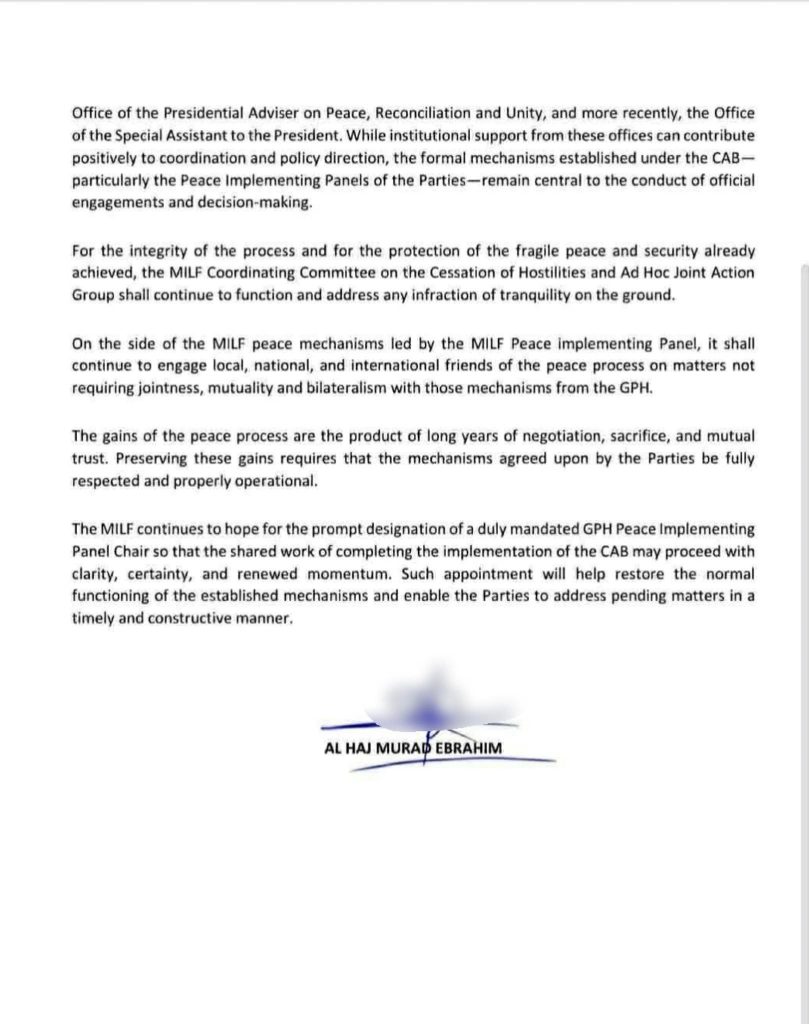
In the delicate choreography of peacebuilding, there can be no dance if one partner suddenly disappears.
The Architecture of Peace Cannot Function Alone
The CAB, signed in 2014, was never meant to be implemented unilaterally. Every mechanism—from political dialogue to normalization—rests on bilateral engagement between the MILF and the Philippine government. The MILF’s declaration that it cannot engage with a “headless counterpart” underscores a fundamental truth: peace agreements are not self-executing documents. They are living processes sustained by trust, political will, and continuous engagement.
When one side of that structure falters, the entire process risks grinding to a halt.
This is precisely what the MILF is warning about. Their statement stresses that the mechanisms of the peace process were designed to operate through “jointness, bilateral actions, and mutuality.” Remove one pillar, and the entire framework becomes unstable.
The danger here is not simply bureaucratic delay—it is institutional collapse.
A Peace Process Already Under Severe Strain
The timing of this development could not be worse. Only weeks earlier, two organizations deeply involved in peace advocacy—the Council for Climate and Conflict Action (CCAA) and the Institute for Autonomy and Governance (IAG)—issued a stark warning that the Bangsamoro political settlement is already “on the brink of collapse.”
Their February statement painted a grim picture: eroding trust between the government and Moro leaders, internal divisions within the MILF, stalled normalization, and growing governance challenges within the Bangsamoro Autonomous Region in Muslim Mindanao (BARMM).
The MILF’s latest declaration appears to confirm those fears.
What once was a cooperative peace implementation environment is increasingly giving way to tension, mistrust, and institutional paralysis.
When Normalization Stalls, Conflict Returns
Central to the current crisis is the stalled normalization process, particularly the decommissioning of MILF combatants and their weapons. This program—one of the cornerstones of the peace agreement—has slowed dramatically after the MILF suspended the process while demanding parallel dismantling of private armed groups.
While the concern over private armies is legitimate, the unilateral suspension has raised serious alarms among peace observers.
The consequences are already visible. Reports of sophisticated weapons circulating in the region—including a recent attack on a mayor using a rocket-propelled grenade—underscore how dangerous the situation has become.
A stalled normalization process does not simply delay peace. It allows the infrastructure of war to quietly reassemble itself.
The Political Crisis Beneath the Surface
Beyond security concerns, a deeper political crisis is unfolding within the Bangsamoro transition.
Debates over whether to postpone the first parliamentary elections in BARMM have intensified fears that democratic legitimacy in the region is being undermined. Previous election delays were justified as necessary to stabilize the transition. But each postponement stretches the patience of the Bangsamoro people and raises uncomfortable questions about governance and accountability.
Peace agreements survive not only on security arrangements but also on political legitimacy. When democratic processes are delayed indefinitely, trust in the entire transition begins to erode.
And once legitimacy erodes, peace itself becomes fragile.
Corruption and Governance Failures Add Fuel to the Fire
Compounding these tensions are allegations of corruption within the Bangsamoro government. Investigations into misuse of public funds and abuse of authority have further damaged public confidence in institutions meant to embody the promise of the peace agreement.
For communities that endured decades of war, corruption is more than a governance problem—it is a betrayal of the sacrifices made in pursuit of peace.
Every peso diverted from development programs is a reminder to ordinary Bangsamoro citizens that the dividends of peace remain unevenly distributed.
And when communities begin to doubt whether peace is delivering tangible benefits, the appeal of armed alternatives can quietly return.
The Bangsamoro People Will Pay the Highest Price
If the peace process collapses, it will not be politicians or negotiators who suffer the most. It will be the Bangsamoro people.
For decades they lived through displacement, militarization, and cycles of violence that devastated communities across Mindanao. The CAB offered a historic opportunity to break that cycle—to replace armed struggle with political autonomy and democratic governance.
Undoing that progress would mean far more than a failed agreement. It would mean returning to uncertainty, instability, and possibly renewed conflict.
The tragedy would not only be political—it would be generational.
From Pause to Collapse: A Real Possibility
The MILF insists that its suspension of engagement is temporary and procedural. Yet history teaches us that peace processes rarely collapse overnight. They unravel gradually—through missed meetings, delayed commitments, unresolved grievances, and eroding trust.
The current pause could easily become the first visible crack in a much larger breakdown.
And once a peace process begins to unravel, rebuilding it becomes infinitely harder than maintaining it.
The Urgent Responsibility of Leadership
The solution to the current crisis is not complicated, but it requires urgency and political seriousness.
The national government must immediately appoint a fully empowered chairperson to the GPH Peace Implementing Panel. This is not merely an administrative requirement; it is a signal of commitment to the peace agreement.
At the same time, both the MILF leadership and the national government must address the broader issues threatening the process—normalization delays, governance concerns, election uncertainties, and the proliferation of weapons.
Peace is not sustained by silence or delay. It is sustained by action.
A Decade of Peace Should Not End in Neglect
For more than twelve years, the CAB has stood as one of the world’s most enduring peace agreements. It has been praised internationally as a rare example of a long-running conflict being transformed through negotiation rather than force.
Allowing it to collapse due to political missteps, bureaucratic gaps, and eroding trust would be an unforgivable failure.
The MILF’s warning should be heard not as a threat—but as a desperate signal that the peace process is entering its most dangerous phase yet.
If the current trajectory continues, the Bangsamoro peace process will not merely stall.
It will return to zero.
And once that happens, rebuilding trust, institutions, and hope may take another generation.