
In the highlands of Lake Sebu, the earth itself has spoken. On February 13, a massive landslide swallowed a long stretch of the Sto. Niño–Maitum Road in Barangay Ned, cutting off a lifeline that farmers, traders, and families depend on every single day. What used to be a one-hour trip to bring crops to market has become a grueling three- to four-hour journey—sometimes on horseback—because a highway simply disappeared beneath moving soil.
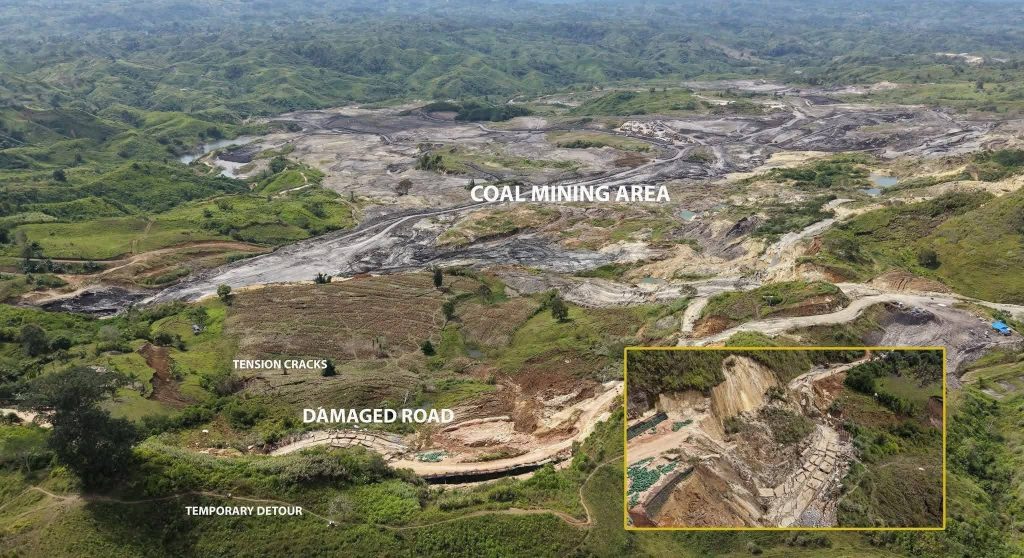
Officials say the cause is still under investigation. According to the Provincial Disaster Risk Reduction and Management Office, the disaster may be linked to weeks of heavy rain, land subsidence, and the geological reality that coal deposits lie beneath the area. They also point out that cracks and ground instability had already been observed years before mining operations began.
But listen closely to the voices from the ground—the residents of Sitio El Dulog. They are not speaking from technical reports. They are speaking from lived experience. They saw the land before and after mining activity expanded nearby. They watched cracks widen, slopes weaken, and the earth slowly lose its grip.
The government may not be ready to assign blame. Yet even officials admit mining could be a contributing factor once the topsoil is disturbed and underground conditions change. That admission alone should be enough to pause, reflect, and ask a question many are already asking:
If this is what a “natural” or partially explained landslide can do, what happens when a full-scale mining disaster strikes?
Because let’s be honest about what just happened. This was not a minor inconvenience. Hundreds of meters of a critical road are gone. Commerce has stalled. Farmers are struggling to deliver produce. Transport costs have surged. Access to goods and services has been disrupted. The government itself is struggling to respond because the ground is still unstable and rebuilding cannot even begin safely yet.
And this is only one landslide.
Imagine something larger—God forbid—triggered by deeper extraction, expanded operations, or a combination of natural forces and human activity. The consequences would not only be cracked roads. It could mean entire communities displaced, watersheds damaged, farms buried, and indigenous ancestral lands permanently altered.
This is why the situation in Barangay Ned cannot be reduced to a debate of “pro-mining versus anti-mining.” That framing misses the point entirely.
The real issue is risk.
The coal operations in the area—run by companies holding contracts in the mountains of South Cotabato—are taking place inside a fragile landscape. This is not just any terrain. It is part of a watershed that feeds farms and communities. It is home to indigenous peoples like the T’boli and Manobo whose lives are tied to the land’s stability. Once that balance is disturbed, the damage is rarely small and never easily reversed.
Even the upcoming provincial hearing led by Vice Governor Arthur Pingoy Jr. acknowledges that the questions surrounding mining in Ned are serious enough to demand answers. Coal extraction has already reached millions of metric tons in recent years. That scale alone should compel a deeper, more honest conversation.
Because disasters rarely begin with a single dramatic moment. They begin with warning signs—cracks in the earth, collapsing slopes, small failures that signal something larger is unfolding beneath the surface.
Barangay Ned may already be showing those warning signs.
The Prophet Isaiah once wrote about a land that suffers when its laws are broken and its balance is ignored. Whether one reads that as scripture, metaphor, or environmental truth, the message still resonates today. When mountains are weakened, when forests are stripped, when watersheds are stressed, the land eventually responds.
And when it does, it does not send a memo. It moves.
The tragedy is that communities like those in Ned are the first to feel the consequences, long before boardrooms or distant investors do. Farmers carry heavier costs. Indigenous families face uncertainty. Local governments struggle to repair damage they did not create alone.
So the question facing South Cotabato now is not simply what caused this landslide.
The real question is whether we are willing to learn from it before something worse happens.
Because if a single collapse can already paralyze livelihoods and infrastructure, then this is not just a landslide story.
It is a warning.