
A Traditional Textile at the Center of a Fashion Controversy
MANILA — A controversy over the use of inaul, the traditional handwoven textile associated with the Maguindanaon and Iranun communities, has ignited a wider debate over cultural respect, artistic freedom and the responsibilities of contemporary fashion designers when working with living cultural heritage. At the center of the controversy is Filipino fashion designer Francis Libiran, whose contemporary creation using inaul patterns drew criticism after he presented the textile through a provocative fashion concept that some cultural advocates said diminished, sexualized and stripped the heritage material of its cultural meaning and dignity.
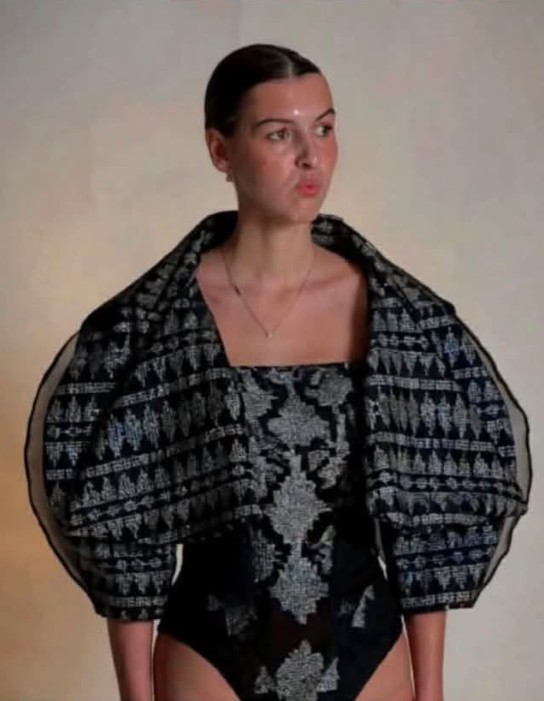
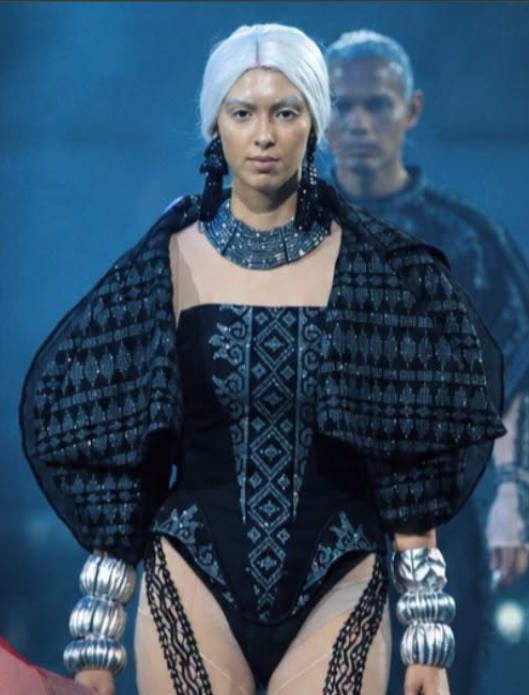
Libiran initially described the project as a deliberate contemporary reinterpretation of traditional inaul. “From concept to runway—Fell in love with our very own Inaul patterns,” he wrote, explaining that the visual activation explored how different motifs could come together while conceptually reworking the palette into a simple two-color combination. Instead of the usual vibrant and bright tones, he said, the weavers were asked to craft the fabric in black and silver “to tone down the color and let the patterns speak louder.” Every mix and every blend, according to Libiran, was designed to highlight the beauty of inaul in one elevated outfit, producing what he described as a “truly Filipino, elevated streetwear look.”
The controversy, however, was not limited to the garment itself. Libiran also described the transformation in deliberately provocative terms. In a now-deleted post, he wrote, “I didn’t preserve tradition. I weaponized it,” describing the textile as transformed into a “graphic, skin-tight bustier” and declaring: “Filipino heritage, but make it dangerous. Make it modern. Make it LIBIRAN.”
For critics, those words went beyond ordinary fashion language and touched a sensitive issue involving the treatment of cultural heritage as an aesthetic commodity. The presentation raised questions over whether a traditional textile carrying generations of history, identity and cultural knowledge was being reinterpreted responsibly or being detached from its context in pursuit of a more provocative, commercially recognizable fashion statement.
BCPCH Condemns the Use and Presentation of Inaul
The Bangsamoro Commission for the Preservation of Cultural Heritage (BCPCH), through its Maguindanao Provincial Office, strongly condemned and denounced what it described as the deeply disrespectful and inappropriate use and public presentation of inaul in the statement entitled “Inaul Undone, Reborn” by Libiran. The commission said the presentation diminished, sexualized or stripped a sacred cultural heritage of its meaning, dignity and identity.
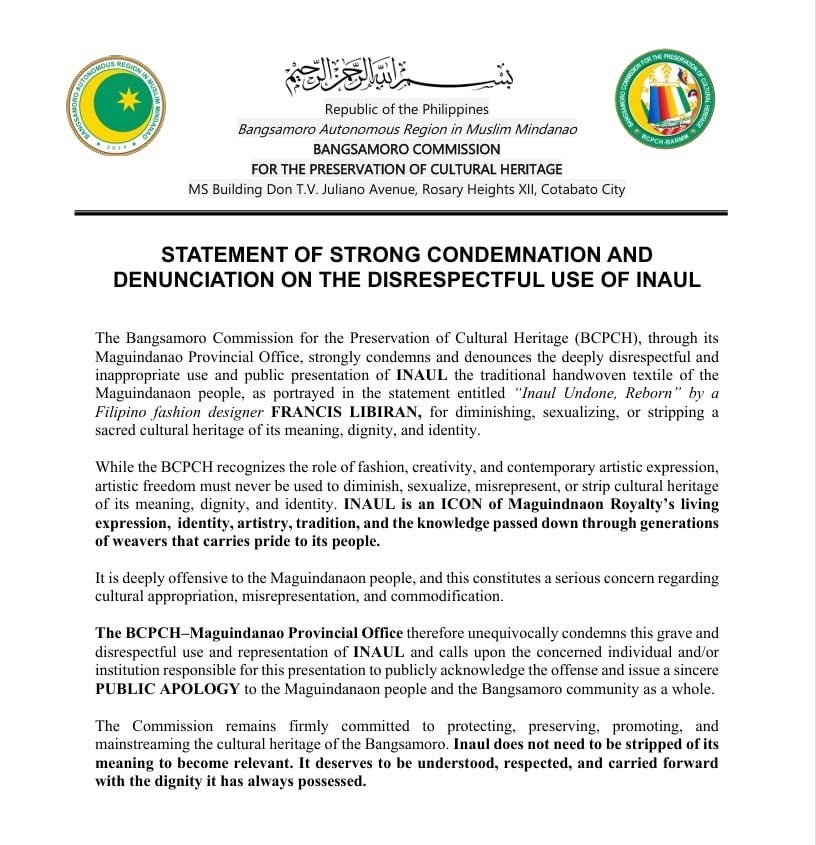
While the BCPCH recognizes the role of fashion, creativity and contemporary artistic expression, it stressed that artistic freedom must never be used to diminish, sexualize, misrepresent or strip cultural heritage of its meaning, dignity and identity. The commission described inaul as an icon of Maguindanaon royalty and a living expression of identity, artistry and tradition, representing knowledge passed down through generations of weavers and carrying pride for its people.
The BCPCH said the presentation was deeply offensive to the Maguindanaon people and constituted a serious concern regarding cultural appropriation, misrepresentation and commodification. The commission therefore called upon the concerned individual and/or institution responsible for the presentation to publicly acknowledge the offense and issue a sincere public apology to the Maguindanaon people and the Bangsamoro community as a whole.
The commission also reaffirmed its commitment to protecting, preserving, promoting and mainstreaming the cultural heritage of the Bangsamoro. Its message was clear: inaul does not need to be stripped of its meaning to become relevant. It deserves to be understood, respected and carried forward with the dignity it has always possessed.
The Problem Is Not Contemporary Fashion
The BCPCH’s position, however, does not amount to a rejection of contemporary fashion or artistic innovation. Rather, it raises a more difficult question about how traditional textiles can be brought into modern design without sacrificing their cultural context and symbolism.
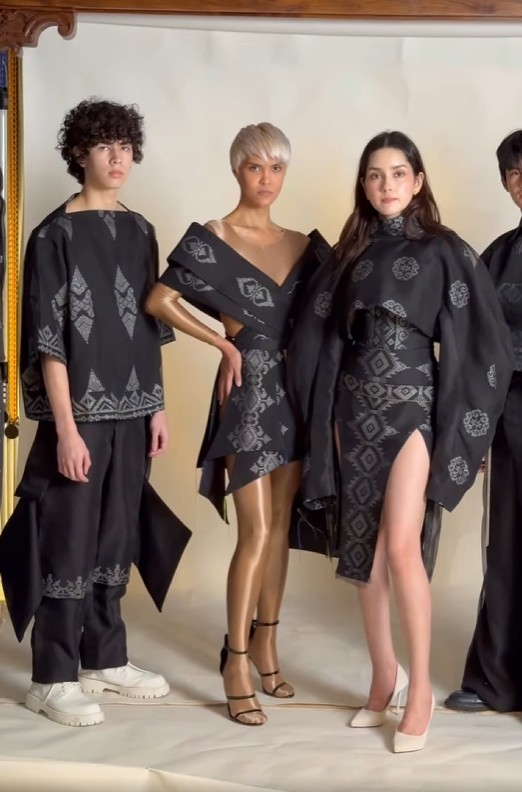
Fashion is an evolving form of creative expression, and traditional textiles have always been capable of taking on new forms. Inaul has appeared in modern Filipiniana, jackets, blazers, trousers and other contemporary pieces, including presentations supported by Bangsamoro institutions. There is therefore nothing inherently wrong with reinterpreting inaul or bringing it to audiences beyond the communities where it originated.
Fashion platform Rampa Pinas offered another perspective, arguing that the controversy should not be reduced to the question of whether inaul may be reinvented at all. “So the real issue is not simply whether Inaul may be reinterpreted. It already is,” Rampa Pinas wrote.
The platform also questioned whether the amount of skin shown by a garment should automatically determine whether cultural disrespect has occurred. “A conventional-looking gown can disregard provenance just as easily as an audacious bodysuit can be made with careful knowledge of the textile it incorporates,” Rampa Pinas argued.
That point is significant because it shifts the discussion away from the garment’s physical appearance and toward the more fundamental questions of provenance, attribution, cultural understanding and economic benefit. A traditional textile can be used in a conservative gown and still be culturally misrepresented, just as a daring contemporary garment can potentially incorporate the same textile responsibly if it is created with proper knowledge, consultation and respect.
The debate, therefore, is not simply about whether inaul can be modernized. It is about how that modernization takes place and whether the cultural identity attached to the textile remains visible throughout the process.
Who Wove the Textile and Who Benefits?
Rampa Pinas argued that attention should also be paid to where the textile came from, who wove it, whether proper attribution was given and whether artisans benefit economically from its commercialization. These questions strike at the heart of the tension between cultural preservation and commercial fashion.
When a traditional textile becomes fashionable, its commercial value can rise dramatically. Designers and fashion houses can gain visibility, prestige and income by incorporating distinctive cultural materials into their collections. But the people whose knowledge and labor made those materials possible may remain largely invisible.
That imbalance is at the center of the larger criticism surrounding cultural appropriation. The concern is not simply that someone outside the community is using a cultural material. The deeper concern is whether the community itself retains agency over how that material is represented and whether the economic value generated from its use reaches the people who continue to preserve the tradition.
This is particularly important in the case of handwoven textiles. A piece of inaul does not emerge from a factory production line without cultural history. It is the product of knowledge, skill, labor and inherited techniques passed through generations. Behind the finished textile are weavers whose work sustains a tradition that could otherwise disappear.
If the fashion industry wants to claim the beauty of that heritage, it must also recognize the people responsible for keeping it alive.
The Debate Over “Commodifying Community Culture”
The controversy also intersects with criticism from food advocate John Sherwin Felix, who accused wealthy designers and entrepreneurs of “commodifying community culture.” Felix challenged romanticized descriptions of inaul as being woven by “Maguindanaon royalty,” emphasizing instead the generations of ordinary but highly skilled Maguindanaon and Iranun weavers who kept the tradition alive.
That distinction matters because cultural heritage can easily be romanticized in ways that make it attractive to consumers while obscuring the realities of the communities that preserve it. Inaul should not be reduced to a luxurious or exotic fashion accessory disconnected from the people who have maintained its production.
The story of inaul is not simply the story of royalty, designers or fashion houses. It is also the story of generations of ordinary people whose knowledge and skill allowed the tradition to survive.
The weavers are not merely producers of fabric. They are cultural bearers.
Their labor is part of the textile’s value, and their knowledge is part of the heritage being presented whenever inaul enters a national or international fashion space.
This is why questions about attribution and economic benefit are not secondary issues. They are central to whether the use of traditional textiles represents meaningful cultural collaboration or merely another form of commodification.
Preservation and Commercialization Do Not Have to Be Enemies
At the same time, the debate should not create a false choice between preservation and commercialization. Rampa Pinas cautioned against precisely that. Broader markets can create demand, and demand can provide income for weaving communities. Traditional crafts cannot survive indefinitely through nostalgia alone. Weavers need markets, younger generations need incentives to continue learning the craft, and communities need economic opportunities that make cultural preservation sustainable.
The problem begins when commercial expansion causes a textile to lose its provenance or when its commercial value fails to reach “the people at the loom.”
There is therefore nothing inherently wrong with inaul entering the fashion industry. In fact, responsible commercialization could help sustain weaving communities and introduce their work to audiences who might otherwise never encounter it. The danger lies in a system where the textile’s cultural identity becomes a marketing tool while the people who preserve it remain economically and culturally marginalized.
The challenge is not to prevent commercialization but to make commercialization responsible. The broader the market becomes, the more important it is that weavers receive fair compensation, proper recognition and meaningful participation in decisions concerning the use and representation of their work.
The runway should create opportunities for the loom, not simply extract value from it.
The Language of “Weaponization”
The language used to promote the Libiran creation also raises a deeper cultural issue. The declaration that tradition was not preserved but “weaponized,” combined with the description of Filipino heritage as something to “make dangerous,” is intended to create a provocative fashion identity. But when the subject being transformed is another community’s cultural heritage, such language can carry implications far beyond the designer’s intended aesthetic.
The colonial echo of “weaponizing” tradition cannot simply be ignored. Framing indigenous textiles through the language of combativeness or “weaponization” can commodify cultural symbols for a Western-facing or elite runway aesthetic while removing them from the historical and cultural circumstances that gave them meaning.
Traditional weaves have historically been tied to identity, royalty and ancestral dignity among Maguindanaon communities. When such textiles are stripped of their cultural context to look “modern” or “dangerous,” there is a risk that sacred or culturally significant craft will be reduced to an edgy aesthetic gimmick.
The problem is not that a designer wants to make something bold. The problem is what happens when shock value becomes more important than cultural context.
There is a fine, often fractured line between dynamic contemporary design and extractive design. True preservation does not require traditional textiles to remain frozen in their original forms. It requires respect for the narratives embedded within them and for the communities whose hands keep the craft alive.
When design discourse leans too heavily into phrases such as “culture with a bite,” “weaponized” heritage or other deliberately provocative descriptions, it can alienate the very cultural bearers whose knowledge sustains the craft. The result is a situation in which individual designer branding risks becoming more prominent than cultural stewardship.
The Designer’s Dilemma
The controversy encapsulates the exact challenge faced when regional textiles such as hablon, patadyong and inaul are elevated to national and international platforms: How do we demand contemporary relevance for handloom weaving without stripping away its soul?
That is the designer’s dilemma.
Traditional textiles cannot simply be placed behind glass and declared untouchable. Culture is living, and living traditions inevitably change. New generations will reinterpret old forms, and new markets will create new applications. Such evolution can be healthy and necessary for cultural survival.
But evolution does not require cultural erasure.
A designer can modernize a textile without pretending its past is irrelevant. A designer can experiment with color, silhouette and construction while still acknowledging the cultural meaning of the material. A designer can create a bold fashion statement without turning the cultural heritage of another community into a metaphor for danger.
The responsibility is therefore not to prevent creativity but to ensure that creativity is informed by cultural knowledge.
True innovation should involve understanding the history of the textile, consulting cultural bearers where appropriate, properly identifying the communities and artisans behind the work, and ensuring that the economic benefits of commercialization are not concentrated exclusively in the hands of those who market the finished product.
Libiran’s Apology Changes the Immediate Conversation
The controversy did not end with the BCPCH’s criticism. In a September 7 statement, BCPCH Chairperson Robert M. Alonto revealed that Libiran personally reached out to the BCPCH-Lanao del Sur office to apologize. The commission said it recognized and appreciated his effort to address the concerns.
That apology is significant because it demonstrates a willingness to engage with the cultural institution rather than allowing the controversy to become a permanent confrontation between the fashion industry and cultural advocates.
But the apology does not eliminate the larger questions raised by the controversy. If anything, it creates an opportunity to address them more seriously.
The BCPCH has made clear that it is not opposed to contemporary fashion. Alonto said the commission recognizes fashion as an evolving form of creative expression and that meaningful efforts to bring Bangsamoro textiles into contemporary design are welcome. However, innovation, the commission stressed, should not come at the expense of cultural context and symbolism.
That position provides an important distinction. Preservation does not mean refusing to allow traditional textiles to evolve. Innovation does not mean having unrestricted freedom to redefine another community’s heritage without regard for its cultural meaning.
The two can coexist, but only if the relationship between them is built on respect.
The Need for Clearer Cultural Guidelines
The BCPCH now plans to review existing policies and develop possible guidelines on the use, representation and contemporary application of traditional textiles through consultations with weavers, elders, cultural organizations, designers, researchers and government agencies.
Such an effort could become one of the most constructive outcomes of the controversy.
The fashion industry needs room for creativity, but cultural communities also need mechanisms through which their concerns can be heard and their heritage can be protected. Clearer guidelines could help designers understand what responsible collaboration looks like while giving cultural bearers a stronger voice in determining how their traditions are represented.
Such guidelines should not be designed merely to restrict fashion designers. They should help establish a framework in which designers, artisans, cultural institutions and communities can work together without one side overwhelming the other.
The goal should be to create a fashion industry that does not merely borrow from culture but builds lasting relationships with the communities whose traditions inspire contemporary work.
When Heritage Travels, the People Must Travel With It
The most important lesson from the controversy may therefore be the simplest: when heritage travels, the people behind it must travel with it. If designers use inaul, the weavers should be acknowledged; if fashion houses profit from the textile, weaving communities should benefit; if a collection is marketed as Filipino heritage, the cultural origins of the material should be accurately represented; and if traditional motifs are reinterpreted, their meaning should be understood rather than casually discarded. Likewise, if designers intend to transform a cultural tradition dramatically, dialogue with the communities who carry that tradition should not be treated as an unnecessary obstacle to creativity.
This is about more than courtesy. It is about cultural ownership, dignity and agency. The Philippines cannot continue celebrating indigenous and regional aesthetics while overlooking indigenous and regional people. We cannot praise the beauty of the textile while ignoring the conditions of the weaver, market cultural heritage as a premium product while treating the communities that preserved it as an afterthought, or claim that a traditional textile represents Filipino identity if the people whose identity it carries are absent from the conversation.
The issue is particularly important because the fashion industry has the power to determine which cultural traditions receive national and international attention. When a celebrated designer places a traditional textile on a major platform, the designer also influences how audiences understand that textile and the culture from which it originates. That influence carries responsibility. The more powerful the platform, the greater the obligation to ensure that cultural representation is accurate, respectful and inclusive of the communities concerned.
Inaul Does Not Need to Be Made Dangerous
Inaul does not need a designer to make it dangerous. It has survived centuries of change, shifting political landscapes, economic hardship, changing tastes and the gradual erosion of traditional livelihoods. Its endurance is already an act of strength. The textile has remained alive because generations of Maguindanaon and Iranun weavers continued to preserve the knowledge and skill required to produce it.
Its patterns do not need to be stripped of their cultural context to become modern. Its identity does not need to be diluted to become fashionable. Its history does not need to be repackaged as an edgy aesthetic before the country will recognize its value. The Maguindanaon people should not have to watch their heritage transformed into a fashion statement while being told that such transformation is the price of relevance.
The real test of contemporary fashion is not whether it can make heritage look different. The real test is whether it can make heritage matter without making its people disappear.
That means recognizing that the value of inaul does not begin when it reaches the runway. Its value begins with the communities that preserved it, the weavers who continue to produce it and the cultural knowledge embedded in its patterns and techniques. A runway may provide visibility, but visibility without recognition of the people behind the textile can become another form of erasure.
A truly elevated Filipino fashion industry should therefore not simply take traditional textiles from the loom to the runway. It should carry with them the history, knowledge, identity and dignity of the communities that preserved them. It should create opportunities for weavers instead of merely creating opportunities from weavers. It should make cultural bearers visible rather than allowing them to disappear behind the prestige of designers, fashion houses and commercial brands.
The runway and the loom do not have to be enemies. Contemporary fashion can create demand for traditional textiles, generate income for artisans and introduce Bangsamoro craftsmanship to audiences around the country and the world. But that relationship must be based on respect, attribution, consultation and fair economic participation.
As Rampa Pinas put it, “The challenge, then, is not to choose between preservation and fashion. It is to build a better relationship between them.”
That is ultimately the challenge presented by the inaul controversy. The issue is not whether Maguindanaon heritage should be allowed to evolve. It should. Nor is the issue whether designers should be allowed to experiment with its patterns, colors, forms and applications. They should. The issue is whether that evolution and experimentation will happen with the people who inherited and preserved the tradition or without them.
Inaul does not have to choose between the loom and the runway. It can belong in both worlds. It can be contemporary without becoming detached from its origins, commercially successful without abandoning its cultural identity, and fashionable without reducing the people behind it to anonymous sources of material.
But when inaul travels from the loom to the runway, the journey must never end with the designer. The people, history, knowledge, artistry and cultural dignity woven into it must travel with it. Otherwise, what is being elevated is not the heritage itself, but merely the commercial image of it.