
TUGUNAN, SGA-BARMM — A military drone was reportedly involved in an operation against the reported position of several armed men during the continuing security operation in Tugunan, Bangsamoro Special Geographic Area (SGA), as authorities tightened security following a series of deadly clashes that left at least seven members of armed groups dead.
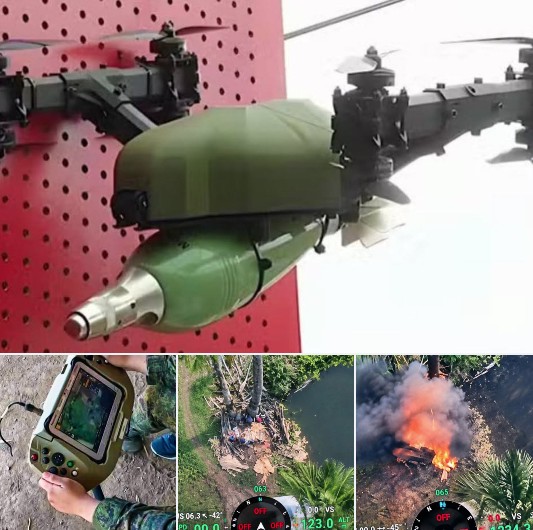
The reported drone incident occurred amid intense fighting that erupted in Sitio Gawang, Barangay Manaulanan, and later spread toward nearby farming enclaves in Barangay Balong on Saturday, September 19.
However, the report that a military drone struck the position of the armed men has not yet been independently confirmed by authorities. Verified accounts from security officials indicate that Philippine Air Force attack helicopters also provided aerial support during the clashes. The precise nature of the reported drone operation, including whether it caused additional casualties, remains subject to official confirmation.
The incident nevertheless highlights the increasingly important role of unmanned aerial systems in the Philippines’ evolving military capabilities.
Seven armed men reported killed
The clashes involved combined elements of the Philippine Army and the Police Regional Office-Bangsamoro Autonomous Region against armed men described by local officials and security authorities as remnants of the Dawlah Islamiya and Bangsamoro Islamic Freedom Fighters (BIFF).
According to local officials, traditional Moro leaders and police personnel cited by local reports, seven armed men were killed during the encounters in Manaulanan and Balong.
Six of the fatalities were identified as Mumin Haron, Haymin Taib, Dagkungan Musa, Norodin Baskie, Abdullah Dalimbang and Abdulrahim Dalimbang.
A seventh man was found dead at one of the encounter sites on Sunday, although investigators were still working to establish his identity.
Earlier reports had initially placed the number of fatalities at four before subsequent assessments raised the reported death toll to seven.
The casualty figure remains subject to official verification as security forces continue clearing and assessing the encounter areas.
Fighting spreads across farming communities
The confrontation reportedly began in Sitio Gawang after security forces moved toward the reported location of armed men.
Officials from the Police Regional Office-BAR and the Army’s 6th Infantry Division said the armed men opened fire as government forces approached, triggering an intense exchange of gunfire.
Several Army and police units participated in the operation, while Philippine Air Force assets provided aerial support.
According to reports, an attack helicopter provided fire support as ground forces engaged the armed group. Some of the gunmen reportedly withdrew from the immediate area while carrying wounded companions.
The fighting subsequently spread to nearby farming enclaves, forcing residents to leave areas considered unsafe.
A disaster situation report cited in local media placed the number of displaced families at 1,346 across Manaulanan, Balong and Macabual. The figure could change as authorities continue validating the number of affected residents and families.
Security forces brace for possible retaliation
The deaths of seven alleged members of the armed groups have raised concerns about possible retaliatory attacks by surviving members.
Police and military units have therefore remained deployed in Tugunan to secure communities and prevent possible attacks.
Security officials have called on residents to remain vigilant and coordinate with authorities amid concerns over possible retaliation.
Tugunan Mayor Abdulbayan Abas described the operation as a legitimate law-enforcement action against wanted individuals.
Local officials have also accused armed groups operating in the area of imposing so-called protection payments on residents.
The men killed in the clashes were described in local reports as among the remaining members of Dawlah Islamiya and BIFF who had not entered a reconciliation process being pursued by the 6th Infantry Division and PRO-BAR for violent extremist groups.
Philippines expands drone warfare capabilities
The reported drone incident comes as the Philippines moves to strengthen the drone capabilities of the Armed Forces of the Philippines (AFP), reflecting a broader shift toward unmanned systems in modern military operations.
The AFP has been working toward building a nationwide pool of approximately 2,500 trained drone pilots, with the goal of giving personnel greater capacity to operate unmanned aerial systems in a range of military missions.
The training is intended to enhance the ability of troops to use drones for surveillance, reconnaissance, battlefield awareness, target identification and other tactical missions.
The program also seeks to improve the integration of unmanned systems with conventional ground, air and maritime forces.
That integration is increasingly significant because modern military operations require commanders to obtain accurate information quickly and maintain awareness of rapidly changing conditions on the battlefield.
Recent conflicts around the world have demonstrated the growing importance of drones in providing real-time intelligence, monitoring troop movements, identifying targets and supporting operations without necessarily placing personnel directly in the same position of exposure.
For the AFP, developing a nationwide corps of approximately 2,500 drone pilots could expand its ability to gather battlefield information rapidly, improve situational awareness and support military units operating across the country’s difficult terrain and maritime environment.
The capability could be particularly relevant to operations involving remote communities, mountainous terrain, coastal areas and other locations where conventional surveillance assets may face operational limitations.
At the same time, the broader drone initiative should not be automatically interpreted as confirmation that the reported drone involved in the Tugunan incident was operated under the 2,500-pilot program.
2024 procurement adds to modernization push
The Philippines had already taken steps toward acquiring more advanced unmanned strike capabilities before the latest reports from Tugunan.
In 2024, the Department of National Defense finalized a procurement involving loitering munitions, commonly described as suicide drones, intended for the Philippine Marine Corps.
Reports at the time said the DND issued a Notice of Award to Thunder Defense, a Makati-based joint venture involving Philippine and Pakistani interests, for a vertical take-off and landing precision-strike munition system.
The system was reported to be capable of carrying either 60mm or 81mm mortar ammunition as its payload and was designed for precision strike missions. Reported specifications included an operational range of about 8 kilometers, loitering endurance of approximately four to five hours, and targeting capabilities that could incorporate night vision.
The reported capabilities were intended for missions against a range of targets, including static installations and certain military assets.
However, the 2024 procurement should be viewed separately from the Tugunan incident unless the AFP or DND officially identifies the specific drone or system involved.
A changing battlefield in Mindanao
The developments in Tugunan illustrate how security operations in Mindanao are taking place against a rapidly changing technological environment.
For decades, military and police operations against armed groups have relied heavily on ground intelligence, patrols, checkpoints and direct engagement.
The increasing availability of unmanned aerial systems introduces another layer: the ability to observe areas from above, monitor movements, identify potential threats and provide information to commanders in near real time.
In a geographically challenging area such as the SGA, where communities are separated by agricultural areas and difficult terrain, such capabilities can potentially provide security forces with additional situational awareness.
But the reported drone incident also underscores the importance of accurate information.
Whether the drone involved in Tugunan conducted surveillance, target identification, precision engagement or another tactical mission remains to be established by official authorities.
For now, the immediate concern remains the security of civilians.
As military and police units continue operations, residents of Manaulanan, Balong and surrounding communities remain vulnerable to displacement and the possibility of renewed violence.
Authorities are expected to provide further details on the reported aerial operation, the identities of those killed, the number of wounded and the overall security situation in Tugunan.
The reported drone operation, together with the AFP’s broader effort to train thousands of drone pilots, points to a Philippine military increasingly adapting to a battlefield in which information, surveillance and unmanned technology are becoming central components of modern security operations.