
The first parliamentary election of the Bangsamoro Autonomous Region in Muslim Mindanao is no longer simply an election. It is shaping up to be a referendum—not necessarily on the Bangsamoro peace agreement itself, but on the political direction that the region will take after years of transition, and perhaps more significantly, on whether the Moro Islamic Liberation Front (MILF) can successfully transform the enormous political capital it accumulated during decades of armed struggle into a durable electoral mandate. For years, one phrase has repeatedly been heard from supporters of the MILF: “BARMM is nothing without the MILF.” There is truth behind that statement. The MILF was central to the armed struggle that eventually produced the Comprehensive Agreement on the Bangsamoro and, ultimately, the creation of BARMM. Its leadership negotiated the peace agreement, participated in the transition, helped establish the Bangsamoro Transition Authority and placed its own political organization—the United Bangsamoro Justice Party (UBJP)—at the center of its strategy for the region’s first parliamentary government. But history creates legitimacy. It does not automatically guarantee electoral victory. And that may be the most uncomfortable question confronting the MILF today. Can an organization that led the struggle for decades also convince voters that it should lead the Bangsamoro government for the next generation? The September 14 parliamentary election may provide the first real answer.
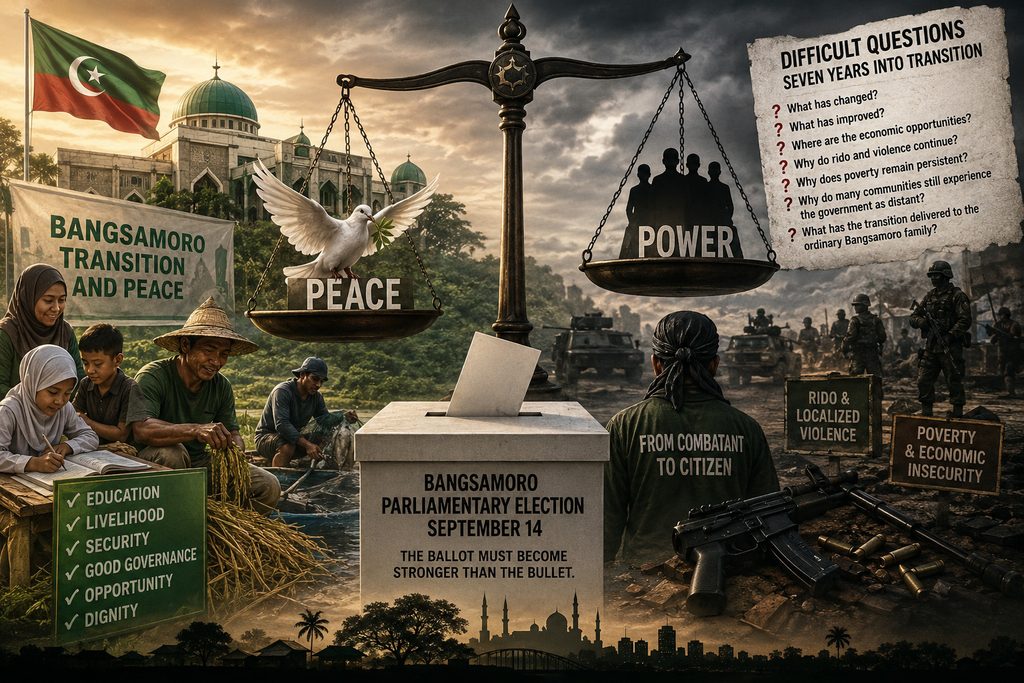
The Political Ground Beneath the MILF Appears to Be Shifting
The most obvious warning sign is political. The UBJP was created as the political vehicle of the MILF’s leadership, allowing a former armed movement to compete within the democratic system it once fought against. That transition was itself historic. The transformation from armed struggle to parliamentary politics was supposed to demonstrate that political grievances could be addressed through institutions rather than through armed confrontation. Yet the political environment surrounding the UBJP appears increasingly complicated. Prominent sitting politicians and local political groups have reportedly moved away from the party, while the Bangsamoro Federal Party (BFP), led by Atty. Naguib Sinarimbo and associated with Chief Minister Abdulraof “Sammy” Macacua, has emerged as an increasingly significant political force. This development cannot simply be dismissed as ordinary political realignment. Bangsamoro politics, like politics in many parts of the Philippines, is deeply influenced by local networks, families, personalities and established political relationships. The importance of clans should neither be romanticized nor ignored. In many communities, political allegiance is not determined solely by party platforms. It can be influenced by family ties, personal relationships, local history, patronage networks and the reputation of individual leaders. This creates a potentially difficult equation for the UBJP. The MILF may argue that it retains the support of the Bangsamoro people because of its historical role in the struggle and peace process. That support may indeed remain substantial. But an electoral contest is ultimately decided by voters—not by history alone. The question is therefore not whether the MILF still has supporters. It clearly does. The question is whether those supporters constitute a sufficient electoral coalition to overcome the increasingly competitive political machinery emerging around it.
The Defections of Former Commanders Carry a Different Weight
Perhaps more consequential is the reported movement of some former MILF commanders and officials toward political formations outside the UBJP. A politician changing parties is normal. A former commander of an armed movement changing political allegiance is something else. The MILF’s transformation was built upon the idea that its fighters and commanders would eventually move from the battlefield into peaceful civilian life. Their loyalty was not merely organizational; it was forged through years of struggle, sacrifice and shared experience. That makes the departure of prominent personalities politically significant. The recent MILF-BIAF reorganization announced at Camp Darapanan reportedly removed numerous senior officers from their positions, including Chief Minister Abdulraof “Sammy” Macacua, Akmad “Toks” Brahim, Butch Malang, Tomanda Antok, Kagui Wahid Tundok and Von Al Haq, among others. The announcement emphasized that those removed would remain members of the MILF even though they would no longer hold their previous positions. The significance goes beyond the personnel changes themselves. It raises a fundamental question about cohesion. If individuals who spent decades inside the organization are prepared to separate themselves politically from the MILF leadership—even at the cost of positions, influence or established relationships—then something deeper may be occurring. That does not automatically mean the MILF is collapsing. But it does indicate that the organization is experiencing an internal political transformation at precisely the moment when it needs maximum cohesion. The reported movement of Von Al Haq and others toward the BFP further illustrates the emerging divide. Al Haq, who previously served in the BIAF leadership structure, has publicly questioned developments within the organization and the conduct of the September 3 assembly, including the presence of firearms and the relationship between the armed structure and political activity. For an organization built on discipline and command structure, such public disagreements are difficult to ignore.
Then Comes the Most Dangerous Question: What Happens If the Election Goes Against the MILF?
This is where political analysis enters territory that should concern everyone—not because conflict is inevitable, but precisely because it must be prevented. The coming election is taking place under an extraordinary security environment. The reported deployment of additional Army battalions from outside BARMM into the region has generated questions and speculation. Government officials and MILF representatives may describe these deployments as security augmentation for the election, and MILF Peace Implementing Panel Chair Mohagher Iqbal himself reportedly welcomed the additional troops, saying they could help protect the elections. But in a region emerging from decades of armed conflict, troop movements are inevitably interpreted through a different lens. For communities accustomed to seeing military deployments as indicators of impending confrontation, perception itself can become a security factor. That is why statements from MILF commanders must be taken seriously—even when there is no evidence that armed conflict is imminent. During the BIAF General Assembly, Commander Abdullah “Bravo” Makapaar reportedly warned: “Kung madaya ang Ameer o leader natin, maghanda tayo brothers and sisters—dahil makikipaglaban tayo.” The statement is deeply troubling not because it proves that the MILF intends to return to war, but because of what it suggests about the possible consequences of a disputed political outcome. The most important word here is “kung.” If the leadership believes an election is fraudulent, what happens next? That is precisely the question that should be answered before election day—not after. The Government of the Philippines, MILF leadership, political parties, security institutions and election authorities have a shared responsibility to make absolutely clear that political grievances must be resolved through legal and democratic mechanisms. The recent memorandum of understanding between the GPH and MILF peace mechanisms is therefore particularly important. The agreement was intended to strengthen coordination, maintain the ceasefire and help ensure a peaceful and transparent parliamentary election. OPAPRU Secretary Mel Senen Sarmiento reportedly emphasized that electoral success should not be measured simply by who wins or loses, but by whether Bangsamoro voters are able to freely express their will and whether peace is maintained. That principle should be non-negotiable. The ballot must become stronger than the bullet.
The Firearms Question Cannot Simply Be Ignored
The controversy surrounding the display and reported presence of firearms during the BIAF assembly adds another layer of concern. Former BIAF spokesperson and intelligence official Von Al Haq publicly questioned why firearms were visible during the gathering at a time when election restrictions were being enforced. Some MILF members reportedly responded that they were inside their camp and therefore could carry firearms. Whatever the legal interpretation may ultimately be, the broader issue goes beyond the technical question of where the gathering occurred. It is about confidence. A peace process cannot survive indefinitely on ambiguity. The Bangsamoro political project requires an increasingly clear separation between the former armed structure and electoral politics. The more difficult it becomes to distinguish between the political party, the former armed organization and its remaining command structures, the greater the risk of confusion, suspicion and mistrust. The MILF itself has a tremendous interest in resolving this ambiguity. If the organization wants to demonstrate that its transformation is irreversible, then every election-related activity should reinforce the message that political power now comes from voters, not armed capability.
Seven Years Is Not Forever
Another issue that can no longer be avoided is performance. BARMM has existed for roughly seven years. For some leaders, the phrase “we are still young” or “we are still in transition” remains a legitimate explanation for institutional weaknesses. In fairness, the Bangsamoro government inherited enormous problems. It is operating in a region affected by poverty, conflict, weak infrastructure, historical underdevelopment, clan disputes and institutional fragmentation. But seven years is also enough time for citizens to ask difficult questions. What has changed? What has improved? Where are the economic opportunities? Why do rido and localized violence continue to affect communities? Why do poverty and economic insecurity remain persistent? Why do many communities still experience the government as distant? And perhaps most importantly: what has the transition delivered to the ordinary Bangsamoro family? The answer cannot be measured only in laws passed, offices created, programs launched or institutions established. The success of autonomy ultimately has to be felt by ordinary people—a mother who can send her children to school safely, a farmer who can earn enough from his land, a fisherman who can support his family, a young person who does not have to leave home simply to find work, a community that does not fear the next rido, a former combatant who has a sustainable livelihood, and a citizen who believes that government institutions will protect his rights. That is the real measure of transition.
The Corruption Question Is Equally Dangerous
The allegations and perceptions of corruption surrounding personalities associated with the transition cannot simply be brushed aside either. This does not mean every accusation is true. It does mean that allegations must be investigated transparently, and that leaders who claim to represent a historic liberation movement should be held to an exceptionally high standard. The MILF’s greatest political asset has always been its claim to represent a historic struggle for justice, dignity and self-determination. That moral authority can be weakened if people begin to associate the movement with the same corruption, political patronage and elite behavior that it once criticized. The danger is not merely electoral. It is ideological. If ordinary Bangsamoro citizens begin asking whether the transition simply replaced one political elite with another, then the legitimacy of the entire political project becomes vulnerable.
What Happens to the Former Combatants?
Perhaps the most important question is not what happens to MILF politicians. It is what happens to former combatants. The peace process was never supposed to be about giving political positions to a particular group forever. It was supposed to create conditions under which combatants could return to civilian life with dignity, security and sustainable livelihoods. If the UBJP loses the parliamentary election, former combatants must not become political casualties. Their rights, welfare and reintegration must remain protected regardless of which party wins. The same applies to the transformation of MILF camps, normalization, decommissioning, transitional justice and other commitments under the peace process. These cannot become partisan programs. They are components of a national peace agreement. The transformation of camps cannot depend on who controls the parliament. The welfare of former combatants cannot depend on which party they supported. Decommissioning cannot become a political bargaining chip. If that happens, the peace process itself becomes vulnerable.
What If UBJP Loses?
This is the question that everyone should be discussing openly. What if the UBJP does not win? What if another political coalition emerges as the dominant force in the 80-seat parliament? What if the next administration chooses different priorities? What if programs initiated by the Bangsamoro Transition Authority are redesigned? What if former MILF officials lose political influence? What if the clans and local political organizations become the dominant force in the new parliament? None of these scenarios necessarily means the end of Bangsamoro autonomy. In fact, democratic transition requires precisely this possibility. A parliamentary government cannot be genuinely democratic if one political organization is expected to win simply because it led the historical struggle. The true test of the peace process is whether the former revolutionary movement can accept losing an election without losing faith in the political system. That is the difference between a movement seeking justice and an organization seeking permanent power. The former can coexist with democracy. The latter cannot.
The GPH-MILF Relationship Has Already Been Tested
The relationship between the MILF and the national government has not been without tension. The MILF has previously accused the national government of interfering in the peace process, including during periods of disagreement involving the implementation of the agreement and the peace mechanisms. The political changes surrounding the transition—including the appointment of Macacua and the removal of Murad from the chief ministerial position—have also affected the relationship between MILF leadership and the national government. Whatever one’s political interpretation of those developments, the reality is that trust between former adversaries is fragile. Peace agreements are not sustained merely by signatures. They are sustained by confidence. When one side believes the other is changing the rules, trust deteriorates. When the government believes the former armed movement is using its remaining organizational strength to influence political outcomes, trust deteriorates. When the MILF believes the government is attempting to weaken its political position, trust deteriorates. And when ordinary citizens see both sides accusing each other while poverty and insecurity continue, public confidence deteriorates. This is why the parliamentary election is more than a contest between parties. It is a test of whether the political architecture created by the peace agreement can withstand political competition.
The MILF’s Greatest Test May Not Be Winning
There is a paradox at the heart of this election. The MILF spent decades fighting for the right of the Bangsamoro people to exercise self-determination. Now the Bangsamoro people may exercise that right—even if they choose someone other than the MILF. That is the ultimate test of the struggle. If voters choose the UBJP, then the party will have received a democratic mandate. If voters choose another party, the MILF must still recognize the outcome. And if the UBJP loses substantial political ground, the organization must ask itself whether it has become disconnected from the people it claims to represent. That requires humility. The MILF cannot demand democracy only when democracy produces the result it wants. The same democratic system that allows the MILF to organize a political party also gives voters the right to reject that party. That is not betrayal. That is democracy.
But What If the Results Are Disputed?
This is where the greatest danger lies. The most dangerous scenario is not necessarily an electoral defeat. It is an election whose results are rejected as illegitimate. A disputed parliamentary election in a region with a history of armed conflict can quickly become something far more serious than a political disagreement. That is why every political party must prepare its supporters for both victory and defeat. The UBJP must be prepared to lose. Its opponents must be prepared to lose. The MILF must be prepared to accept an unfavorable result. The government must be prepared to ensure that an unfavorable result for the MILF is not interpreted as an attack on the peace process. And the security sector must be prepared to act professionally, proportionately and impartially. Most importantly, any allegation of electoral fraud must go through the legal mechanisms available under Philippine law. Not through armed mobilization. Not through intimidation. Not through threats. Not through another war.
The Peace Process Must Be Bigger Than the MILF
This may be the hardest lesson for everyone involved. The peace process cannot belong exclusively to the MILF. Nor can it belong exclusively to the national government. It belongs to the Bangsamoro people. The MILF played an indispensable role in bringing the process this far. But a peace agreement is successful only when it eventually becomes larger than the organization that negotiated it. The moment the survival of the peace process becomes dependent on the electoral survival of one party, the process itself becomes dangerously fragile. BARMM must eventually develop institutions that can survive changes in leadership. Programs must survive elections. The parliament must survive political realignment. The bureaucracy must survive political transitions. And peace must survive electoral defeat. That is what institutionalization means.
The Real Question Is Not Whether the MILF Will Lose
There is still time before September 14. No one can responsibly declare the outcome in advance. The UBJP may still have significant support across the Bangsamoro. The BFP and other political formations may be gaining momentum, but electoral strength must ultimately be measured at the ballot box. The reported defections and political realignments are significant, but they do not automatically translate into votes. The clans remain influential, but they do not control every voter. And the MILF’s historical legitimacy remains powerful, particularly among communities that remember the years of armed struggle and the sacrifices that preceded the peace agreement. So the question is not simply whether the MILF will lose. The greater question is whether the MILF is psychologically, politically and institutionally prepared for the possibility that it may no longer dominate Bangsamoro politics. That is a very different question. Because if the answer is yes—if the MILF can accept electoral defeat, preserve the ceasefire, continue normalization and allow democratic institutions to function—then the movement may actually achieve something greater than electoral victory. It will prove that the transition was real. But if an electoral setback produces accusations of betrayal, mobilization, intimidation or armed confrontation, then the region could find itself standing dangerously close to the past it worked so hard to escape.
From the Battlefield to the Ballot Box
The MILF’s greatest legacy should not be that it won every political contest. Its greatest legacy should be that it helped make political contests possible. For decades, the battlefield was where political grievances were fought. Now the ballot box is supposed to be the battlefield of ideas. That transformation must be defended. The first parliamentary election is therefore not simply about who will occupy seats in the Bangsamoro parliament. It is about whether the region has finally reached the point where political power can change hands without guns, threats or bloodshed. The MILF has already proven that it can fight. It has already proven that it can negotiate. It has already proven that it can enter government. Now comes the hardest test: Can it accept democracy when democracy does not necessarily guarantee that it will remain in power? If it can, then the MILF’s historic struggle will have produced something far more important than political dominance. It will have produced a political system capable of surviving the organization that gave birth to it. And if the Bangsamoro can reach that point peacefully, then regardless of which party wins on September 14, the real winner will be the Bangsamoro people. That is the promise of autonomy. That is the meaning of peace. And that is the true test of whether the transition has finally become irreversible.