
TAGOLOAN, Misamis Oriental — The United States Embassy in Manila has clarified the circumstances surrounding the reported presence of U.S. military personnel at the Sanjia Steel Corp. facility in Tagoloan, Misamis Oriental, saying the visit was part of routine planning for the 2027 Balikatan exercises and that the team did not insist on entering the facility.
The clarification came after a police blotter entry dated August 19 documented a complaint involving individuals identified by a security guard as American soldiers accompanied by Philippine Veterans Investment Development Corporation (PHIVIDEC) personnel. According to the police record, the group reportedly sought access to the Sanjia Steel compound but was not allowed to proceed after failing to present documents authorizing the proposed inspection.
In its statement, the U.S. Embassy said the visit should be understood within the context of ongoing joint planning between the United States and the Philippines for Balikatan 2027, the annual bilateral military exercise between the two countries.
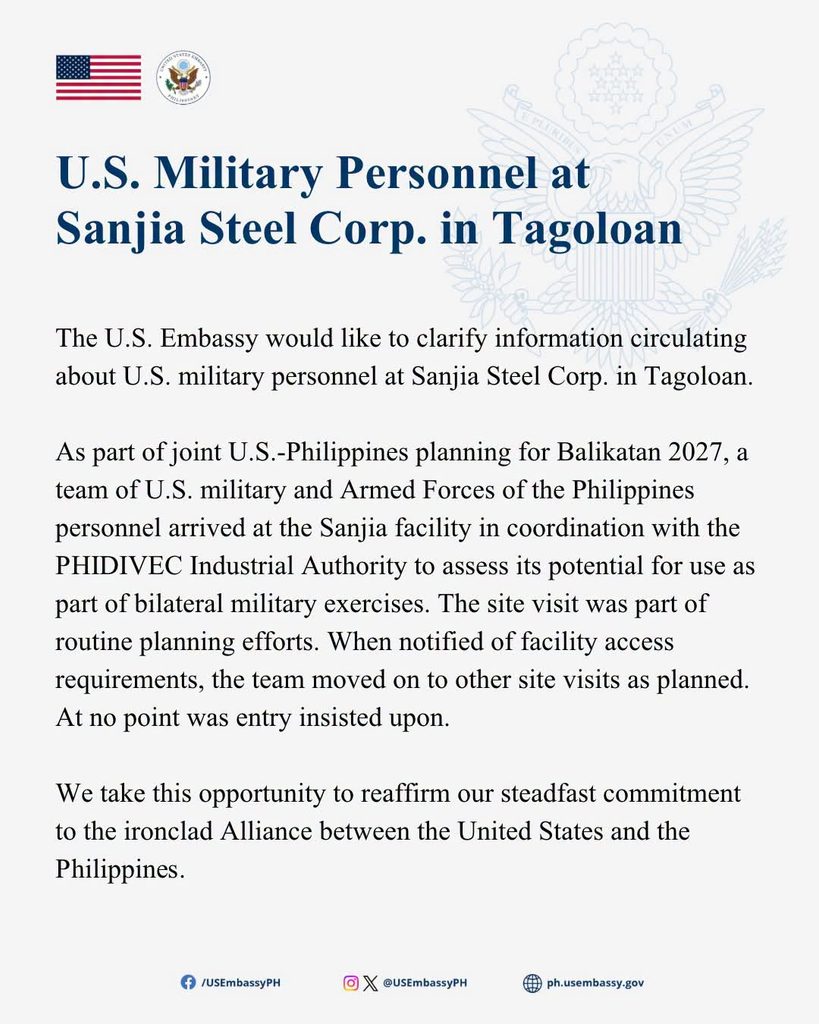
“As part of joint U.S.-Philippines planning for Balikatan 2027, a team of U.S. military and Armed Forces of the Philippines personnel arrived at the Sanjia facility in coordination with the PHIDIVEC Industrial Authority to assess its potential for use as part of bilateral military exercises,” the embassy said.
The embassy characterized the activity as a site assessment rather than an enforcement or unilateral inspection operation, saying the visit formed part of routine preparations for future bilateral exercises.
Team Left After Being Informed of Access Requirements
The U.S. Embassy also addressed the central issue raised in the August 19 police report: the group’s inability to enter the facility.
According to the embassy, once the team was informed about the facility’s access requirements, it moved on to other planned site visits.
“When notified of facility access requirements, the team moved on to other site visits as planned,” the embassy said.
The embassy specifically emphasized that the personnel did not attempt to force their way into the facility or insist on being granted access.
“At no point was entry insisted upon,” it said.
The clarification provides an important distinction from the initial account documented in the police blotter, which described a reported attempt to enter the premises for an inspection and the subsequent refusal by personnel securing the facility.
The police blotter itself did not establish whether the individuals had official authorization that was simply not presented to the security personnel, nor did it determine whether their visit was connected to a military exercise planning activity.
The U.S. Embassy statement now provides an official explanation for the presence of the American and Philippine military personnel and identifies the purpose of the visit as preliminary planning for Balikatan 2027.
Sanjia Site Assessed for Possible Use in Bilateral Exercises
The embassy said the team was assessing the Sanjia facility for its potential use in future bilateral military exercises.
Such planning may involve identifying facilities and locations that could support training scenarios, logistics, or other activities associated with joint exercises. The embassy, however, did not disclose specific details about what portions of the Sanjia facility were being considered or what activities could potentially take place there.
The statement also did not indicate that Sanjia Steel had been selected as a venue for Balikatan 2027.
Instead, the wording indicated that the facility was among sites being assessed as part of the broader planning process.
The presence of both U.S. military and Armed Forces of the Philippines personnel likewise indicates that the activity was being undertaken in a bilateral context, rather than by U.S. personnel acting independently.
Clarification Follows Questions Over Alleged Inspection
The development follows heightened attention to the August 19 incident after the Tagoloan Municipal Police Station documented the account of security guard Jermie Espartero.
According to the police blotter, Espartero reported that the group arrived at approximately 10:12 a.m. and said they intended to conduct an inspection of the Sanjia Steel facility. Philippine Army personnel securing the premises reportedly prevented entry because the group allegedly failed to present a permit or other authorization required to access the compound.
The incident was formally recorded at approximately 11:05 a.m. for documentation.
At the time, however, the police record did not identify the individual American military personnel or PHIVIDEC officials involved, nor did it establish the legal or administrative purpose of the proposed inspection.
The latest statement from the U.S. Embassy substantially clarifies that point, identifying the activity as part of U.S.-Philippine planning for Balikatan 2027 and saying the purpose was to assess the facility’s potential suitability for bilateral exercises.
It also makes clear that the U.S. personnel did not insist on entry after being informed of the facility’s access requirements.
Chinese Embassy Had Raised Questions
The incident had also attracted diplomatic attention after the Chinese Embassy in Manila questioned reports of American military personnel appearing at the Sanjia Steel facility.
The Chinese Embassy described the reported presence as concerning and raised questions over why U.S. military personnel would allegedly be involved in an inspection of a company operating in the Philippines.
It also questioned whether the reported activity could be connected to broader issues involving the PHIVIDEC Industrial Estate and reported plans involving an American fuel hub in the approximately 3,000-hectare industrial area.
Those questions were not established by the original police blotter, which only documented the security guard’s account of the reported attempted entry.
The U.S. Embassy’s clarification now places the visit within a different context, stating that the activity was related to joint military-exercise planning rather than an enforcement inspection.
No Indication of Forced Entry
The embassy’s statement also resolves one of the most significant points of uncertainty surrounding the incident.
There is no indication in the embassy’s account that U.S. military personnel attempted to override the facility’s security procedures or compel Sanjia Steel personnel to grant them access.
Instead, the embassy said the team complied with the facility’s access requirements by moving on to other planned site visits.
This distinction is significant because the original police report documented only the fact that entry was not permitted and did not independently establish the intentions or authority of the individuals involved.
The embassy’s account indicates that the refusal of access did not result in a confrontation or an attempt by the visiting personnel to force entry.
U.S. Reaffirms Alliance With Philippines
In concluding its statement, the U.S. Embassy used the incident to reaffirm Washington’s commitment to its longstanding defense relationship with Manila.
“We take this opportunity to reaffirm our steadfast commitment to the ironclad Alliance between the United States and the Philippines,” the embassy said.
The clarification comes as the two countries continue preparations for future military cooperation and bilateral exercises.
Balikatan, which means “shoulder-to-shoulder,” has become a major component of U.S.-Philippine defense cooperation and involves military personnel from both countries in a range of training and interoperability activities.
The embassy’s statement does not suggest that the August 19 visit represented an operational deployment or enforcement action at Sanjia Steel. Rather, it describes the activity as part of the preliminary assessment of potential sites for future exercises.
What the Clarification Establishes
Based on the U.S. Embassy’s statement and the previously documented police blotter, several points can now be distinguished from the earlier uncertainties surrounding the incident:
- U.S. military personnel were present at the Sanjia Steel facility as part of a team that also included Armed Forces of the Philippines personnel.
- The visit was coordinated with the PHIDIVEC Industrial Authority, according to the U.S. Embassy.
- The purpose was site assessment for possible use in future bilateral military exercises connected to Balikatan 2027.
- The activity was part of routine joint planning, according to the embassy.
- The team did not insist on entering the facility.
- After being informed of access requirements, the team proceeded to other planned site visits.
- The original police blotter did not establish wrongdoing or unauthorized activity by the individuals involved.
- The embassy’s statement provides an official explanation that was not contained in the initial police record.
The clarification does not, however, provide details on the specific access requirements communicated to the team, the precise areas of the facility that were being assessed, or whether Sanjia Steel has agreed to participate in or host any future Balikatan-related activity.
For now, the incident appears to have been a routine site-assessment activity that encountered facility access requirements, rather than an attempt by U.S. military personnel to forcibly enter or conduct an unauthorized inspection.
The episode nevertheless highlights the sensitivity surrounding foreign military activities, industrial facilities, and defense cooperation in strategic areas of Mindanao. The official clarification from the U.S. Embassy provides important context to the August 19 police report and helps distinguish the documented facts of the incident from earlier speculation about its purpose and implications.