
DAVAO CITY, Philippines — The Davao City Police Office (DCPO) has issued a stern warning against making, posting, or spreading false bomb threats, stressing that such acts are not harmless jokes or online pranks but criminal offenses that can lead to arrest, prosecution, and possible imprisonment.
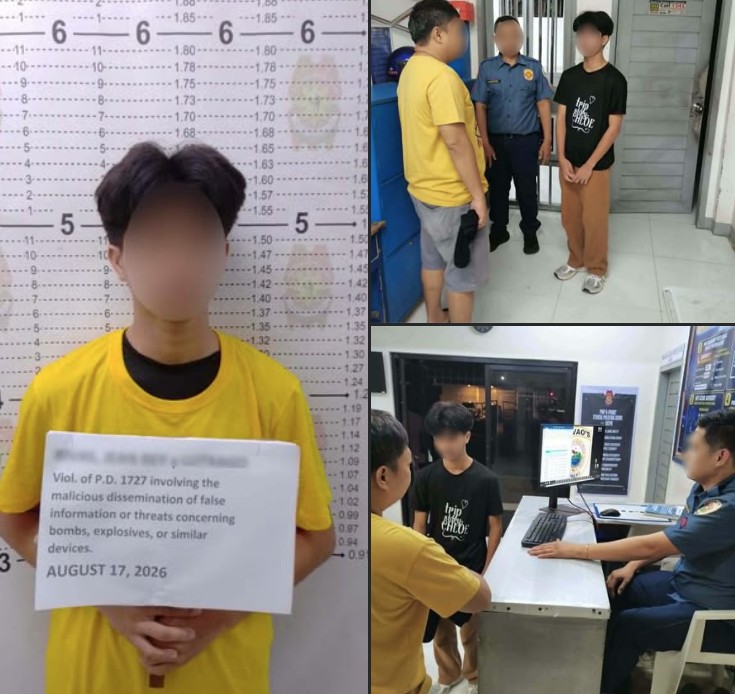
The warning came after police formally filed criminal charges against a 19-year-old individual who allegedly posted a bomb-related joke during a livestream of the Kadayawan Festival, prompting authorities to respond to a reported threat along Davao City’s Coastal Road.
The suspect was charged before the Office of the City Prosecutor for violation of Presidential Decree No. 1727, or the law penalizing the malicious dissemination of false information concerning bombs and explosives.
According to the DCPO, the case stemmed from a social media comment claiming that an explosive device had been planted along the Coastal Road. The report was treated as a genuine security concern and immediately subjected to verification by law enforcement authorities.
Explosive Ordnance Disposal (EOD) and Special Weapons and Tactics (SWAT) personnel were deployed to check the reported location and determine whether an actual explosive threat existed.
Authorities subsequently verified that the area was safe and that no explosive device was found.
The investigation, however, did not end with the clearing of the reported threat.
Through cybercrime investigative efforts, police were able to identify the individual allegedly responsible for the online post. The suspect was subsequently taken into custody and is now facing formal criminal prosecution.
The case carries a recommended bail of ₱42,000, according to police.
The DCPO said the arrest should serve as a clear warning to individuals who may believe that posting bomb threats online, making bomb-related jokes, or deliberately spreading unverified explosive warnings carries no serious consequences.
It does.
“Public safety is never a joke, and spreading false threats is a punishable crime under the law,” said PCOL Peter B. Madria, City Director of the DCPO.
“A reckless comment creates public panic and wastes vital security resources,” Madria added. “What happened to this suspect will happen to anyone else who commits this crime.”
The police director further warned individuals behind threats directed at schools and public gatherings that authorities will not dismiss such incidents as mere jokes, even when they are made through social media or other online platforms.
“To those targeting our schools or public gatherings: we treat every threat with absolute seriousness. Whatever it takes, anyone who violates the law shall face its full length,” Madria said.
The warning comes amid a series of online bomb threats reportedly targeting school institutions in Davao City, placing renewed attention on the use of social media platforms to create fear, disrupt school operations, and trigger emergency responses.
Police emphasized that every reported bomb threat must be assessed as potentially genuine until properly verified. This means that a single online post can trigger the deployment of specialized personnel, security units, and other emergency resources that would otherwise be available for legitimate public safety operations.
False reports can therefore have consequences beyond the person who made the post.
A bomb threat can cause panic among students, teachers, parents, employees, festivalgoers, and other members of the public. It can also force the temporary disruption or evacuation of facilities while authorities conduct security sweeps and determine whether an actual explosive device is present.
For law enforcement agencies, responding to a false threat also consumes manpower, equipment, transportation, and operational time.
The DCPO stressed that the fact that a threat is posted anonymously, through a social media account, during a livestream, or under the guise of humor does not make the person responsible immune from investigation.
Cybercrime investigators can work to identify the source of online threats, while specialized police units can be mobilized to verify reports involving possible explosives.
The arrest of the 19-year-old suspect demonstrates how an online post that may initially appear to be nothing more than a joke can eventually become the subject of a criminal investigation.
The police office reiterated that the public should exercise responsibility when posting or sharing information involving bombs, explosives, shootings, or other security threats.
Individuals who encounter suspicious information online are urged to report it through appropriate authorities rather than amplify unverified claims or participate in the circulation of threatening content.
The DCPO also cautioned parents, students, and other social media users to understand that digital platforms do not provide protection from legal accountability.
A post, comment, message, livestream statement, or other digital content can become evidence in a criminal investigation when it is used to communicate a false threat.
Police said cybercrime units remain actively deployed to identify, arrest, and assist in prosecuting individuals responsible for such acts.
The DCPO’s message is unequivocal: a bomb threat is treated as a security threat regardless of whether the person making it considers it a joke.
As schools, public spaces, and major gatherings remain potential targets for disruptive threats, authorities are warning that anyone who deliberately creates false alarms should expect the same level of seriousness from law enforcement as the threat itself demands.
The case involving the Kadayawan Festival livestream is now before prosecutors, while police continue to emphasize that similar incidents will be investigated and pursued in accordance with the law.