
The Commission on Elections (COMELEC) has reiterated that the issuance of Voter Certification is free of charge nationwide following social media allegations that voters were being asked to pay fees at election offices in Cotabato, prompting an investigation and a public clarification from election officials.
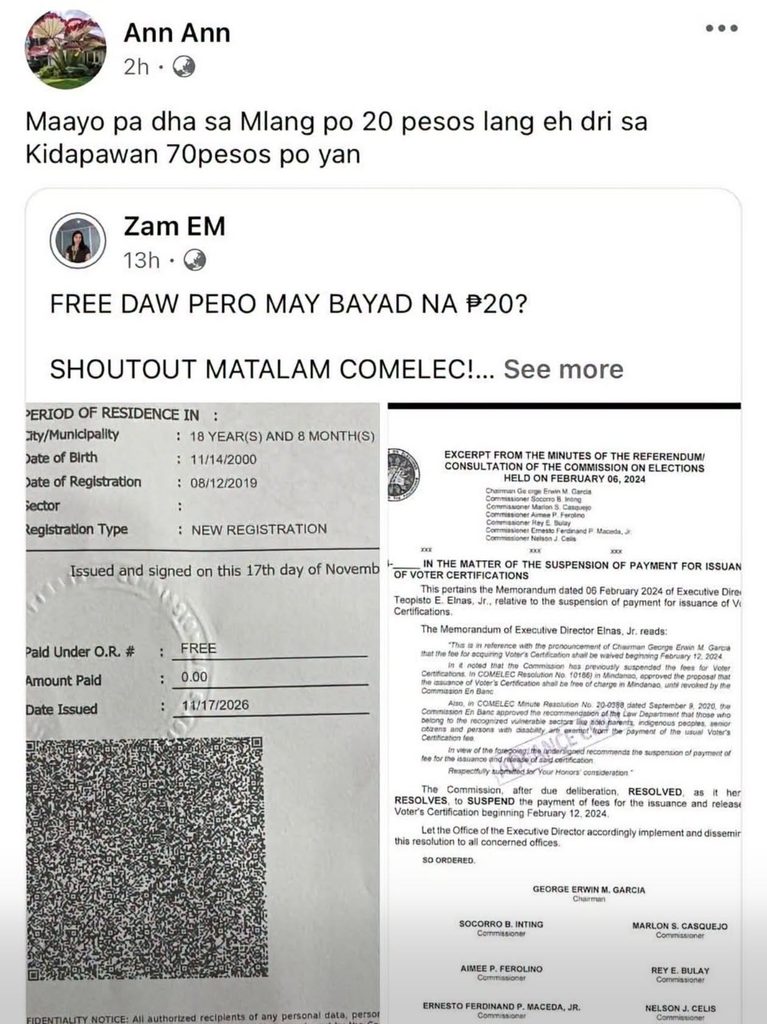
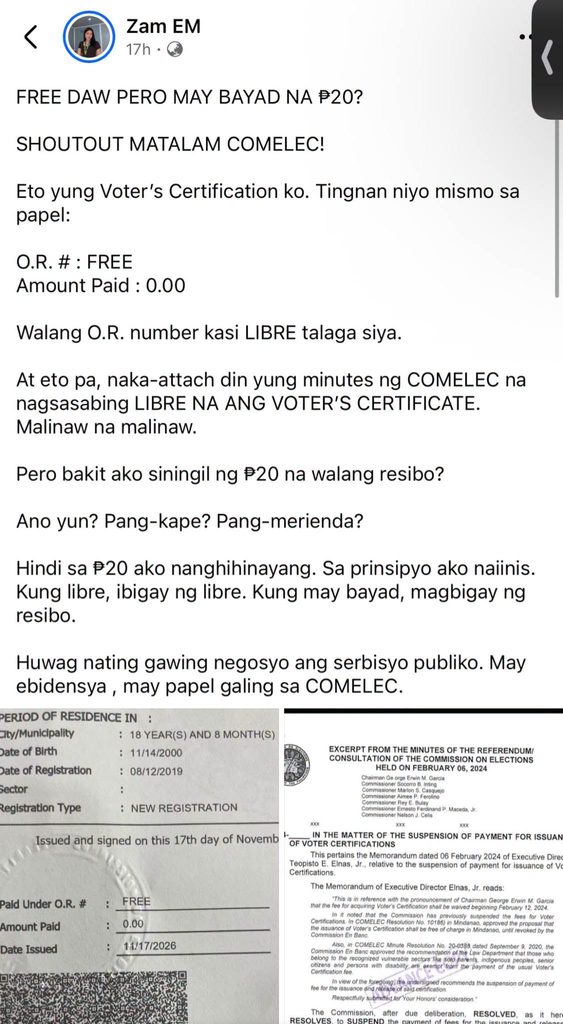
The controversy surfaced on November 18, 2026, after a Facebook user identified as “Zam Em” posted an allegation that the COMELEC office in Matalam, Cotabato Province, was collecting ₱20 for the issuance of a Voter Certification, despite the service supposedly being free.
The post was subsequently shared by another Facebook user, “Ann Ann,” a resident of Kidapawan City, who raised a separate allegation that the COMELEC office in Kidapawan was charging ₱70 for the same document. Her post compared the alleged charges with those in other municipalities, further fueling public discussion about the supposed collection of fees.
The allegations prompted COMELEC offices in Cotabato and Region XII to issue clarifications and initiate efforts to establish what actually happened.
In an official public statement, COMELEC Region XII said it had taken cognizance of the social media post concerning the alleged ₱20 collection at the Matalam office. It stressed that Voter Certification is issued free of charge under existing COMELEC rules and that unauthorized collection of fees would not be tolerated.
The regional office said it was conducting a thorough investigation and would personally reach out to the individual who published the allegation to obtain her account, gather relevant details, and secure any available evidence.
COMELEC Region XII also addressed a separate allegation that its personnel had contacted the complainant and called her a “reklamador.” The office categorically denied making such communication or using the alleged remark, emphasizing that complaints about public services should be welcomed and treated seriously.
Meanwhile, the COMELEC office in Kidapawan also defended its position, challenging the social media user to identify the person who allegedly demanded payment and saying it was prepared to pursue appropriate legal action if necessary.
The controversy took another turn on the morning of November 19, when Ann Ann personally appeared at the COMELEC office in Kidapawan and apologized over her social media post.
According to the office, the Facebook user sought to apologize, and her apology was accepted. The development followed the circulation of her allegation that the Kidapawan office was collecting ₱70 for Voter Certification.
COMELEC Kidapawan reiterated that it does not collect fees for the document and clarified that the service had already been free since February 26, 2024.
However, a broader clarification issued by COMELEC reminded the public that the nationwide policy of free Voter Certification processing has been in effect since 2022, covering local and overseas voter certification services.
For local voters, applications may be processed through the National Central File Division at the COMELEC Main Office in Intramuros, Manila, or through the Office of the Election Officer in their respective cities, districts, and municipalities, including authorized off-site locations.
For overseas voters, the service is available through the COMELEC Office for Overseas Voting at the main office or its designated off-site locations.
The commission also clarified that Voter Certification cannot be processed or released entirely online. Applicants or their duly authorized representatives must personally visit the appropriate COMELEC office to secure the document.
It further warned the public against unauthorized individuals or intermediaries offering to facilitate the issuance of Voter Certification in exchange for payment, stressing that transactions should be conducted only with authorized COMELEC personnel.
Voter Certification is recognized as a valid government-issued identification document, making access to the service particularly important for Filipinos who need official proof of their voter registration.
The public is encouraged to report any personnel or individuals demanding unauthorized payments for the service through the Office of the COMELEC Chairman at ocgemg@comelec.gov.ph, the 8888 Citizens’ Complaint Hotline, or the Anti-Red Tape Authority (ARTA).
While the apology in Kidapawan has addressed one part of the controversy, the separate allegation involving the Matalam office remains subject to investigation. Establishing the facts behind each complaint is essential to protecting both the integrity of public institutions and the right of citizens to question and report possible irregularities in government services.
COMELEC’s reminder is clear: Voter Certification is free, and no voter should be required to pay an unauthorized fee to obtain it.