
MANILA, Philippines — The Department of the Interior and Local Government (DILG) has announced a ₱50-million reward for information leading to the capture of Senator Ronald “Bato” Dela Rosa, intensifying a nationwide manhunt linked to an arrest warrant issued by the International Criminal Court (ICC) over alleged crimes against humanity connected to the administration of former President Rodrigo Duterte’s anti-drug campaign.
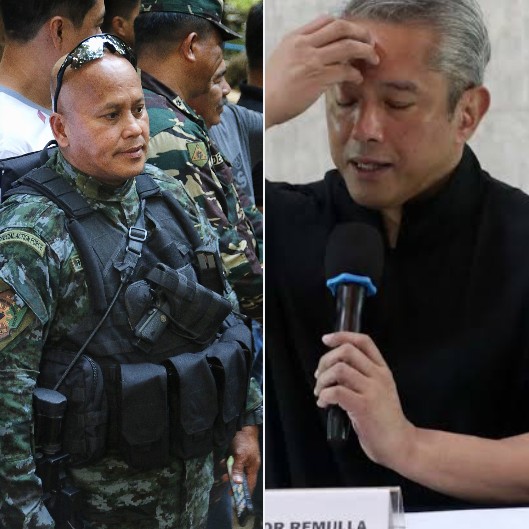
DILG Secretary Jonvic Remulla and Philippine National Police (PNP) Chief Gen. Jose Melencio Nartatez Jr. announced the bounty during a joint press briefing at Camp Crame on Friday, October 23, 2026. The announcement followed the reported failure of negotiations with individuals or a group believed to be protecting the senator. Authorities have given Dela Rosa one week to surrender.
Remulla also warned of the potential consequences of an operation to locate and apprehend the senator, saying he was believed to be hiding under the protection of a large group in Mindanao. According to the account provided, Remulla suggested that an operation in the area could result in more than 10,000 deaths.
The figure underscores the government’s stated concern about the risks of a potentially violent confrontation. However, the specific basis for the estimate, the identity of the group allegedly sheltering Dela Rosa, and whether authorities have independently verified its strength have not been established in the information available. The claim should not be interpreted as a confirmed casualty forecast.
The government has classified Dela Rosa as armed and dangerous and described him as the country’s most wanted person. The announcement raises significant questions about the legal authority for the bounty, the use of intelligence funds, and the procedures for enforcing the ICC warrant in the Philippines.
Lawyer questions legal basis for ₱50-million reward
Dela Rosa’s lawyer, Israelito Torreon, has strongly challenged the government’s action, arguing that the bounty was announced without a Philippine arrest warrant or a domestic criminal case against the senator.
In a statement titled “A Bounty Without a Warrant,” Torreon questioned what specific Philippine offense the reward was intended to address, which domestic court had authorized the arrest, and what criminal case number supported the government’s action.
Torreon argued that the DILG’s established reward system for most-wanted persons relies on Philippine arrest warrants and documented criminal cases. He cited DILG Memorandum Circular No. 2015-136, which concerns monetary rewards for the arrest, surrender, or death of wanted persons, as well as PNP Memorandum Circular No. 2011-001, which he said requires most-wanted listings to be supported by arrest warrants.
The lawyer contrasted Dela Rosa’s case with the government’s reported ₱10-million reward for businessman Atong Ang in January 2026, which Torreon said followed the issuance of a warrant by a Regional Trial Court in Santa Cruz.
Applying the same framework to Dela Rosa, Torreon said there was no Philippine offense filed against the senator, no issuing Philippine court, and no domestic criminal case number identified to support the bounty.
The government’s stated basis, he argued, was an ICC warrant. He maintained that no Philippine judge had examined and adopted that warrant or issued a corresponding domestic warrant.
These are arguments advanced by Dela Rosa’s legal counsel, not a judicial ruling that the bounty is unlawful. The precise legal authority invoked by the government and any formal documents authorizing the reward remain central to the dispute.
Dispute over the ICC warrant and Philippine jurisdiction
The manhunt stems from the ICC’s investigation into alleged crimes against humanity associated with the Duterte administration’s anti-drug campaign. Dela Rosa, who served as PNP chief during the early years of that campaign before becoming a senator, has been linked to allegations arising from his role in implementing the policy.
The ICC has identified him as an alleged co-perpetrator in the case, according to the information provided. The allegations remain accusations and should not be treated as a conviction.
The Philippines’ withdrawal from the Rome Statute took effect on March 17, 2019. However, the legal implications of that withdrawal for the ICC’s jurisdiction over alleged crimes committed while the country was a member, as well as the domestic enforcement of an ICC arrest warrant, are separate legal questions.
Torreon argued that the Philippines’ withdrawal and the absence of a domestic warrant undermine the government’s authority to proceed as announced. He also pointed to a pending Supreme Court case, G.R. No. 278747, concerning constitutional questions surrounding the ICC warrant, and urged the executive branch to allow the judiciary to resolve the issues.
The legal dispute therefore extends beyond the existence of an ICC warrant. It involves the extent of Philippine cooperation with the international tribunal, the domestic legal procedures for taking a person into custody, and the authority of government agencies to expend public funds in support of an international arrest process.
Lawyer raises concerns over intelligence funds
Torreon also questioned the reported plan to finance the ₱50-million reward from intelligence funds of the DILG and PNP.
He cited Article VI, Section 29(1) of the 1987 Constitution, which restricts the withdrawal of public money from the Treasury to expenditures authorized by law, and Section 4 of Presidential Decree No. 1445, which requires government funds to be used for public purposes and in accordance with applicable laws and regulations.
He further cited COA-DBM-DILG-GCG-DND Joint Circular No. 2015-01, which governs confidential and intelligence funds. Torreon argued that rewards paid to informants must have the appropriate approval, supporting documentation, and a direct connection to authorized confidential activities.
The lawyer called on the government to identify the specific legal authority for the expenditure and disclose the applicable DILG memorandum circular, Philippine court warrant, and criminal case number.
The government has yet to be shown, in the information provided, to have publicly addressed each of these specific legal objections. Whether the bounty can lawfully be financed through intelligence funds will depend on the applicable legal framework, the authorization documents, and the circumstances of the proposed expenditure.
‘Armed and dangerous’ designation questioned
Torreon also challenged the government’s description of Dela Rosa as “armed and dangerous,” arguing that a statement made at a press briefing is not equivalent to a judicial finding.
He warned that the combination of a large bounty, a public call for the senator’s capture, and the designation could encourage armed individuals to pursue him for financial gain. He argued that the rules governing arrests by private persons under Rule 113, Section 5 of the Rules of Criminal Procedure permit warrantless arrests only in specified circumstances.
The lawyer maintained that the announcement could create risks if private individuals interpreted the bounty as authorization to seize the senator outside the legal grounds for a citizen’s arrest.
The government’s classification and the existence of a reward do not, by themselves, establish that private individuals may use unlawful force or conduct an otherwise unauthorized arrest. Any apprehension must comply with applicable law.
Government faces calls to disclose legal authority
Torreon challenged the government to publicly identify four documents or legal bases: the Philippine court that issued a warrant against Dela Rosa, the corresponding criminal case number, the DILG memorandum circular authorizing the reward, and the legal basis for drawing the money from intelligence funds.
He also cited Section 17 of Republic Act No. 9851, which addresses the surrender of persons to international courts, arguing that its use of the word “may” does not itself constitute an arrest warrant or an unconditional command to surrender a person.
The government, meanwhile, has intensified efforts to locate Dela Rosa and is reportedly monitoring areas associated with the senator, including Davao City and other locations where authorities believe he may have support.
Authorities have indicated that if Dela Rosa is apprehended outside Senate premises, he would be turned over for the process of surrender to the ICC in The Hague. The exact legal and procedural steps would depend on the warrant, applicable Philippine law, and any relevant judicial action.
Dela Rosa’s legal team has maintained that the senator has not received formal notice and that anti-drug operations carried out under his command were lawful. That position does not resolve the allegations before the ICC, just as the existence of an arrest warrant does not establish guilt.
A high-stakes test of law enforcement and due process
The ₱50-million bounty places the government under pressure to explain not only how it intends to locate Dela Rosa but also the legal framework governing his apprehension and the use of public funds.
The reported presence of a large group protecting the senator, coupled with Remulla’s warning about the potential for mass casualties, adds a serious security dimension to the operation. But the government must distinguish verified intelligence from estimates and ensure that any action avoids unnecessary bloodshed.
At the same time, Torreon’s challenge places the legal basis for the reward under scrutiny. The central questions are whether the government has sufficient domestic authority to implement the ICC warrant, what procedures must be followed, and whether the proposed expenditure complies with rules governing intelligence funds.
The outcome could have consequences beyond Dela Rosa’s case, potentially shaping the relationship between Philippine law enforcement, domestic courts, public accountability, and international criminal justice.
For now, the competing positions remain clear: the government is pursuing the senator in connection with an ICC warrant, while his lawyer insists that the legal authority for the bounty must be publicly demonstrated. The resolution will depend on verifiable official documents, applicable law, and any rulings issued by the courts.