
Elected youth official was reportedly under police surveillance for months; viral video and unexplained leave request raise questions about accountability
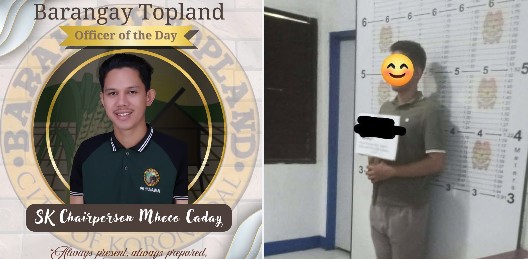
KORONADAL CITY, South Cotabato — An elected Sangguniang Kabataan (SK) chairperson in Koronadal City is facing scrutiny after voluntarily surrendering to police over allegations of illegal drug use, raising questions about the accountability expected of public officials entrusted with representing the city’s youth.
Mheco Caday, the SK chairperson of Barangay Topland, surrendered to the Koronadal City Police Station’s City Drug Enforcement Unit (CDEU) at around noon on Wednesday, October 21, 2026, according to Police Lieutenant Colonel Harold V. Cornel, chief of the Koronadal City Police Station.
Caday was accompanied by his live-in partner, sibling, and barangay captain when he presented himself to authorities.
Police said Caday had been under surveillance for several months and was classified as a high-value individual (HVI) in connection with allegations of illegal drug use. Cornel said authorities had been preparing an anti-drug operation against him, but the official surrendered before the planned operation could be carried out.
The development has drawn attention not only because of the allegations against Caday, but also because of the position he holds. As an elected youth official, an SK chairperson is expected to help represent young constituents and serve as a public example of responsible leadership. The allegations, however, remain subject to verification and due process.
Viral video adds to scrutiny
A video circulating on social media reportedly shows Caday using illegal drugs. However, the video’s authenticity, context, and contents have not been independently established in the available information.
The circulation of the footage has intensified public attention on the case, but the video alone should not be treated as conclusive proof of criminal liability. Authorities have yet to publicly establish the circumstances surrounding the recording or announce a final finding based on it.
The police account of months-long surveillance and preparations for an operation indicates that the allegations were already on law enforcement’s radar before Caday’s surrender. Nevertheless, the precise evidence gathered by investigators and the basis for his classification as an HVI have not been fully disclosed.
Mayor surprised by leave request without stated reason
Koronadal City Mayor Erlinda P. Araquil said she was surprised by Caday’s surrender, particularly because she had received a leave-of-absence request from him through the Department of the Interior and Local Government (DILG).
According to Araquil, Caday requested leave from October 9 to November 9, 2026, and designated the number one SK councilor as officer-in-charge during his absence.
The mayor said the request did not specify a reason for the leave. She had intended to clarify the matter with the DILG before signing the request, she reportedly explained.
Caday’s subsequent surrender therefore brought a new dimension to the previously unexplained absence request. However, there is no established evidence in the information made available that the leave request was filed to evade authorities or conceal wrongdoing.
The sequence of events nevertheless raises questions that the concerned offices may need to clarify, including the reason for the leave, the status of the request, and the arrangements for continuity of the SK council’s work during the chairperson’s absence.
Drug test pending; surrender does not settle the case
Following his surrender, Caday underwent profiling, booking procedures, and debriefing. He was also subjected to drug testing, with the result still pending according to the police account.
Cornel said Caday could be assessed for possible inclusion in a Community-Based Drug Rehabilitation Program (CBDRP), depending on the results and the applicable procedures. The intervention may be handled at the barangay or city level, including through the City Anti-Drug Abuse Council (CADAC), as appropriate.
Police clarified that no criminal complaint had been filed against Caday in connection with the surrender at the time of the report. No arrest operation had been carried out because he voluntarily presented himself to authorities.
The absence of a criminal complaint at this stage does not constitute a finding that the allegations are true or false. Nor does voluntary surrender, by itself, establish criminal guilt or automatically resolve any possible administrative consequences.
Authorities must still determine the appropriate course of action based on the evidence, the drug test result, and applicable legal procedures.
Possible legal and administrative consequences
Section 15 of Republic Act No. 9165, or the Comprehensive Dangerous Drugs Act of 2002, addresses the use of dangerous drugs and provides for legal procedures and consequences where the statutory requirements are met. Whether the provision applies to Caday will depend on the evidence, applicable procedures, and findings of the competent authorities.
Separately, his status as an elected SK official may bring administrative scrutiny. The DILG and other offices with jurisdiction may assess whether a formal complaint is warranted and what rules apply to his conduct and continued service.
Any administrative charge, possible penalty, or disqualification would depend on the applicable law, the evidence, and due process. No final administrative finding or removal from office has been established in the information available for this report.
The case highlights the distinction between criminal proceedings and administrative accountability: the two processes have different legal standards and procedures, and neither should be presumed to have reached a conclusion before the appropriate authorities act.
City anti-drug council stresses both accountability and rehabilitation
Rey Calanao, an officer of the Koronadal City Anti-Drug Abuse Council, expressed disappointment over the allegations involving Caday, noting that SK leaders are expected to set a positive example for young people.
Calanao also emphasized that the city remains open to helping individuals who seek to stop using illegal drugs, including through appropriate intervention and rehabilitation programs.
The city’s position underscores two responsibilities that must be addressed together: enforcing the law where evidence warrants it and providing suitable treatment and support when rehabilitation is appropriate.
In Caday’s case, the drug test result and the outcome of the relevant assessment are expected to help determine the next steps. Rehabilitation, if warranted and pursued through the proper process, would not by itself resolve any separate administrative question concerning his public duties.
Public trust and youth leadership at stake
The allegations against Caday place renewed attention on the standards expected of elected youth representatives. SK chairpersons exercise public responsibilities and occupy positions intended to give young people a voice in local governance. Public confidence in those institutions depends on transparency, responsible conduct, and the fair application of the rules.
But accountability must be evidence-based. The allegations and circulating video warrant proper examination, while Caday remains entitled to due process and must not be declared criminally liable without the required findings.
The questions now facing the relevant authorities are concrete: What will the drug test show? Will investigators establish grounds for a criminal complaint? Will the DILG review Caday’s conduct or leave request? And what steps will be taken to ensure that Barangay Topland’s SK council continues to perform its responsibilities?
For now, Caday’s voluntary surrender marks a significant development in the allegations against him, but it is not the end of the matter. The next steps by the police, anti-drug council, and DILG will determine whether the case leads to rehabilitation, formal legal proceedings, administrative action, or some combination of measures permitted by law.