
The death of Cheryl Sarate was not merely a tragic accident. It was a catastrophic institutional failure — one that exposed how negligence, complacency, and the absence of accountability can turn a university celebration into a funeral procession.
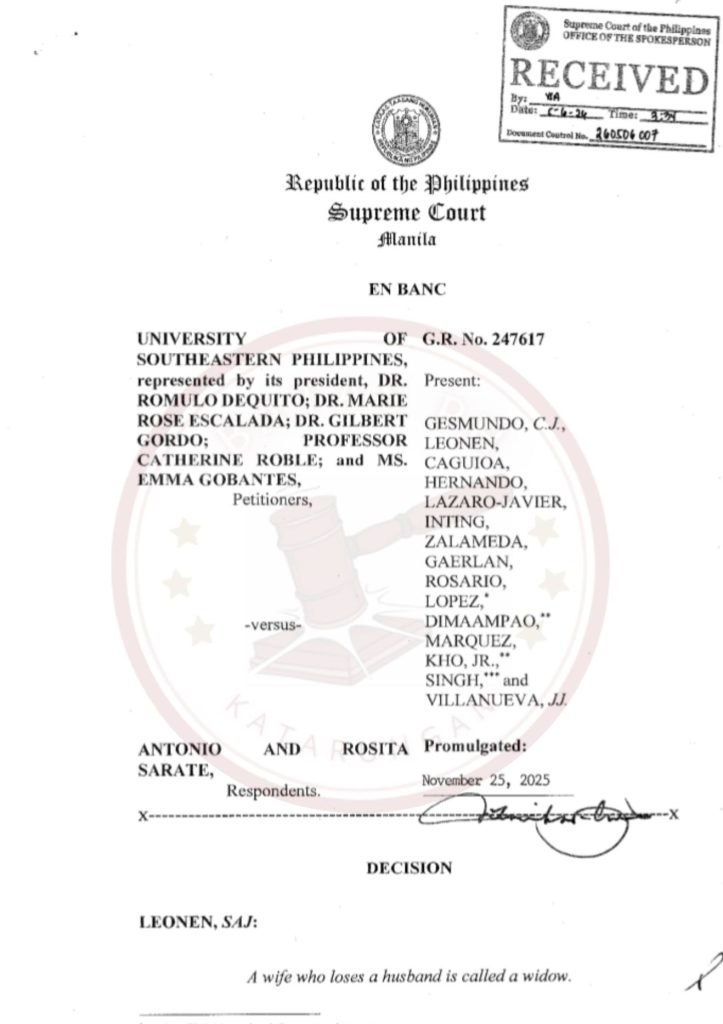

For nearly two decades, Cheryl’s story lingered as a painful reminder of what happens when educational institutions forget their most sacred duty: protecting the lives entrusted to them. Now, the decision of the Supreme Court of the Philippines ordering the University of Southeastern Philippines and its officials to pay PHP 6.45 million in damages is more than a legal judgment. It is a moral reckoning.
The facts are horrifying.
A young student walked a makeshift runway illuminated by open flames. She wore a highly flammable costume made of cotton, plastic cellophane, feathers, and tie wire. The venue lights were dimmed to dramatize the candlelit effect. No fire suppression response happened immediately. Students — not trained personnel — tried desperately to save her. The ambulance reportedly arrived 30 minutes later. And perhaps most disturbingly, the beauty pageant resumed after Cheryl was taken to the hospital, as though the spectacle mattered more than the human being who had just been burned alive before their eyes.
That detail alone should haunt every educational institution in the country.
The Supreme Court was correct in rejecting USEP’s attempt to distance itself from responsibility by claiming the pageant was an “unauthorized activity.” Universities cannot conveniently disown student organizations when tragedy strikes while simultaneously benefiting from their existence, prestige, and participation in campus life. A recognized student organization remains part of the university ecosystem. Its activities occur under the umbrella of institutional authority and supervision.
The Court’s ruling establishes a crucial principle: schools are not passive landlords renting out facilities to students. They are guardians exercising special parental authority.
That authority carries obligations.
Universities frequently champion student leadership, extracurricular engagement, and creative expression. They encourage pageants, festivals, cultural nights, intramurals, and performances because these activities supposedly develop character and community. Yet too many institutions treat safety as an afterthought — a bureaucratic checklist instead of a life-saving necessity.
How many campus events today still operate without emergency response protocols? How many venues lack visible fire extinguishers? How many student organizers receive no safety orientation whatsoever? How many faculty advisers sign documents mechanically without genuinely assessing risks?
Cheryl’s death forces uncomfortable questions that schools can no longer ignore.
This case also reveals a dangerous culture common in many institutions: performative supervision. Officials are present in title but absent in action. Advisers exist on paper but fail in actual oversight. Safety policies are written but unenforced. Everyone assumes someone else is responsible — until disaster arrives.
Negligence is rarely dramatic at first. It accumulates quietly through ignored warnings, lax preparation, normalized shortcuts, and institutional indifference. Then one spark changes everything.
The Supreme Court’s decision should therefore resonate far beyond USEP. It sends a warning to every school, college, and university in the Philippines: when institutions fail to protect students, accountability will follow.
But legal accountability alone is insufficient.
No amount of monetary damages can restore Cheryl’s life or erase the unimaginable suffering endured by her family. The PHP 5 million awarded as moral damages recognizes emotional devastation, but grief cannot be quantified by court orders. The ruling may close a legal chapter, yet it leaves behind enduring ethical questions about how educational institutions define responsibility.
A university is supposed to be a sanctuary of learning, growth, and protection. Parents send their children to school believing they will return home safely. That trust is sacred. Once broken, it damages not only a single institution but public faith in the educational system itself.
The deeper issue here is not simply fire safety. It is institutional empathy.
Would this tragedy have unfolded differently if administrators genuinely viewed student welfare as non-negotiable? Would someone have questioned the use of open flames near flammable costumes? Would emergency responders have been stationed nearby? Would faculty supervision have been stricter? Would the event have stopped immediately after the incident instead of resuming?
Most likely, yes.
What Cheryl Sarate’s death teaches us is that negligence is not merely the absence of action. It is the failure to value human life with sufficient seriousness before tragedy occurs.
Educational institutions must now move beyond symbolic condolences and reactive policy statements. They should conduct mandatory risk assessments for all student events, require emergency preparedness training for organizers, establish stricter faculty accountability, and ensure accessible safety equipment in every venue. Student creativity should never come at the expense of student survival.
Cheryl should have gone home after that pageant.
Instead, she became a painful lesson in what happens when institutions neglect the responsibilities attached to their authority.
The Supreme Court ruling is not anti-university. It is pro-accountability. And accountability, especially in places of learning, is not punishment — it is justice.