
DAVAO CITY — After six days of relentless search and retrieval operations, authorities have recovered the body of one of the two senior citizens reported missing following the deadly trash slide at the sanitary landfill in Barangay New Carmen, Tugbok District, Davao City.
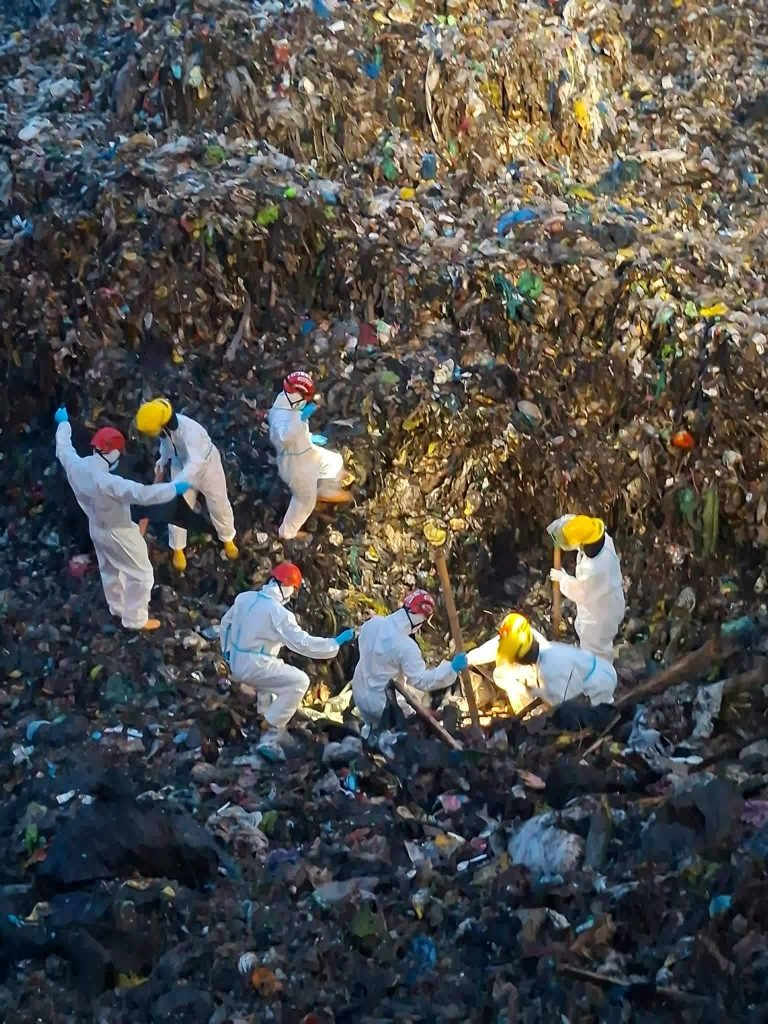
The body of 78-year-old Luisa Estardante Felame, a resident of Purok 8, Barangay New Carmen, was found at around 6 p.m. on Tuesday, May 26, during coordinated operations conducted by the Bureau of Fire Protection-Special Rescue Unit (BFP-SRU) and Central 911 Urban Search and Rescue (USAR) teams.
Felame was among the residents believed buried when a massive portion of the garbage mound at the New Carmen Sanitary Landfill collapsed on May 20 amid days of continuous heavy rainfall in Davao City.
Search and retrieval operations remain ongoing for another missing senior citizen, identified as Rosita, 67, who is still feared trapped beneath tons of waste and debris.
The landfill tragedy previously claimed the life of a scavenger identified as Cristel, a resident of the area, while two others — including a 16-year-old boy and an adult woman — were injured during the incident.
Authorities earlier said the collapse occurred at around 1:15 p.m. on May 20 after heavy rains allegedly caused water buildup beneath the landfill, weakening the stability of the massive garbage mound and triggering what experts described as a “mass wasting” event.
The collapse buried residential structures occupied by scavengers and nearby residents living close to the dumpsite.
More than 100 families were evacuated from the area following fears of another collapse, while roads leading to Purok 8 were immediately cordoned off by authorities for safety reasons.
In response to the incident, the Department of Environment and Natural Resources in Davao Region (DENR-XI) and the Environmental Management Bureau (EMB-XI) ordered the temporary suspension of waste disposal operations at the New Carmen Sanitary Landfill beginning May 22.
In a statement, DENR-XI Regional Executive Director Atty. Maria Mercedes V. Dumagan said the suspension was necessary to allow the city government to implement slope stabilization measures and other corrective actions required under Republic Act No. 9003, or the Ecological Solid Waste Management Act, as well as the conditions stated in the landfill’s Environmental Compliance Certificate (ECC).
“The disposal of waste at the sanitary landfill is currently suspended by DENR-XI and EMB-XI to allow our LGU to implement slope stabilization measures, among other recommended actions, to comply with RA 9003 and the conditions of their ECC,” Dumagan said.
The DENR also urged the public to cooperate in reducing waste generation by practicing proper waste segregation at home.
“We strongly encourage all Dabawenyos to practice waste segregation at home and adopt proper waste management to reduce the volume of garbage collected by our LGU,” the agency stated.
Meanwhile, the City Government of Davao confirmed that it has already filed a motion for reconsideration with DENR-Davao on May 26 regarding the suspension order.
City Information Office head Harvey Lanticse said the city government submitted the results of geotechnical assessments conducted in the area along with recommended corrective measures intended to address the landfill’s stability issues.
Despite the suspension, Lanticse assured residents that garbage collection operations in the city will continue as scheduled.
“The city will utilize its new landfill facility adjacent to the existing site in Barangay New Carmen,” he said.
The City Environment and Natural Resources Office (CENRO) also renewed its call for residents to segregate waste properly to help reduce the volume of garbage being transported to the landfill daily.
The tragedy has also reignited concerns among environmental groups and advocates over waste management practices, landfill safety, and the dangerous conditions faced by informal waste workers and scavengers operating in disposal sites.
As retrieval operations continue, authorities remain on high alert due to unstable ground conditions and the risk of further movement within the landfill area.