
After 21 years of waiting, the award of an ancestral domain title is a historic victory for the Teduray and Lambangian. But with killings continuing and competing land claims still unresolved, recognition on paper must now be followed by protection on the ground.
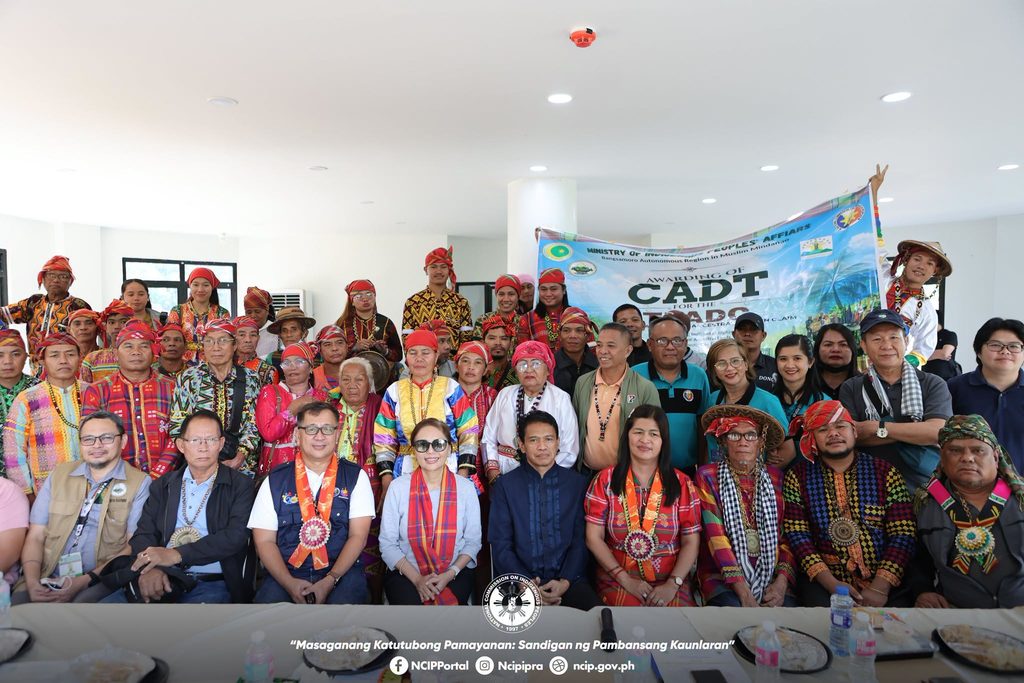
On October 22, 2026, the Teduray and Lambangian peoples achieved what generations of their leaders had fought for: formal recognition of their ancestral domain through the awarding of a Certificate of Ancestral Domain Title (CADT), covering 11 parcels with a combined area of approximately 117,101.78 hectares across Maguindanao and Sultan Kudarat.
The milestone, 21 years after their application was filed in 2005, deserves to be celebrated. It represents the perseverance of Indigenous communities who have spent decades asserting their identity, defending their land, and demanding recognition of rights they believe should never have been left in limbo for so long.
But celebration must not become complacency.
For the Teduray and Lambangian, the question is no longer simply whether the government recognizes their ancestral domain. The more urgent question is whether that recognition will finally make it possible for them to live, farm, fish, travel, govern their communities, and raise their children without fear.
Will this title end the killings, displacement, intimidation, and harassment associated with the struggle over ancestral lands? Or will the formal recognition of their claim intensify tensions with those who contest it, particularly where other land uses, settlements, and armed interests overlap?
The CADT is a historic achievement. Whether it becomes a turning point toward peace or another document that communities must struggle to defend remains to be seen.
Twenty-one years of waiting, and a human cost that cannot be ignored
A 21-year wait for recognition is not merely a bureaucratic inconvenience. For communities whose identity, livelihood, culture, and customary governance are inseparable from their ancestral territory, every year of uncertainty can mean another year of vulnerability.
The scale of the violence documented by Indigenous advocates makes that uncertainty particularly disturbing. The materials provided for this commentary cite Timuay Justice and Governance and Climate Conflict Action documentation recording at least 102 Non-Moro Indigenous Peoples, including leaders and community members, killed in the Bangsamoro region since its establishment in 2019. The same documentation cites as many as 3,000 Teduray residents who have temporarily fled their communities because of fear of targeted violence.
These figures should be attributed to the groups that documented them and independently verified where possible. But even with that qualification, the pattern of reported killings, displacement, and recurring threats demands serious attention from the government.
Among the reported victims were Teduray and Lambangian community leaders and elders. In 2024, Lambangian leader Baywan Angan was reportedly shot dead while fishing, followed days later by the killing of his wife, Cita Angan, who had attempted to identify the assailants. In 2025, Teduray leader Nicasio Mindo was reportedly killed in an ambush, while tribal elder Fernando Promboy and community leader Ramon Lupos were reported killed in separate incidents.
These are not just names in a list of incidents. Each death leaves a family grieving, a community deprived of leadership, and survivors asking whether asserting their rights puts their lives at risk.
The latest reported shootings underscore the urgency. According to the Ministry of Indigenous Peoples’ Affairs (MIPA), Barangay Kagawad Joel Manguda Magtud was killed in a shooting on October 17, 2026, in Datu Unsay, Maguindanao del Sur. On October 18, Sayrel Guiaman Tomas was killed and Jayjay Guiaman was seriously wounded in another shooting in the same area of Barangay Maitumaig.
The circumstances, motives, and responsibility for these incidents must be established through impartial investigations. It would be irresponsible to attribute every killing to a single cause or to identify perpetrators without evidence. Nevertheless, the frequency of reported violence against members of the affected communities, against the backdrop of longstanding land disputes, makes effective protection and credible investigations indispensable.
This is the reality against which the new title must be judged.
A government cannot reasonably declare a land-rights struggle resolved simply because a certificate has been awarded while the people whose rights it recognizes continue to fear for their safety.
A title is a victory, not a magic shield
The CADT matters because formal recognition can strengthen the Teduray and Lambangian’s ability to assert their ancestral land rights, protect their cultural heritage, preserve customary governance, and participate in decisions affecting their territory.
It can provide an important legal foundation for addressing encroachment and resolving competing claims. It can also help establish a clearer basis for determining which activities are permissible within the recognized ancestral domain and which require further legal scrutiny, consultation, or consent under applicable law.
But a title does not automatically remove armed individuals, settle every overlapping claim, restore displaced families to their homes, or guarantee that witnesses can safely testify against those responsible for violence.
Nor does the ceremony itself establish that every boundary has been physically demarcated, every competing interest reconciled, or every government agency prepared to enforce the resulting rights.
That is where the real test begins.
If the CADT is followed by clear boundaries, accessible documentation, effective legal remedies, adequate security, and meaningful participation by the affected communities, it could become a foundation for lasting peace. If it is left to stand alone, its promise may be undermined by the same practical obstacles that have prolonged the conflict.
The danger is that the state will treat the award as the conclusion of a process when, for the people concerned, it is only the beginning of another difficult phase: making recognized rights real.
The overlapping land question cannot be wished away
One of the most consequential challenges concerns the government’s parallel effort to document land parcels within the six previously acknowledged Moro Islamic Liberation Front (MILF) camps.
The Parcellary Inventory Project, led by the Office of the Presidential Adviser on Peace, Reconciliation and Unity (OPAPRU) and the Department of Agrarian Reform (DAR), was designed to map statutory and customary land claims in priority areas within those camps. Its stated purpose includes informing land-tenure interventions, socioeconomic development, and normalization initiatives, including possible housing for decommissioned MILF combatants.
That is a legitimate and important peacebuilding objective. Former combatants and their families also need lawful access to land, housing, livelihoods, and the opportunity to rebuild their lives after conflict.
But peacebuilding cannot mean resolving one community’s historical insecurity by creating another community’s dispossession.
The materials informing this commentary raise a particularly sensitive concern: two parcels identified in the MILF camps inventory reportedly overlap with the Teduray-Lambangian ancestral domain claim. The exact locations, extent, legal status, and nature of these overlaps must be established through examination of the relevant maps, coordinates, land records, and official decisions. The available information does not, by itself, establish that the inventory has extinguished, superseded, or legally defeated the CADT.
That distinction is essential.
A GIS-based inventory is a tool for identifying and analyzing land claims. It is not, by itself, a final adjudication of ownership. Mapping a parcel does not automatically confer title, settle competing rights, or authorize the transfer of land to a particular claimant.
Conversely, the award of a CADT does not make every practical dispute over occupancy, boundaries, historical use, or competing legal interests disappear overnight. Those issues must be addressed through the applicable legal framework and legitimate, transparent processes.
The government therefore faces a difficult but unavoidable responsibility: reconcile the requirements of ancestral domain recognition with the land and housing interventions envisioned under the peace process.
It must not allow separate agencies, operating under different mandates, to produce maps and decisions that leave communities confronting one another on the ground.
If the reported overlaps are confirmed, they should trigger a transparent interagency review involving MIPA, the National Commission on Indigenous Peoples (NCIP), OPAPRU, DAR, the relevant land and environment agencies, the MILF peace mechanisms, and the affected Teduray and Lambangian communities.
The review must establish what each record actually represents, distinguish customary claims from existing legal instruments and actual occupation, identify areas of agreement and dispute, and determine the appropriate legal process for resolving them.
Most importantly, the communities must be informed and heard before decisions affecting their homes, ancestral lands, and livelihoods are implemented.
The people who have already suffered from uncertainty should not be forced to bear the consequences of poor coordination between institutions.
The danger of turning a land dispute into an ethnic confrontation
This issue must be handled with particular care because the Teduray and Lambangian are Non-Moro Indigenous Peoples living within the Bangsamoro region, where the protection of their rights exists alongside the broader political project of Moro self-determination.
These are not inherently incompatible aspirations.
The Bangsamoro struggle for self-determination and the Teduray and Lambangian struggle for recognition of their ancestral domain need not be competing projects. Both involve historical grievances, identity, dignity, land, and the demand that political institutions respect communities that have too often been denied meaningful control over their own futures.
The danger emerges when institutions fail to reconcile those rights and leave communities to negotiate uncertainty in an environment where armed actors, political interests, and contested claims may influence events.
It would be wrong to portray the conflict as a simple confrontation between Moro communities and Non-Moro Indigenous Peoples. Such a framing risks deepening ethnic divisions, obscuring the particular responsibility of individuals and institutions, and punishing entire communities for actions they may neither support nor control.
The MILF’s participation in the peace process, the legitimate needs of decommissioned combatants, and the aspirations of Moro communities deserve recognition. So do the ancestral rights and physical security of the Teduray and Lambangian.
The task of government is not to decide which community deserves peace more. It is to ensure that peace is not built at the expense of another community’s rights.
A credible Bangsamoro autonomy project must demonstrate that Indigenous Peoples who are not Moro are not merely tolerated within the region but protected as rights-bearing communities with their own history, institutions, and legitimate claims.
The strength of autonomy should be measured not only by the powers exercised by regional institutions, but also by their ability to protect minorities and resolve disputes fairly.
If the Teduray and Lambangian receive formal recognition but remain unable to safely exercise their rights, the promise of inclusive self-government will remain incomplete.
Who will protect the titleholders now?
The most immediate question is security.
The government must not wait for another killing to demonstrate that the problem remains unresolved. Nor should every new attack be answered only with a statement of condemnation and a promise of investigation.
MIPA has called for impartial investigations and stronger protective measures following the recent shootings. Those calls should be translated into specific, measurable action.
The Philippine National Police, other appropriate law enforcement agencies, and relevant regional and national institutions should prioritize credible investigations into attacks against community members and leaders. Investigators must pursue evidence, identify suspects, protect witnesses, and ensure that cases move through the justice system without intimidation or political interference.
Where credible threats exist, authorities should work with affected communities to establish appropriate security arrangements that protect lives without unnecessarily restricting Indigenous people’s freedom of movement, livelihood, or customary activities.
The government must also examine whether previous cases have stalled and why. Were witnesses adequately protected? Were threats reported and acted upon? Were suspects identified and prosecuted? Were families and communities given meaningful updates? These questions deserve answers grounded in case records, not speculation.
Accountability matters because impunity communicates its own message. When violence repeatedly goes unresolved, communities can reasonably lose confidence that the law will protect them. When perpetrators are identified and prosecuted through due process, the state demonstrates that no land dispute, political affiliation, or armed connection places anyone above the law.
Security, however, cannot be reduced to deploying personnel after an attack. It must include prevention, early warning, community consultation, safe reporting mechanisms, and sustained engagement with people facing threats.
Protection must also extend beyond prominent leaders. Ordinary farmers, fishers, elders, women, children, and displaced families are entitled to safety. They should not have to become public figures, victims of headline-making violence, or beneficiaries of emergency interventions before the government responds to their concerns.
The CADT should mark the beginning of a more serious protection regime, not the end of government attention.
Recognition must lead to justice, not merely development
Another risk is that the conversation will shift too quickly from ancestral land rights to economic development.
Infrastructure, livelihood assistance, housing, investment, and public services are important. But development cannot substitute for the recognition and protection of rights.
For the Teduray and Lambangian, ancestral domain is not simply a tract of land available for economic use. It is fusaka ingëd: a place bound to identity, history, culture, livelihood, and customary systems of governance.
Any development program within the domain must respect applicable legal safeguards, including the relevant requirements for consultation and free, prior and informed consent where required. The community’s participation must be substantive rather than ceremonial.
That means providing understandable information, disclosing the actual implications of proposed projects, allowing communities adequate time to deliberate, and respecting the decision-making processes recognized under the law.
It also means ensuring that benefits do not flow only to influential individuals while ordinary community members remain displaced or excluded.
The government should establish accessible mechanisms for resolving complaints, monitoring encroachment, documenting violations, and reviewing projects that may affect the ancestral domain. It should provide the technical and legal assistance needed for communities to understand and defend their rights.
The ultimate measure of success will not be the number of ceremonies held, documents signed, or development plans announced. It will be whether families can return to their homes, whether livelihoods can recover, whether customary governance can function, and whether future generations can inherit their land without inheriting the same fear.
The government must confront its own institutional failures
The 21-year wait raises a broader question that cannot be ignored: why did it take so long for the state to recognize a claim that the affected communities had been pursuing since 2005?
The delay spans multiple administrations and institutional arrangements, including the establishment of the Bangsamoro region in 2019. The materials provided describe how BTA Resolution No. 38 in 2019 halted NCIP delineation and titling activities involving the Teduray-Lambangian claim. The precise legal and administrative consequences of that measure warrant further examination, but the broader lesson is clear: competing institutional mandates and unresolved jurisdictional questions can have devastating consequences when the people affected are left without effective protection.
Government institutions cannot continue treating coordination as an administrative concern detached from human lives. When agencies disagree over jurisdiction, land records, boundaries, or the implementation of laws, the resulting uncertainty is experienced not in conference rooms but in communities where people may lose access to their homes, livelihoods, and security.
The CADT award must therefore be accompanied by an honest assessment of what went wrong, which safeguards failed, and how similar delays can be prevented.
That includes determining whether existing regional laws and mechanisms protecting Non-Moro Indigenous Peoples have been adequately implemented, whether affected communities have meaningful access to justice, and whether regional and national agencies possess clear responsibilities for responding to overlapping claims and threats.
The responsibility does not rest on MIPA alone. The NCIP, regional government, national government, local authorities, justice institutions, and peace-process mechanisms must coordinate according to their respective legal mandates.
The government should publish a clear implementation roadmap, identify responsible agencies, establish deadlines, and report publicly on progress. Independent monitoring, with the participation of Indigenous communities and credible civil society organizations, could help determine whether commitments are being fulfilled.
Without transparency and accountability, another generation could inherit the same problems under a different set of documents.
A historic award should not become another source of conflict
There is a legitimate concern that formal recognition may heighten tensions in the short term, particularly if competing claims remain unresolved or if individuals who believe they may lose access to land respond with threats or violence.
That possibility must be taken seriously, but it should not be used to undermine or delay the recognition of legitimate Indigenous rights.
The answer is not to withhold justice because implementing it may be difficult. Nor is it to enforce boundaries carelessly, disregard competing legal interests, or allow the strongest armed presence to determine who controls the land.
The answer is a deliberate, lawful, and transparent transition from contested claims to enforceable rights.
That transition requires clear delineation, verification of overlapping records, genuine dialogue, due process, protection against retaliation, and a credible mechanism for resolving disputes. It also requires authorities to distinguish peaceful claimants from individuals who engage in threats or violence.
Where disputes exist, they must be addressed through lawful procedures. Where crimes have been committed, they must be investigated. Where families have been displaced, their protection and options for safe return must be addressed. Where Indigenous rights have been violated, remedies must be available.
Peace cannot be built by asking vulnerable communities to remain silent so that a development or normalization program can proceed without controversy.
Neither can it be built by allowing unresolved land disputes to become justification for collective blame against Moro communities or former combatants.
The government must demonstrate that it can protect the rights of all parties without sacrificing the rights of any one community.
The real test begins after October 22
The awarding of the Teduray-Lambangian CADT is an occasion for celebration, and the communities have every reason to take pride in a victory earned through decades of perseverance.
But the ceremony should also serve as a moment of reckoning.
The reported killings, displacement, and intimidation demand more than expressions of solidarity. The reported overlaps between the ancestral domain claim and parcels covered by the MILF camps inventory demand more than assurances that government agencies are coordinating. And the 21-year delay demands more than congratulations to those who finally secured recognition.
It demands results.
First, the government must establish a coordinated and transparent process for examining the reported land overlaps, with the affected Indigenous communities meaningfully involved in decisions that concern their ancestral domain.
Second, authorities must strengthen preventive security measures and pursue impartial investigations into killings and other reported attacks, ensuring that victims and witnesses have access to protection and justice.
Third, the regional and national governments must clarify how the CADT will be implemented in practice, including the delineation of boundaries, the protection of customary governance, and the handling of competing claims under applicable law.
Fourth, displaced and threatened families must receive meaningful assistance, including protection and support for safe and voluntary return where feasible. Their circumstances should not disappear from public attention simply because the title has been awarded.
Finally, the government must establish a public mechanism for tracking implementation, reporting violations, resolving disputes, and holding responsible institutions accountable.
These are not unreasonable demands. They are the minimum conditions necessary to transform a historic legal achievement into a durable peace.
The Bangsamoro government, in particular, has an opportunity to demonstrate that regional autonomy can protect the self-determination of the Moro people while also safeguarding the ancestral rights and dignity of Non-Moro Indigenous Peoples within its territory.
That is not a contradiction. It is a test of inclusive governance.
The celebration is justified. Declaring victory is premature.
For the Teduray and Lambangian, October 22, 2026, should be remembered as the day a decades-long struggle achieved a major milestone. Their persistence deserves recognition, and the institutions that helped bring the CADT process to this point should be encouraged to finish the work.
But the title must not become an excuse for government to declare the problem solved.
A certificate cannot grieve with a family that has lost a loved one. It cannot, by itself, guarantee the safety of a tribal leader receiving threats. It cannot automatically settle a boundary dispute or persuade a displaced family that it is safe to return home.
Those responsibilities belong to the institutions that recognize the rights, enforce the law, and promise to protect the people.
The reported land overlaps must be resolved before they become another flashpoint. The killings must be investigated rather than normalized. The communities must be protected rather than repeatedly asked to endure uncertainty in the name of a peace process whose benefits they have waited decades to experience.
And the government must remember that peace is not simply the absence of open warfare between armed groups. Peace also means that an Indigenous farmer can cultivate ancestral land without fear, that a tribal leader can speak for the community without becoming a target, and that a child can grow up without wondering whether defending the family’s heritage will cost someone their life.
The Teduray and Lambangian have finally secured an important form of recognition. They should not have to spend the next 21 years fighting to make that recognition meaningful.
The question now is not whether the government can award an ancestral domain title. It is whether it can protect the people to whom it has awarded it.
Until the killings stop, the threats are addressed, the displaced can find safety, and overlapping land claims are resolved through a credible and lawful process, the struggle cannot honestly be called over.
October 22 should be remembered as a historic victory. Whether it becomes the beginning of lasting peace will depend on what the government does next.
Because the true measure of this achievement will not be how loudly the title was celebrated, but whether, years from now, the Teduray and Lambangian can live on their ancestral lands without fear—and whether their children will inherit not another generation of conflict, but a future in which their rights are respected and their lives are safe.